The tempted prince
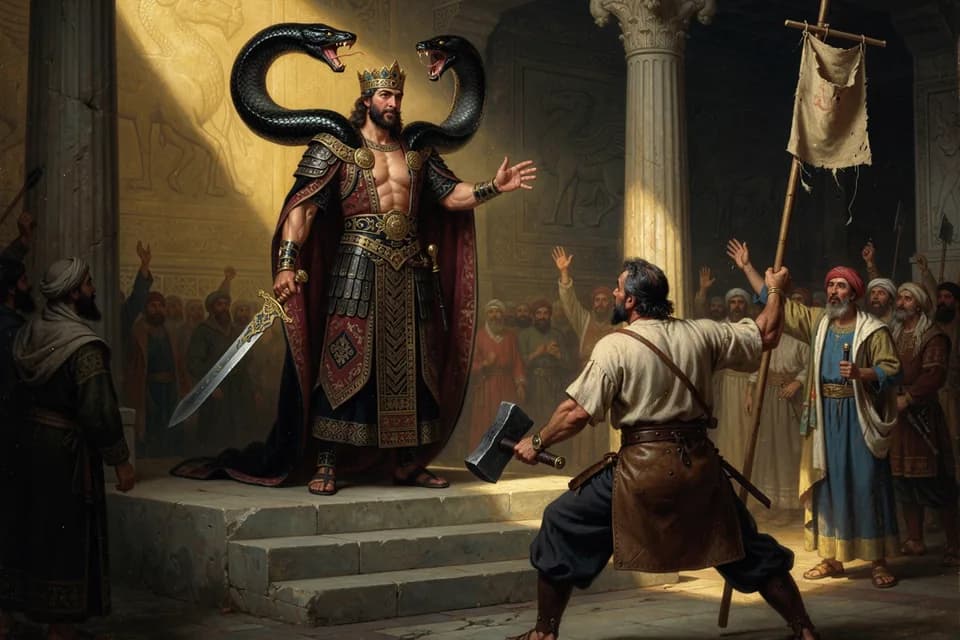
Ferdowsi's Shahnameh tells of Zahhak, son of a good king, Mardas. Iblis, the Devil, came to the young prince in disguise and, having bound him by an oath of secrecy, persuaded him to kill his father so as to rule sooner; Mardas fell into a pit that Iblis had dug in his garden path. Iblis then came to Zahhak again as a skilled cook and fed him, for the first time, on the meat of animals, dish after richer dish. Delighted, Zahhak offered him any reward, and the cook asked only to kiss his shoulders. Where he kissed, two black serpents grew. When they were cut off, they grew back. Iblis returned a third time, now as a physician, and advised that the serpents be fed human brains so that they might grow quiet and perhaps die.
The thousand-year tyranny
In Iran, meanwhile, King Jamshid had grown proud and lost the divine glory, and the Iranians turned to Zahhak, who seized the throne and later had Jamshid sawn in two. Zahhak reigned for a thousand years. Every day two young men were killed to feed the serpents on his shoulders. Two righteous men who entered his kitchen managed to save one of each pair, substituting sheep's brains, and sent the survivors into the mountains; Ferdowsi says their descendants became the Kurds.
The dream and the child
Zahhak dreamed that three warriors attacked him and the youngest struck him down with an ox-headed mace. His interpreters told him that a child not yet born, Fereydun, would overthrow him. Zahhak hunted for the boy, killing his father Abtin; his mother Faranak hid the child with a keeper of a wonderful cow, Barmayeh, who nursed him, and later took him to safety in the Alborz mountains. Zahhak found and killed the cow.
Kaveh's apron
Zahhak, fearing the prophecy, forced the nobles of the realm to sign a declaration that he had ruled only with justice. At that moment the blacksmith Kaveh burst into the court, crying out for justice: seventeen of his eighteen sons had been taken for the serpents, and now the last was to die. Zahhak released his son and asked him to sign the declaration. Kaveh read it, tore it up, and walked out. In the marketplace he fixed his leather blacksmith's apron to the point of a spear and raised it as a banner, and the people gathered around him and went to find Fereydun. Fereydun honored the banner and adorned it with brocade and jewels; it became the royal standard of Iran, the Derafsh-e Kaviani.
The fall of Zahhak
Fereydun had smiths forge a mace with the head of an ox and led the army to Zahhak's palace. He struck the tyrant down with it, but the heavenly messenger Sorush told him not to kill Zahhak, whose time had not yet come, but to bind him. Fereydun took him to Mount Damavand and chained him in a cave within the mountain, where he hangs still.
The Avestan dragon behind the king
In the Avesta, Azhi Dahaka is a three-headed, three-mouthed, six-eyed dragon created by Angra Mainyu, and Thraetaona is the hero 'who smote Azhi Dahaka'. Ferdowsi's human tyrant with serpents on his shoulders is that dragon retold as a king, and his Fereydun is Thraetaona. Middle Persian tradition adds that at the end of time Dahag will break free, only to be killed by the hero Keresaspa.