Persian (Iranian) Traditionbanner
Derafsh-e Kaviani
- Rallying the people against tyranny
- Emblem of legitimate kingship
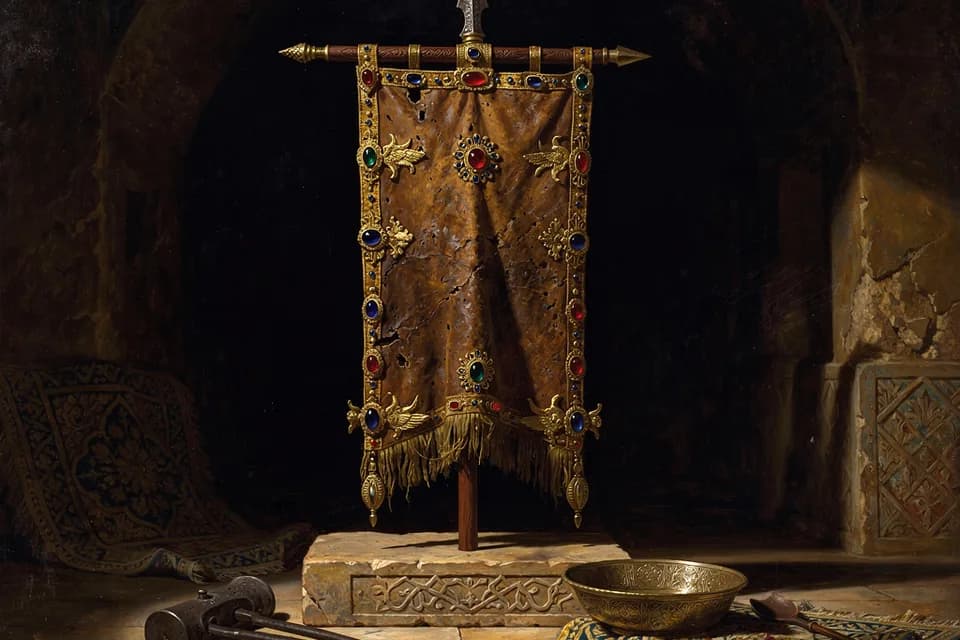
The banner of Kaveh: the leather apron the blacksmith raised on a spear against the tyrant Zahhak, adorned with jewels by Fereydun and carried as Iran's royal standard until, the historians say, it was captured in the Arab conquest.
About Derafsh-e Kaviani
The apron on a spear
In the Shahnameh, when the blacksmith Kaveh learns that his last son is to be killed to feed Zahhak's serpents, he tears up the tyrant's declaration of justice, fixes his leather apron to the point of a spear in the marketplace, and calls the people to rise. They follow the apron to Fereydun, who honors it by covering it with brocade and jewels; each later king, Ferdowsi says, added more jewels, until it shone like the sun in the night.
A real standard
The Sasanian kings had a great royal banner called the Drafsh-i Kawiyan, 'banner of the Kays' (the legendary royal dynasty), which the Kaveh story explains through a popular etymology linking it to the blacksmith. Arab historians including al-Tabari report that this jeweled standard was captured at the battle of al-Qadisiyyah, around 636 CE, in the Arab conquest of Iran, and divided as spoil.
Symbol
The banner of Kaveh has remained a symbol of Iranian nationhood and of revolt against tyranny, used in modern political imagery by movements of very different kinds.
Origin
Raised by Kaveh in revolt against Zahhak and adorned by Fereydun (Ferdowsi, Shahnameh, reign of Zahhak).
Sources and further reading
Source notes
These references are recorded in the catalog. Their passage wording and translation have not been checked, so quotations are not displayed here.
- Ferdowsi, Shahnameh, reign of Zahhak (paraphrase)
About this entry
By Elizabeth Stein for Mythos Atlas. About the author. Editorial notes are grounded in the site's cited sources and can be challenged through the contact page.