Side by sideSiblings

Aengus Óg vs Midir

Aengus Óg
Aengus ÓgCeltic
Midir
MidirCeltic

Aengus Óg and Midir are recorded as siblings in the Celtic Pantheon.

At a glance

Aengus Óg and Midir compared
Aengus ÓgMidir
TraditionCeltic PantheonCeltic Pantheon
Domainslove, youth, poetry, dreamsotherworld, pride, horses
Symbolsbirds, kisses, harpcrane, three cranes, chariot
Also calledÓengus, Aengus of the Brugh, Mac ind ÓgMidhir, Midir of Brí Léith

Where they meet

The atlas records no domain or symbol that Aengus Óg and Midir share.

They are compared because of how the myths connect them, not because of what they rule.

Where they part

Only Aengus Óg

Associated with love, youth, poetry, and dreams.

Only Midir

Associated with otherworld, pride, and horses.

How each was worshipped

Aengus Óg

Cult sites
Brug na Boinne / Newgrange in later tradition

Medieval Irish literature loves him; contemporary cult evidence is thin. Newgrange is a Neolithic tomb later tied to the Dagda's son. Admit the gap: a lover in stories more than a parish god.

Midir

Cult sites
Bri Leith in the sagas

Tochmarc Etaine is the dossier. Sid mounds, not inscribed altars. Do not dress a literary rival of the Dagda as a reconstructed festival god.

The two figures

Celtic Pantheon

Aengus Óg

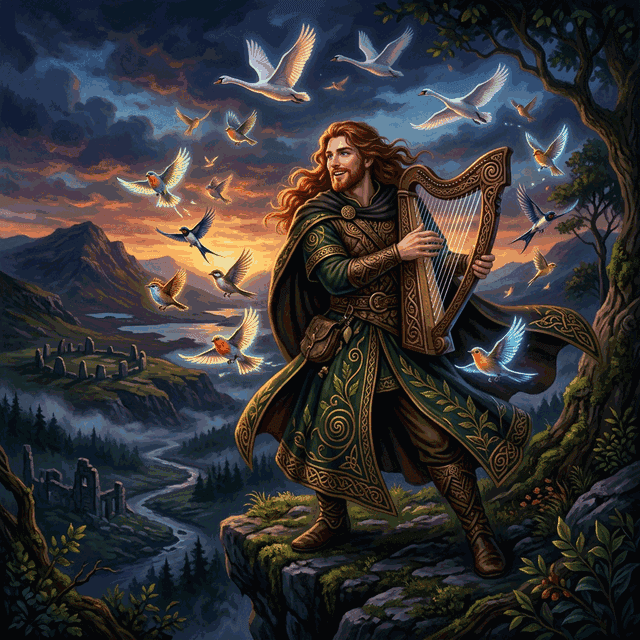
The ever-young god of love and poetic inspiration, whose kisses become birds that hover around young lovers' heads, whispering sweet nothings.

Aengus is the son of **the Dagda** and **Boann**, goddess of the River Boyne. Their union was an affair: Boann was married to Elcmar (or Nechtan), so the Dagda sent Elcmar away on a journey and caused nine months to pass as a single day. Thus Aengus was conceived and born before Elcmar returned. Aengus was fostered by **Midir** at Brí Léith, unaware of his parentage. When he came of age, he learned his true heritage and cleverly won the **Brú na Bóinne** (Newgrange) from his father through a word-trick: he asked to stay "a day and a night," but in Irish idiom this means "forever."

Aengus Óg, the "Young Son" or "Youthful Strength", is the Irish god of love, youth, and poetic inspiration. Forever young and beautiful, he represents the eternal renewal of passion and creativity. His four magical birds, said to be kisses transformed, fly above lovers' heads, inspiring tender words.

Read the full Aengus Óg entry

Celtic Pantheon

Midir

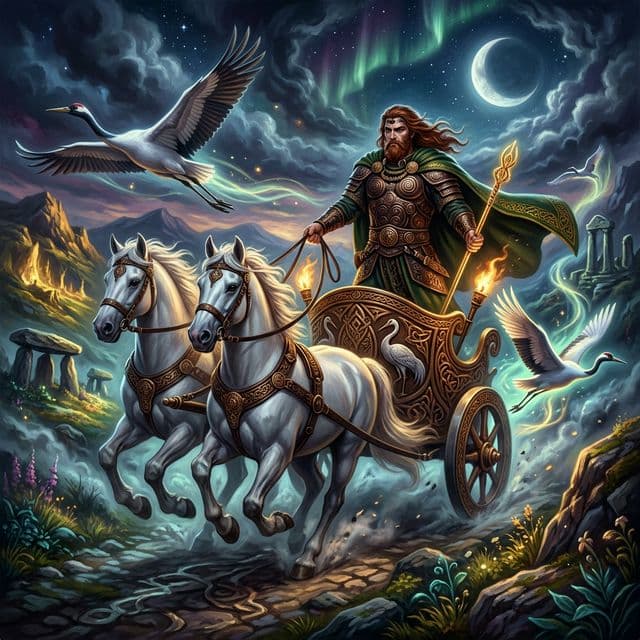
Lord of the Otherworld at Brí Léith, whose love for the mortal woman Étaín sparked wars between the fairy realms and the High King of Ireland.

Midir is a son of **the Dagda** and a lord of the Tuatha Dé Danann. He rules the síd of **Brí Léith** (near modern Ardagh in County Longford), one of the greatest fairy mounds of Ireland. He fostered **Aengus Óg** and helped him win Brú na Bóinne from the Dagda. Midir's own great tale is his love for **Étaín**: his first wife Fuamnach, jealous of Étaín's beauty, transformed her into a fly and drove her from the Otherworld. After a thousand years and several rebirths, Étaín became a mortal queen of Ireland. Midir found her, won her back through a game of fidchell, and carried her away to the síd, sparking war between the fairy realm and the High King.

Midir the Proud is one of the great lords of the Tuatha Dé Danann, master of the síd at **Brí Léith** and central figure in one of the most romantic tales in Irish mythology. His love for **Étaín** spans centuries and the boundaries between worlds.

Read the full Midir entry
About this comparison

Comparisons pair figures that play a similar role across traditions, or that the myths connect within one. A shared role does not, by itself, establish a shared origin.