Norse Pantheon
Heimdall
Also known as Heimdallr, The White God, Rig

- vigilance
- light
- foreknowledge
- class structure
Watchman of the gods who guards the rainbow bridge Bifrost connecting Asgard and Midgard. Possesses incredible hearing and eyesight, and will blow his horn Gjallarhorn to signal the onset of Ragnarok.
About Heimdall
The Watchman of Asgard
Heimdall is the ever-vigilant guardian of the Bifrost, the rainbow bridge. He requires less sleep than a bird and can hear the grass growing.
The Horn of Doom
He possesses the Gjallarhorn, which he will sound at the beginning of Ragnarok to summon the gods to battle. He is destined to kill and be killed by Loki during the final conflict.
Origin story
Heimdall's birth is one of the most mysterious in Norse mythology. According to the Eddas, he was born of nine mothers simultaneously - the nine daughters of the sea giant Aegir, who are the waves of the ocean. These nine giantesses nourished the infant god with the strength of the earth, the moisture of the sea, and the heat of the sun. This unique origin gave Heimdall his extraordinary senses and his connection to all the realms. He is sometimes called the White God due to his shining appearance. Under the name Rig, he is credited with creating the three classes of Norse society - thralls, karls, and jarls - during a journey through Midgard.
Across traditions
Parallel figures
Figures who play a role like Heimdall's in other traditions.
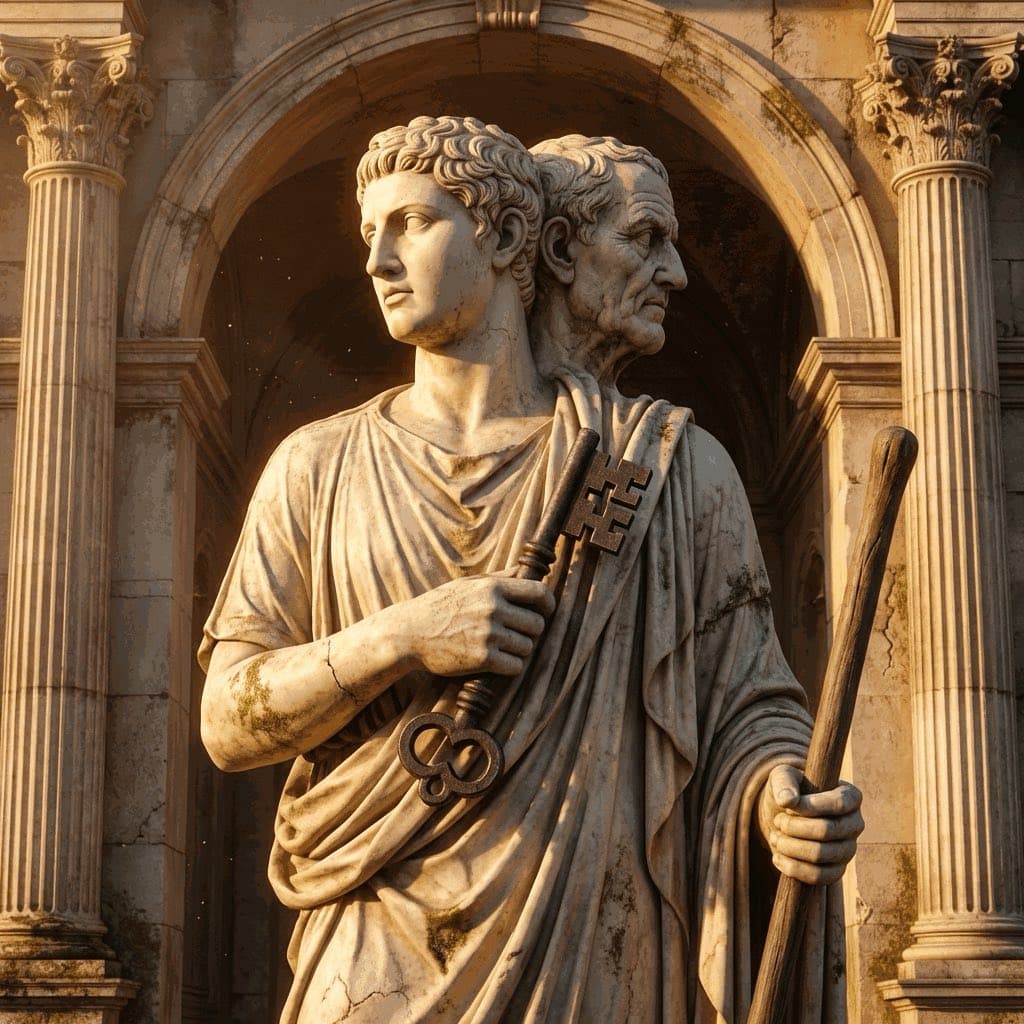 RomanJanusIllustration
Both are vigilant guardians of a boundary or threshold (the Bifrost bridge vs. doorways and transitions)
Compare Heimdall and Janus side by side
Worship and cult
Temples, festivals, and practices recorded for Heimdall
Watchman, horn, gold teeth. Almost no cult footprint. He is a poem's sentinel. Do not give him a festival list the sources do not.
Sacred sites
- No securely identified temple; Bifröst and Himinbjörg are mythic
In the atlas
Where Heimdall appears
Artifacts
Play the myth
Branching retellings featuring Heimdall: your choices decide the ending.
Sources and further reading
Source notes
These references are recorded in the catalog. Their passage wording and translation have not been checked, so quotations are not displayed here.
- Prose Edda, Gylfaginning (trans. Anderson)
- Prose Edda, Gylfaginning (trans. Anderson)
About this entry
By Elizabeth Stein for Mythos Atlas. About the author. Editorial notes are grounded in the site's cited sources and can be challenged through the contact page.
Parallels are editorial comparisons across traditions: a shared role does not, by itself, establish a shared origin.
Keep exploring
One myth a week, with its sources in a short email. The sign-up form is just below.
Genealogy
Family tree
Heimdall's parents, consorts, children and rivals, as recorded in the atlas.