Inca and Andean Tradition
Pachacamac
Pachakamaq
Also known as Pachakamaq, Pacha Camac
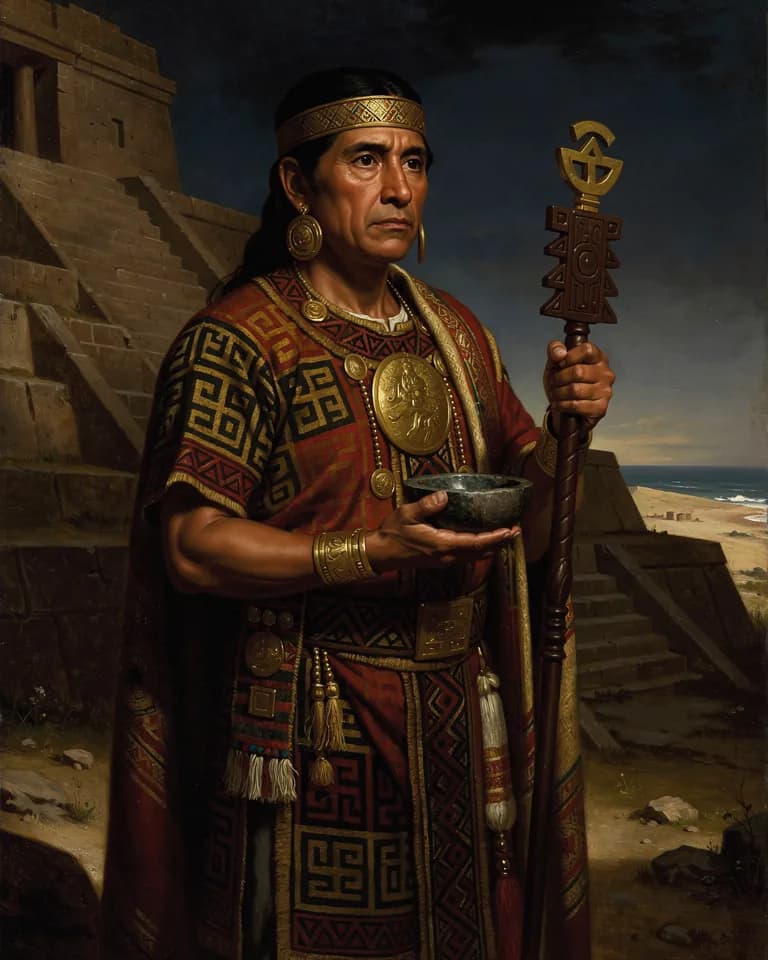
- the earth and its tremors
- oracles
- the coast
The great oracle god of the central Peruvian coast, whose sanctuary south of Lima drew pilgrims for centuries before the Incas, and who kept his shrine even after the Incas built a Temple of the Sun beside it.
About Pachacamac
The oracle of the coast
Pachacamac's sanctuary near the mouth of the Lurín River, south of modern Lima, was a pilgrimage and oracle center for well over a thousand years. When the Incas conquered the coast in the fifteenth century they did not suppress it; they built a Temple of the Sun and a house of chosen women on the same site, and consulted the oracle themselves. Hernando Pizarro reached the sanctuary in January 1533 in search of its gold, forced his way into the inner chamber, and had the idol broken before the assembled people, an episode described in his own letter and in Miguel de Estete's account.
Garcilaso's invisible god
Garcilaso de la Vega argued that the Incas worshipped Pachacamac inwardly as the unseen sustainer of the world, a supreme god like the Christian one, and that the coastal idol was a corruption. This interpretation served Garcilaso's apologetic purpose and is not accepted at face value by historians, who treat Pachacamac first as a powerful regional huaca with a far-reaching oracle network.
In the Huarochirí stories
The Huarochirí material gives Pachacamac a wife, Urpay Huachac, and two daughters, whom Cuniraya encounters on the shore at Pachacamac after Cavillaca disappears into the sea there. A carved wooden figure recovered at the site in 1938, now in the site museum, has been radiocarbon-dated to the eighth or ninth century CE and may be an image of the god.
Origin story
No surviving account describes Pachacamac's origin; later coastal traditions recorded by the Augustinian Antonio de la Calancha (1638) make him a son of the Sun, but that version is late and heavily reworked.
Worship and cult
Temples, festivals, and practices recorded for Pachacamac
Pilgrims and rulers consulted the oracle through its priests, bringing offerings of cloth, gold, and other goods; branch shrines of Pachacamac elsewhere on the coast were regarded as his 'children'.
Sacred sites
- The sanctuary of Pachacamac on the Lurín coast south of Lima, including the Painted Temple and, from the Inca period, a Temple of the Sun and a house of chosen women (acllahuasi).
In the atlas
Where Pachacamac appears
Stories
Sources and further reading
Source notes
These references are recorded in the catalog. Their passage wording and translation have not been checked, so quotations are not displayed here.
- Francisco de Ávila, Tratado de los errores, ch. II (trans. Markham 1873)
- Garcilaso de la Vega, Comentarios Reales, Part I, Book 2 (paraphrase)
About this entry
By Elizabeth Stein for Mythos Atlas. About the author. Editorial notes are grounded in the site's cited sources and can be challenged through the contact page.
Parallels are editorial comparisons across traditions: a shared role does not, by itself, establish a shared origin.