Source recordAncient text
Enuma Elish
Anonymous Babylonian priests · c. 1100 BCE · Akkadian
Ancient text
Enuma Elish
Anonymous Babylonian priests
The Babylonian creation epic describing the rise of Marduk to supremacy among the gods and his creation of the world from the body of Tiamat.
About this work
The Babylonian creation epic describing the rise of Marduk to supremacy among the gods and his creation of the world from the body of Tiamat.
Where to start
Start with Tablet IV for the climactic battle between Marduk and Tiamat, then read Tablet I for the primordial creation of sweet and salt waters, followed by Tablet VI for the creation of humankind.
Figures in the text
Heroes and divinities who feature prominently, with where they appear.
Deities and immortals
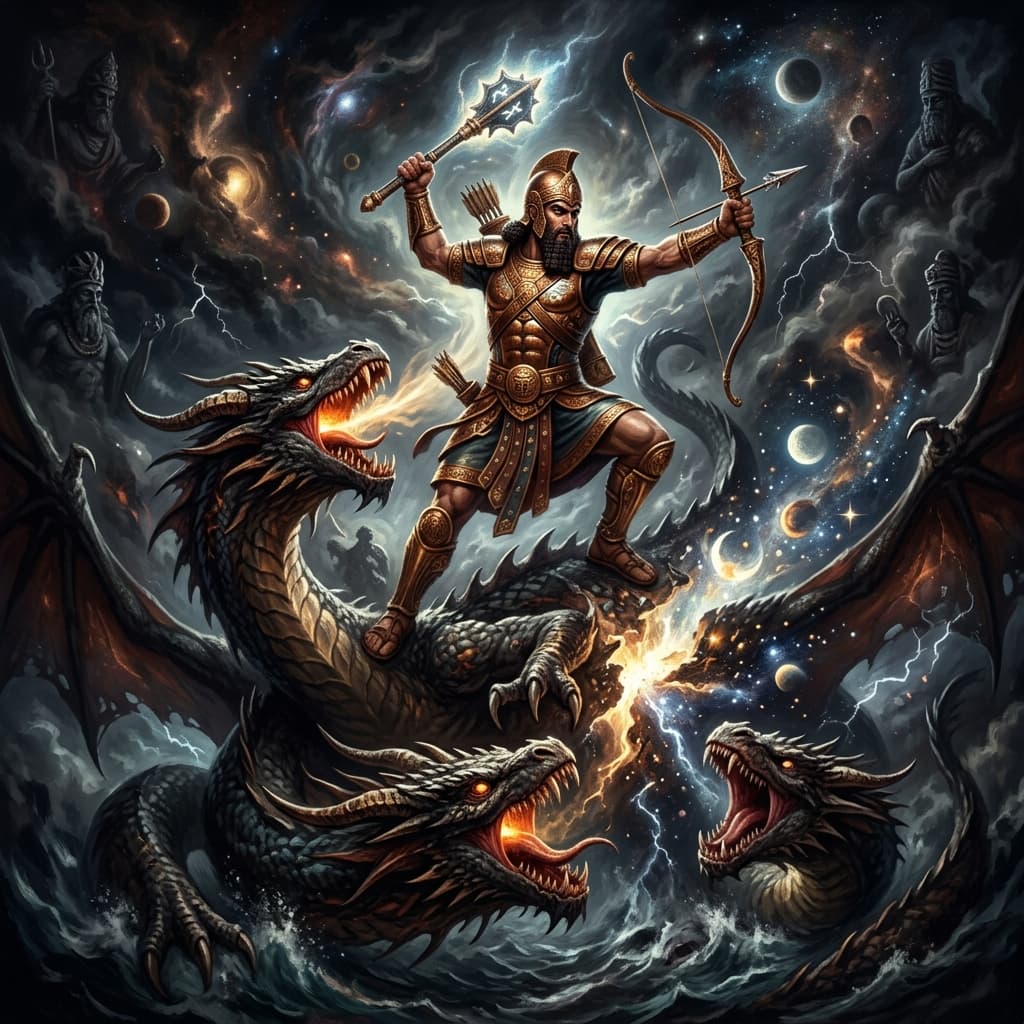
 MardukTablets IV-VIChampion of the gods who slays Tiamat and crafts the cosmos from her body
 TiamatTablets I-IVPrimordial salt-water sea dragon and mother of monsters who wages war against the younger gods
 EnkiTablets I-IIGod of wisdom and subterranean sweet waters (Ea) who slays Apsu and fathers Marduk
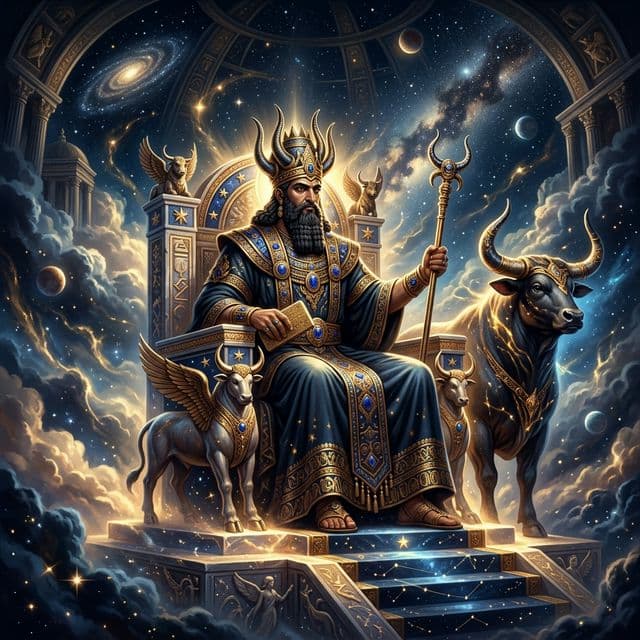 AnuTablet IIPrimordial sky god sent first to confront Tiamat before fleeing her wrath
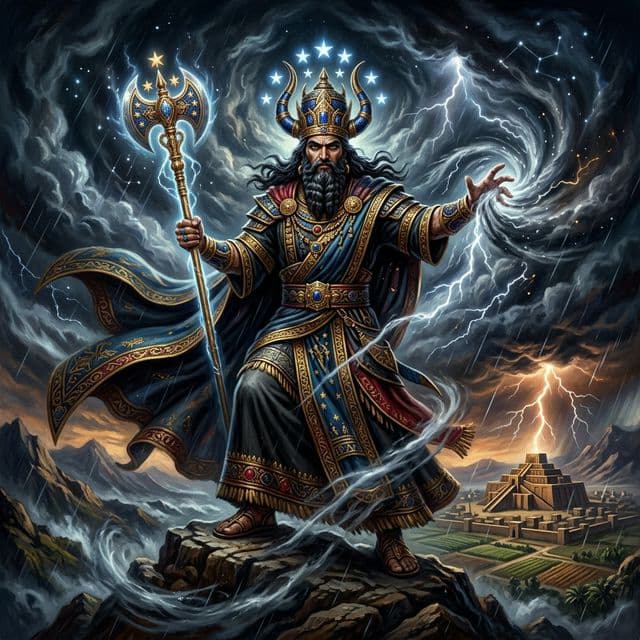 EnlilTablets III-IVLord of wind and storm whose supreme lordship passes to Marduk upon the victory
Key scenes
Turning points of the work, in reading order.
Tiamat's Uprising and the Army of Monsters
Enraged by the death of her consort Apsu, Tiamat spawns an army of eleven horned serpents, dragons, and demons, bestowing the Tablet of Destinies upon Kingu.
Marduk Chosen as Divine Champion
The elder gods assemble in terror; Marduk agrees to face Tiamat only on condition that the council grant him supreme and absolute rule over the universe.
The Cosmic Battle and Slaying of Tiamat
Armed with the four winds and a divine net, Marduk traps Tiamat, drives the evil wind into her gaping maw, splits her heart with an arrow, and divides her corpse to fashion heaven and earth.
Creation of Humanity and Esagila
From the blood of the slain rebel Kingu, Ea creates humankind to bear the labor of the gods, and the immortals build the great temple Esagila in Babylon to honor Marduk.
Passages
Direct quotations are distinguished from editorial paraphrases and records awaiting verification.
“When in the height heaven was not named, And the earth beneath did not yet bear a name,”
Enuma Elish · Tablet I, 1–2
Translation: Leonard W. King
The Seven Tablets of Creation, trans. Leonard W. King (1902), public-domain Sacred Texts transcription; English-only replacement of prior unverified wording. Exact source capitalization and terminal comma retained from the cited First Tablet transcription; only the line break was joined to a space. Akkadian text was not retained or certified. English transcription checked 2026-09-23.
Read source“He split her up like a flat fish into two halves; One half of her he stablished as a covering for heaven.”
Enuma Elish · Tablet IV, 137–138
Translation: Leonard W. King
The Seven Tablets of Creation, trans. Leonard W. King (1902), public-domain Sacred Texts transcription; English-only replacement of prior unverified wording. Exact source capitalization, punctuation, and the translation's archaic 'stablished' retained from the cited Fourth Tablet transcription; only the line break was joined to a space. Akkadian text was not retained or certified. English transcription checked 2026-09-23.
Read sourceStories drawn from it
Retellings in the atlas that quote or cite this work.
About this record
By Elizabeth Stein for Mythos Atlas. About the author. Editorial notes are grounded in the site's cited sources and can be challenged through the contact page.
Dates and authorship follow standard scholarly references; for many ancient works both are approximate or disputed.