Source recordAncient text
Popol Vuh
Anonymous K'iche' Maya · c. 1554-1558 CE (written; oral tradition much older) · K'iche' Maya
Ancient text
Popol Vuh
Anonymous K'iche' Maya
The creation narrative of the K'iche' Maya, telling of the Hero Twins and multiple attempts by the gods to create humanity. The most important text of Mesoamerican mythology.
About this work
The creation narrative of the K'iche' Maya, telling of the Hero Twins and multiple attempts by the gods to create humanity. The most important text of Mesoamerican mythology.
Where to start
Read Parts II and III first for the gripping epic of the Hero Twins descending into Xibalba, then read Part I for the primordial creation of the universe and Part IV for the sacred origin of humanity from corn.
Figures in the text
Heroes and divinities who feature prominently, with where they appear.
Deities and immortals
 Hunahpu and XbalanqueParts II-IIIHunahpu and Xbalanque, miraculous twins who avenge their father and outwit the death-lords of Xibalba
 Hun HunahpuPart IIFather of the twins, defeated in Xibalba, whose severed head in the calabash tree conceived the twins with Xquic
 KukulkanParts I, IVThe Plumed Serpent (Gucumatz), sovereign creator god who speaks the cosmos into existence alongside Heart of Sky
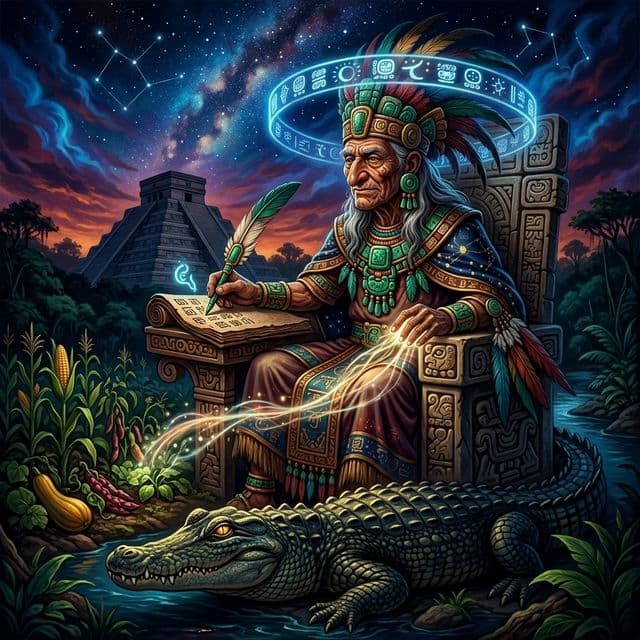 ItzamnaPart IPrimordial sky deity representing celestial wisdom and priestly authority
 Ah PuchParts II-IIISkeletal death-sovereign representing the lords of the underworld (One Death and Seven Death)
 CamazotzPart IIIMonstrous death-bat of Xibalba who beheads Hunahpu during the trial of the Bat House
Key scenes
Turning points of the work, in reading order.
The Dawn of Creation and the Mud and Wood Races
Heart of Sky and Plumed Serpent speak creation into existence; animals cannot praise them, mud people dissolve, and wooden mannequins lack hearts and minds and are destroyed in a flood of black pitch.
The Trials of the Underworld Houses
The Hero Twins survive the Dark House, Razor House, Cold House, Jaguar House, and Fire House through clever tricks, animal alliances, and illusion.
The Decapitation in Bat House and the Ballgame
Camazotz severs Hunahpu's head; Xbalanque carves a replacement gourd head, tricks the Xibalbans into using the real head as the ball, recovers it, and restores his brother.
Creation of the True Humans from Maize
The creators find yellow and white ears of corn at Paxil; Grandmother Xmucane grinds the maize into dough, creating the flesh and strength of the first four true men.
Passages
Direct quotations are distinguished from editorial paraphrases and records awaiting verification.
“THIS IS THE ACCOUNT OF HOW ALL WAS in suspense, all calm, in silence; all motionless, still, and the expanse of the sky was empty.”
Popul Vuh · Part I, ch. 1 (PDF physical p. 3; printed p. 2)
Translation: Delia Goetz and Sylvanus Griswold Morley (from Adrián Recinos’s Spanish translation)
Popul Vuh, Plantin Press (1954), attributed public-domain web PDF; English-only replacement of prior unverified wording. Exact capitalization and wording checked on PDF physical page 3 (printed page 2); the PDF credits Goetz and Morley and states the text is public domain. K'iche' text was not retained or certified. English transcription checked 2026-09-23.
Read source“One was given the sun, the other, the moon. Then the arch of heaven and the face of the earth were lighted.”
Popul Vuh · Part II, ch. 14 (PDF physical p. 48; printed p. 47)
Translation: Delia Goetz and Sylvanus Griswold Morley (from Adrián Recinos’s Spanish translation)
Popul Vuh, Plantin Press (1954), attributed public-domain web PDF; English-only replacement of prior unverified wording. Exact wording checked on PDF physical page 48 (printed page 47); the PDF credits Goetz and Morley and states the text is public domain. K'iche' text was not retained or certified. English transcription checked 2026-09-23.
Read source“Then came the word. Tepeu and Gucumatz came together in the darkness, in the night, and Tepeu and Gucumatz talked together. They talked then, discussing and deliberating; they agreed, they united their words and their thoughts.”
Popol Vuh · Part I, Chapter 1; PDF page 3
Translation: Delia Goetz and Sylvanus G. Morley, from Adrián Recinos
1954 Plantin Press edition. This K’iche’ passage concerns Gucumatz; it is a comparison from a related tradition, not a direct attestation of Yucatec Kukulkan. English transcription checked 2026-09-23. Replaces prior unverified wording; no original-language text is supplied or certified.
Read sourceStories drawn from it
Retellings in the atlas that quote or cite this work.
 The Hero Twins and the Lords of XibalbaheroThe central narrative of the Maya Popol Vuh: the Hero Twins Hunahpu and Xbalanque descend to the underworld, outwit the lords of death, resurrect their father the Maize God, and ascend to become the sun and moon.
 The Death and Rebirth of the Maize GodmythThe Maya myth of the Maize God's death, burial, and resurrection - a sacred narrative that explains the agricultural cycle and the deep connection between human sacrifice, agriculture, and cosmic renewal.
 The House of BatsquestThe Hero Twins Hunahpu and Xbalanque face the terrifying Camazotz in one of Xibalba's deadly trial houses.
About this record
By Elizabeth Stein for Mythos Atlas. About the author. Editorial notes are grounded in the site's cited sources and can be challenged through the contact page.
Dates and authorship follow standard scholarly references; for many ancient works both are approximate or disputed.