A father's prayer
The Epic of Aqhat survives on three tablets (KTU 1.17-1.19), with the beginning and end missing. It opens with Danel, a ruler called "the man of Rapiu", who judges the case of the widow and the orphan at the city gate, but who has no son. For six days he makes offerings to the gods and sleeps in the sanctuary; on the seventh Baal takes pity and asks El to bless him. El agrees, and promises a son who will perform a son's duties: set up his father's ancestral stela, hold his hand when he is drunk, plaster his roof, wash his clothes (KTU 1.17 I). The list is one of the best descriptions of filial duty in ancient literature. Danel rejoices, and in time Aqhat is born.
The gift of the bow
One day, sitting at the gate, Danel sees the craftsman god Kothar-wa-Khasis coming, carrying a bow and arrows. He has his wife Danatiya prepare a lamb, and they feed and honour the god. Kothar leaves the bow, and Danel gives it to Aqhat, telling him to offer the first of his hunting to the gods (KTU 1.17 V).
Anat's offer
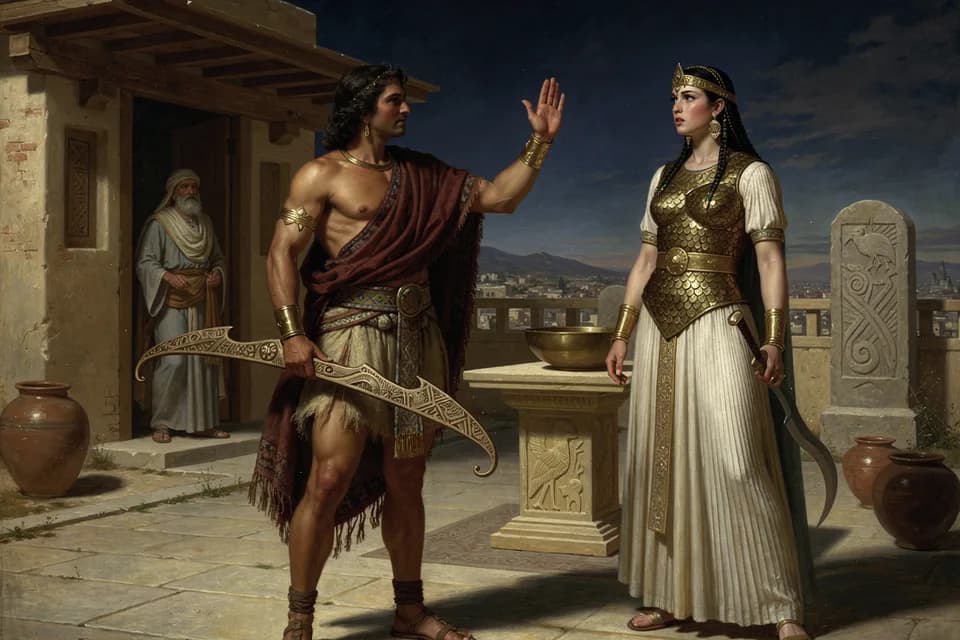
At a feast, the goddess Anat sees the bow and wants it. She offers Aqhat silver and gold; he tells her to have Kothar make her one. She offers him immortality: to count years with Baal, to live as long as the gods. Aqhat refuses, saying she should not deceive him; old age and death come to all men, and he will die the death of all men. He adds that bows are for warriors, and asks whether women now hunt (paraphrase of KTU 1.17 VI). Anat laughs, but warns him.
The vultures
Anat goes to El and, after threatening him, gets permission for revenge. She recruits her henchman Yatpan. While Aqhat sits eating, Anat carries Yatpan like a bird among a flock of vultures hovering over him, and Yatpan strikes him on the head; his life goes out of him like breath (KTU 1.18 IV). But the bow is broken or falls into the water in the attack, and Anat does not get it.
Drought and mourning
Danel's daughter Pughat, "who carries water on her shoulder" and "knows the course of the stars", sees the fields drying and the birds circling, and weeps. News comes that Aqhat is dead. Danel prays that Baal will break the wings of the vultures; one by one they fall, and he searches their bodies, until in Sumul, the mother of vultures, he finds his son's remains. He buries them, curses the towns near the place where Aqhat died, and mourns for seven years (KTU 1.19 I-IV).
Pughat's revenge
Then Pughat asks her father's blessing to avenge her brother. She puts on a warrior's clothes and weapons beneath a woman's garments and goes to Yatpan's camp. He welcomes her, thinking her one of Anat's women, drinks her wine, and boasts that the hand that killed Aqhat will kill thousands. Pughat keeps serving him. There the tablet breaks off, and the rest of the story is lost.
Themes
The poem sets human mortality against divine desire: Aqhat's refusal of immortality is either wisdom or pride, and scholars have argued both. It is also a story about the duties of children, the justice of rulers, and a sister's courage, and about a land that suffers when the gods act on their passions.