A world without light
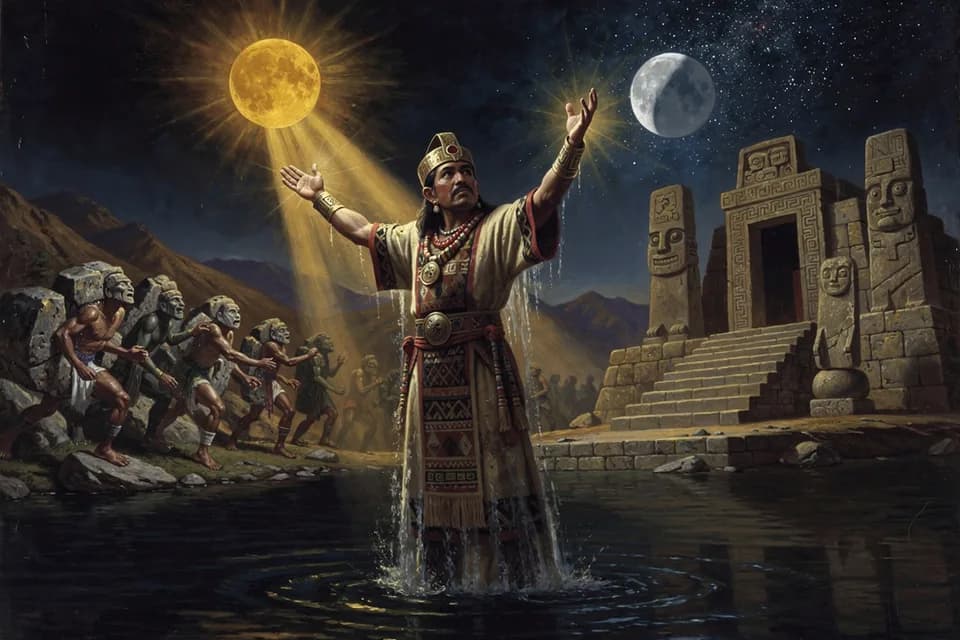
In the account Juan de Betanzos wrote down in Cusco in 1551, the world began in darkness. Out of a lake in the Collao, the great basin of Lake Titicaca, came a lord called Con Tici Viracocha. He made a sky and an earth and a first people who lived in that darkness. These people did something that angered him (Betanzos does not say what), and Viracocha turned them and their lord into stone.
Sun, moon, and stars at Tiwanaku
Then Viracocha came out of the lake a second time and went to Tiwanaku, a short way to the south. There he made the sun and the day, the moon and the stars, and commanded the sun to move along its course. The Inca sanctuary on the Island of the Sun in the lake was later honored as the place where the sun first rose, a tradition recorded by Cobo and other writers.
The nations shaped in stone
At Tiwanaku Viracocha also shaped the peoples who would fill the land. He carved them in stone, groups of men and women, and painted on each group the clothing it would wear; he gave each nation its language, its songs, and the seeds it would plant. He then sent them down under the earth, to travel underground and emerge in the places he had appointed for them: from springs, caves, hills, trees, and lakes. These emergence places, the pacarinas, became the shrines of each people's origin.
Cristóbal de Molina, who questioned Cusco elders in the 1570s, tells the same episode: the Creator made the peoples at Tiwanaku and painted their clothes on them, and this is why each people honored the place where it emerged.
The journey of the Creator
Viracocha sent two helpers to call the peoples out of the earth, one along the coast and one along the edge of the eastern forests, while he himself went northwest through the highlands toward Cusco. At Cacha the people did not recognize him and came at him with weapons. He called down fire from the sky, which set a hill ablaze until the stones burned; when the people threw down their arms and begged for mercy, he put the fire out with his staff. The Incas later built a great temple there, the building whose massive central wall still stands at Raqchi.
Passing through Urcos and Cusco, Viracocha continued north to the coast at Puerto Viejo, near modern Manta in Ecuador. There he met his helpers again, and together they walked out across the sea and were seen no more.
What the story does and does not say
This is a myth of the Inca state as told by Cusco informants two decades after the conquest. Its image of a tall man in a long robe who walks across the sea invited Spanish readers to see an apostle or saint, and the Andean habit of calling the Spaniards viracochas was later misread as proof that the invaders were taken for returning gods. Neither reading is in the story itself, which concerns how the Creator gave the peoples of the Andes their places, languages, and dress.