Inca and Andean Traditioncreation
Viracocha Makes the World at Titicaca
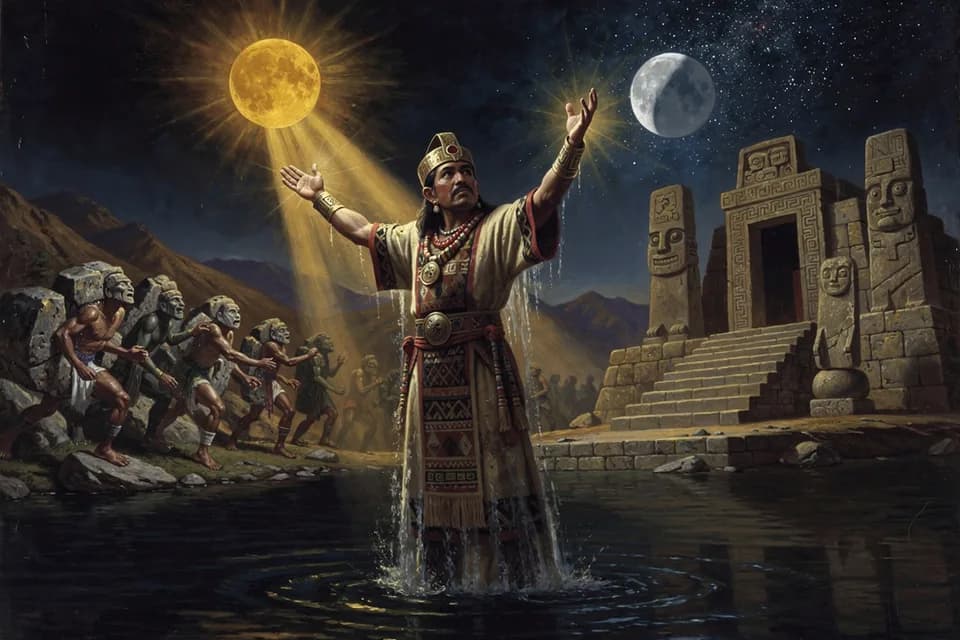
Rising from Lake Titicaca into a world of darkness, the Creator turns a first, disobedient people to stone, makes the sun, moon, and stars at Tiwanaku, shapes the nations in stone and sends them underground to emerge at their own places, then walks away across the western sea.
An editorial retelling
The story
A world without light
In the account Juan de Betanzos wrote down in Cusco in 1551, the world began in darkness. Out of a lake in the Collao, the great basin of Lake Titicaca, came a lord called Con Tici Viracocha. He made a sky and an earth and a first people who lived in that darkness. These people did something that angered him (Betanzos does not say what), and Viracocha turned them and their lord into stone.
Sun, moon, and stars at Tiwanaku
Then Viracocha came out of the lake a second time and went to Tiwanaku, a short way to the south. There he made the sun and the day, the moon and the stars, and commanded the sun to move along its course. The Inca sanctuary on the Island of the Sun in the lake was later honored as the place where the sun first rose, a tradition recorded by Cobo and other writers.
The nations shaped in stone
At Tiwanaku Viracocha also shaped the peoples who would fill the land. He carved them in stone, groups of men and women, and painted on each group the clothing it would wear; he gave each nation its language, its songs, and the seeds it would plant. He then sent them down under the earth, to travel underground and emerge in the places he had appointed for them: from springs, caves, hills, trees, and lakes. These emergence places, the pacarinas, became the shrines of each people's origin.
Cristóbal de Molina, who questioned Cusco elders in the 1570s, tells the same episode: the Creator made the peoples at Tiwanaku and painted their clothes on them, and this is why each people honored the place where it emerged.
The journey of the Creator
Viracocha sent two helpers to call the peoples out of the earth, one along the coast and one along the edge of the eastern forests, while he himself went northwest through the highlands toward Cusco. At Cacha the people did not recognize him and came at him with weapons. He called down fire from the sky, which set a hill ablaze until the stones burned; when the people threw down their arms and begged for mercy, he put the fire out with his staff. The Incas later built a great temple there, the building whose massive central wall still stands at Raqchi.
Passing through Urcos and Cusco, Viracocha continued north to the coast at Puerto Viejo, near modern Manta in Ecuador. There he met his helpers again, and together they walked out across the sea and were seen no more.
What the story does and does not say
This is a myth of the Inca state as told by Cusco informants two decades after the conquest. Its image of a tall man in a long robe who walks across the sea invited Spanish readers to see an apostle or saint, and the Andean habit of calling the Spaniards viracochas was later misread as proof that the invaders were taken for returning gods. Neither reading is in the story itself, which concerns how the Creator gave the peoples of the Andes their places, languages, and dress.
Listen or change reading mode
Highlights
Con Tici Viracocha rises from Lake Titicaca, petrifies a first people, makes the sun, moon, and stars at Tiwanaku, paints the nations in stone and sends them underground to emerge at their pacarinas, calls down fire at Cacha, and walks away over the sea near Manta.
Why it matters
The principal creation myth of the Inca state, tying the origin of all Andean peoples to Lake Titicaca and Tiwanaku, a site already ancient and ruined when the Incas claimed it.
Other versions
2 alternate accounts in the catalog.
Pedro Sarmiento de Gamboa, Historia de los Incas
The Creator's first creation is a race of giants, destroyed not by petrification alone but by a flood that covered the world, before the second creation at Tiwanaku.
Note: The flood element may reflect genuine Andean tradition, but it also invited comparison with Noah and has been scrutinized for Christian influence.
Inca Garcilaso de la Vega, Comentarios Reales
Garcilaso gives little weight to Viracocha as creator, presenting the unseen Pachacamac as the supreme god and the Sun's children as the civilizers of humanity.
Note: Garcilaso's apologetic aim, to present Inca religion as a proto-monotheism, shapes his selection.
Sources and further reading
By Elizabeth Stein for Mythos Atlas. About the author. Editorial notes are grounded in the site's cited sources and can be challenged through the contact page.
Works cited
Suma y narración de los Incas, Part 1, chs. 1-2
Juan de Betanzos
Relación de las fábulas y ritos de los Incas
Cristóbal de Molina
Historia de los Incas
Pedro Sarmiento de Gamboa