Inca and Andean TraditionCreator
Viracocha
Wiraqucha(Wiraqucha (Spanish spellings Viracocha, Uiracocha))
Also known as Con Tici Viracocha, Tici Viracocha, Pachayachachic, Wiraqucha
- creation
- the ordering of peoples
- civilization
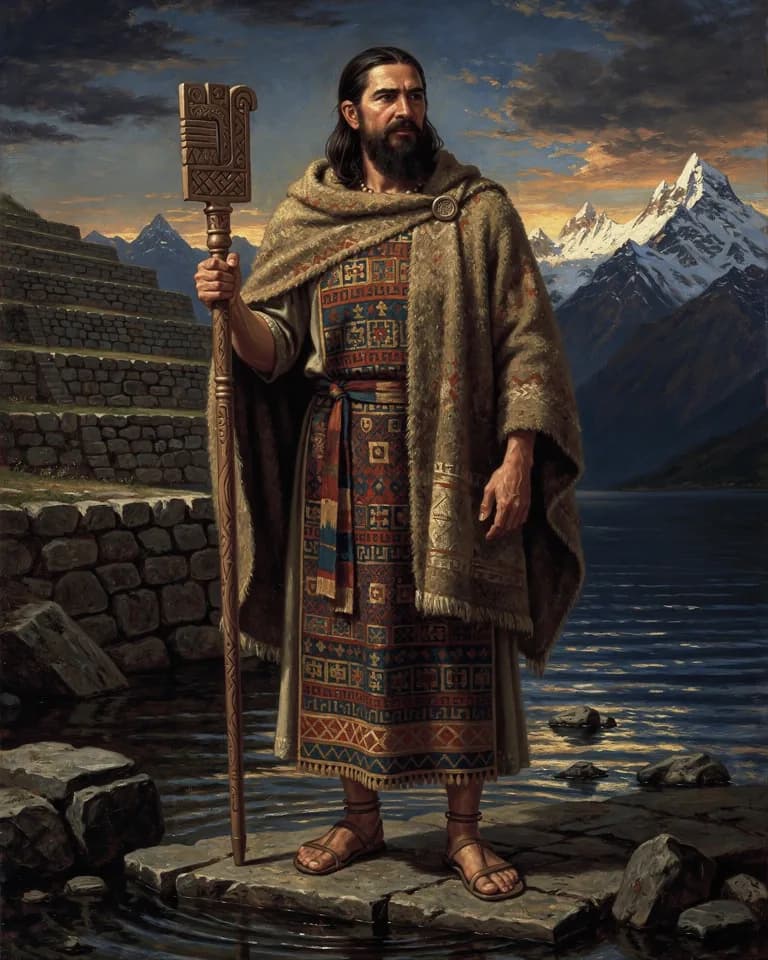
The creator of the Inca state cult, who in Betanzos's account rises from Lake Titicaca, makes the sun, moon, and stars at Tiwanaku, shapes each nation from stone, and finally walks away across the western sea.
About Viracocha
Attestation
The fullest early account is Juan de Betanzos's Suma y narración de los Incas (1551), which opens with Con Tici Viracocha emerging from Lake Titicaca into a world without light. He makes a first people who displease him and turns them to stone; he then goes to Tiwanaku, makes the sun, moon, and stars, and shapes the nations of the Andes in stone, painting on each its dress and giving it a language, before sending them underground to emerge from their own springs, caves, and hills. Cristóbal de Molina (c. 1575) and Pedro Sarmiento de Gamboa (1572) tell related versions; Sarmiento adds that the Creator destroyed an earlier world by a flood.
The departing maker
Viracocha then travels northwest through the highlands with two helpers who take the coast and the forest edge. At Cacha, where the Incas later built the great temple now called Raqchi, people attack him and he calls fire down on a hill before relenting. He passes through Cusco and at the coast near Puerto Viejo (Manta, in modern Ecuador) walks away over the sea.
A god seen through Spanish eyes
Viracocha's image in the chronicles is especially exposed to colonial reshaping. Betanzos describes him as a tall man in a long white robe carrying a staff, details that invited comparison with Christian apostles; Andeans also called the Spaniards viracochas, a usage Francisco de Ávila notes and that later writers sometimes misread as proof that the invaders were taken for gods. Garcilaso, keen to present an Andean monotheism, gives the role of invisible supreme god to Pachacamac instead. Scholars continue to debate how far the Creator's pre-eminence reflects Inca state theology and how far it reflects Spanish expectations.
Origin story
Viracocha is uncreated in the chronicles: he emerges from Lake Titicaca before there is light, and everything else, including the sun and moon, is his work.
Across traditions
Parallel figures
Figures who play a role like Viracocha's in other traditions.
 AztecQuetzalcoatl
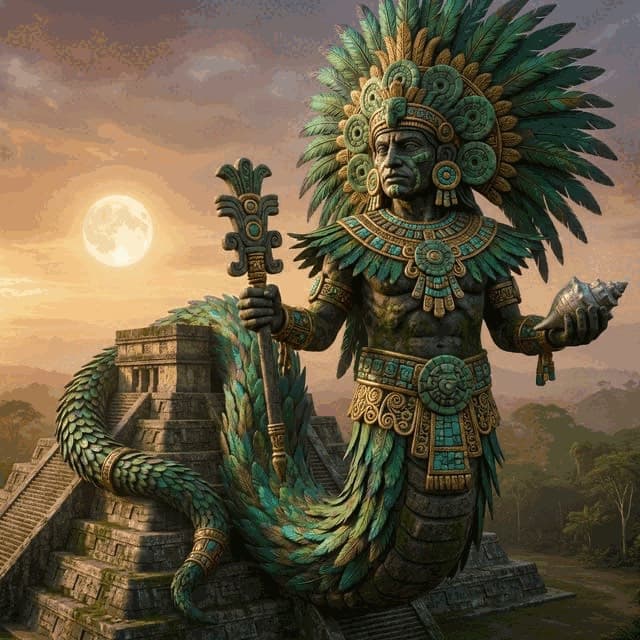
Both are creator and culture-hero figures remembered as departing over the sea (Viracocha from the Ecuadorian coast in Betanzos, Quetzalcoatl eastward from Tollan), and in both cases colonial writers reshaped the departure into a prophecy of Spanish arrival. The comparison is typological; there is no evidence of contact between the two traditions.
Compare Viracocha and Quetzalcoatl side by side
Worship and cult
Temples, festivals, and practices recorded for Viracocha
Molina records Quechua prayers addressed to the Creator by Cusco priests and nobles, recited during the great state ceremonies rather than at a festival of Viracocha's own. No calendrical festival devoted solely to him is securely attested.
Sacred sites
- The temple at Cacha (the archaeological site of Raqchi, Cusco region), which Betanzos says the Incas built where Viracocha called down fire; its great central wall still stands.
- In Cusco the Creator was honored in the state cult beside the Sun and Thunder; the Andean chronicler Juan de Santa Cruz Pachacuti Yamqui (c. 1613) drew an oval gold plate representing the Creator above the altar of the Coricancha.
In the atlas
Where Viracocha appears
Sources and further reading
Source notes
These references are recorded in the catalog. Their passage wording and translation have not been checked, so quotations are not displayed here.
- Juan de Betanzos, Suma y narración de los Incas, Part 1, ch. 1 (paraphrase)
- Francisco de Ávila, Tratado de los errores, ch. I (trans. Markham 1873), on the invocation of Viracocha's name in Huarochirí
About this entry
By Elizabeth Stein for Mythos Atlas. About the author. Editorial notes are grounded in the site's cited sources and can be challenged through the contact page.
Parallels are editorial comparisons across traditions: a shared role does not, by itself, establish a shared origin.
Genealogy
Family tree
Viracocha's parents, consorts, children and rivals, as recorded in the atlas.