Inca and Andean Tradition
Mama Killa
Mama Killa
Also known as Mama Quilla
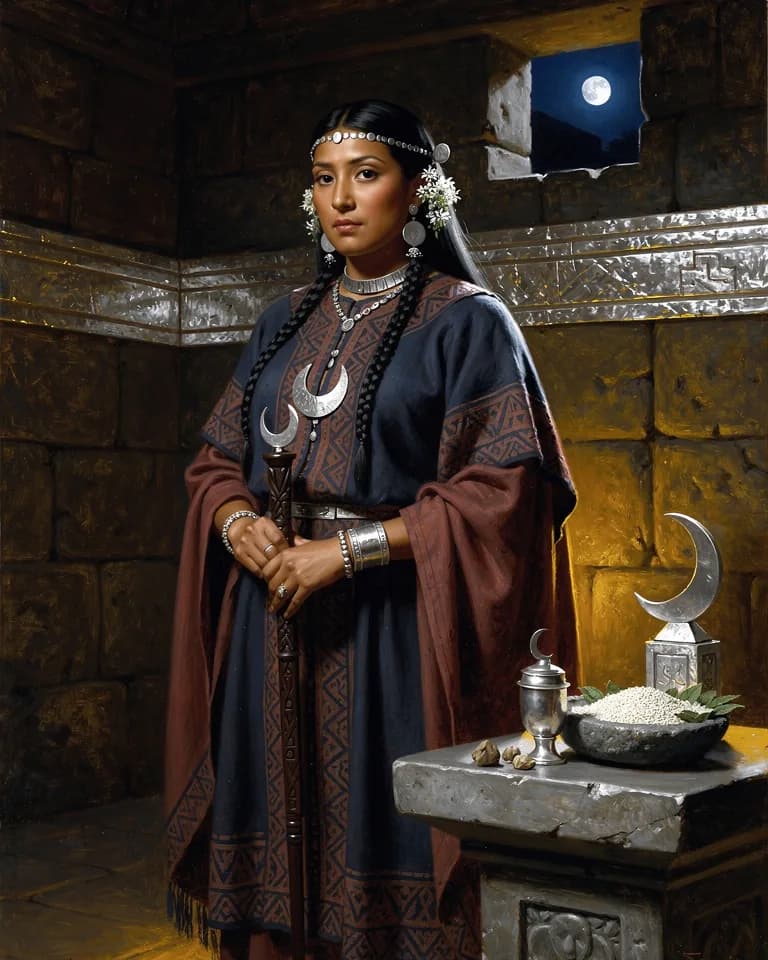
- the moon
- the calendar
- the queen (coya)
The Moon, sister and wife of the Sun in the Inca state cult, honored in a silver-lined chamber of the Coricancha and associated with the queen and with the reckoning of months and festivals.
About Mama Killa
Wife of the Sun
Garcilaso de la Vega calls the Moon Mama Quilla, 'Mother Moon', and describes her as the sister and wife of the Sun and the mother of the Incas. In the Coricancha her chamber was lined with silver and held a silver image with a woman's face, and the bodies of dead queens (coyas) were set there, much as the kings' bodies sat before the Sun. The pairing mirrors the royal marriage of the Inca ruler to his sister-queen, and the queen was the Moon's earthly counterpart.
Months and eclipses
The Inca calendar combined solar observations with lunar months (killa means both 'moon' and 'month'), and many festivals were timed by the moon. Guaman Poma's calendar names the September month Coya Raymi, the feast of the queen, the season of the Citua purification ceremonies that Molina describes. Garcilaso reports that during a lunar eclipse people believed the Moon was falling sick and might die, and shouted, blew horns, and beat dogs to make them howl so that she would wake.
Evidence
Mama Killa is attested almost entirely through descriptions of the Cusco state cult; no extended myth about her survives comparable to those of Viracocha or the Huarochirí huacas.
Origin story
Made by Viracocha at Tiwanaku together with the Sun and the stars, in Betanzos's account; in royal ideology she is the Sun's sister-wife and mother of the Inca lineage.
Worship and cult
Temples, festivals, and practices recorded for Mama Killa
Noise-making, horn-blowing, and beating dogs to make them howl during lunar eclipses, as reported by Garcilaso; the queen (coya) was regarded as the Moon's counterpart.
Sacred sites
- A silver-lined chamber of the Coricancha in Cusco dedicated to the Moon, according to Garcilaso.
Festivals
- Coya Raymi (September), the queen's month in Guaman Poma's calendar, when the Citua purification was held in Cusco.
Family
Mama Killa's family at a glance
- Who are Mama Killa's children?
- Children of Mama Killa recorded in the atlas: Manco Cápac.
- Who were Mama Killa's spouses and consorts?
- Spouses and consorts of Mama Killa recorded in the atlas: Inti.
In the atlas
Where Mama Killa appears
Sources and further reading
Source notes
These references are recorded in the catalog. Their passage wording and translation have not been checked, so quotations are not displayed here.
- Garcilaso de la Vega, Comentarios Reales, Part I, Book 3 (paraphrase)
- Garcilaso de la Vega, Comentarios Reales, Part I, Book 2 (paraphrase of the eclipse custom)
About this entry
By Elizabeth Stein for Mythos Atlas. About the author. Editorial notes are grounded in the site's cited sources and can be challenged through the contact page.
Parallels are editorial comparisons across traditions: a shared role does not, by itself, establish a shared origin.
Family relationships come from the atlas's kinship records. Ancient sources often disagree on divine genealogy.
Genealogy
Family tree
Mama Killa's parents, consorts, children and rivals, as recorded in the atlas.