Inca and Andean TraditionFounding Ancestor
Manco Cápac
Manqu Qhapaq
Also known as Manco Capac, Ayar Manco, Manqu Qhapaq
- the founding of Cusco
- kingship
- agriculture
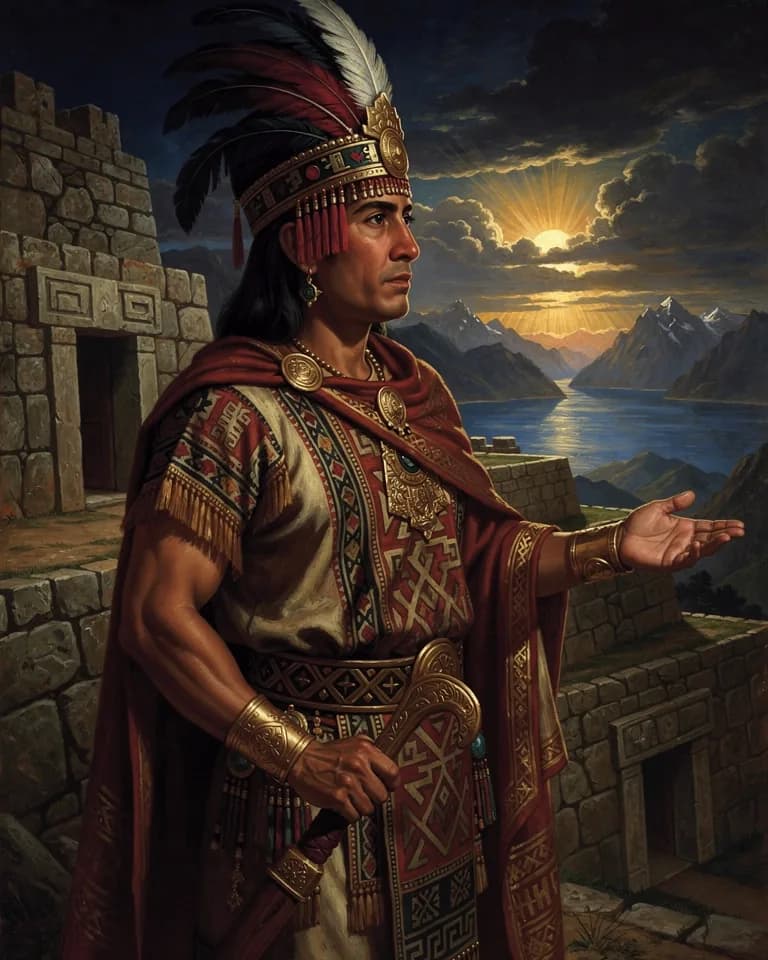
The first Inca, founder of Cusco, presented by Garcilaso as a son of the Sun sent to Lake Titicaca with his sister-wife Mama Ocllo, and by Betanzos and Sarmiento as the leader of four brothers and four sisters who emerged from a cave at Pacaritambo.
About Manco Cápac
Two origin traditions
The chroniclers preserve two main accounts of Manco Cápac. Garcilaso de la Vega (1609) says the Sun, pitying humanity's savage state, placed his son and daughter in Lake Titicaca with a golden rod; they were to settle where it sank into the ground at a single thrust, which happened at Huanacauri above the valley of Cusco. Juan de Betanzos (1551) and Pedro Sarmiento de Gamboa (1572) instead tell of four brothers, the Ayars, and four sisters who emerged from a cave called Tambo Toco at Pacaritambo, south of Cusco. On the journey one brother, Ayar Cachi, is tricked back into the cave and sealed in; another, Ayar Uchu, turns to stone on Huanacauri; and Manco, the survivor, founds Cusco.
Ancestor and huaca
Whatever his historicity, Manco Cápac functioned as the dynasty's founding ancestor, and the Inca kings traced their right to rule to him and through him to the Sun. The ruling lineages of Cusco each claimed descent from a particular king, beginning with Manco's. His stone at Huanacauri and the sites of the Pacaritambo journey were huacas visited in the initiation rites of young Inca nobles, which Molina describes.
Historicity
Modern historians generally treat the first Inca rulers in the king lists, Manco Cápac among them, as legendary or semi-legendary; firmer chronology begins with Pachacuti in the fifteenth century.
Origin story
Son of the Sun and brother-husband of Mama Ocllo in Garcilaso's version; the leader of the Ayar siblings who emerged from the cave of Tambo Toco at Pacaritambo in Betanzos's and Sarmiento's.
Worship and cult
Temples, festivals, and practices recorded for Manco Cápac
Veneration of the founding ancestor through his lineage and the huacas of the founding journey; the royal mummies of later kings, not a mummy of Manco, were the focus of ancestor cult in Cusco.
Sacred sites
- The huaca of Huanacauri above Cusco, and the cave of Tambo Toco at Pacaritambo, both visited in Inca state rituals connected with the founding journey.
Festivals
- The initiation of young Inca nobles (huarachicoy) during Capac Raymi, which included pilgrimages to Huanacauri, as described by Molina.
Family
Manco Cápac's family at a glance
- Who are Manco Cápac's parents?
- The atlas's kinship records name 2 parents of Manco Cápac: Inti and Mama Killa. Ancient accounts do not always agree on divine parentage.
- Who were Manco Cápac's spouses and consorts?
- Spouses and consorts of Manco Cápac recorded in the atlas: Mama Ocllo.
- Who are Manco Cápac's siblings?
- Siblings of Manco Cápac recorded in the atlas: Mama Ocllo.
In the atlas
Where Manco Cápac appears
Sources and further reading
Source notes
These references are recorded in the catalog. Their passage wording and translation have not been checked, so quotations are not displayed here.
- Garcilaso de la Vega, Comentarios Reales, Part I, Book 1, ch. 15 (paraphrase)
- Pedro Sarmiento de Gamboa, Historia de los Incas (paraphrase)
About this entry
By Elizabeth Stein for Mythos Atlas. About the author. Editorial notes are grounded in the site's cited sources and can be challenged through the contact page.
Parallels are editorial comparisons across traditions: a shared role does not, by itself, establish a shared origin.
Family relationships come from the atlas's kinship records. Ancient sources often disagree on divine genealogy.
Genealogy
Family tree
Manco Cápac's parents, consorts, children and rivals, as recorded in the atlas.