Inca and Andean Traditionstaff
Golden Rod of Manco Cápac
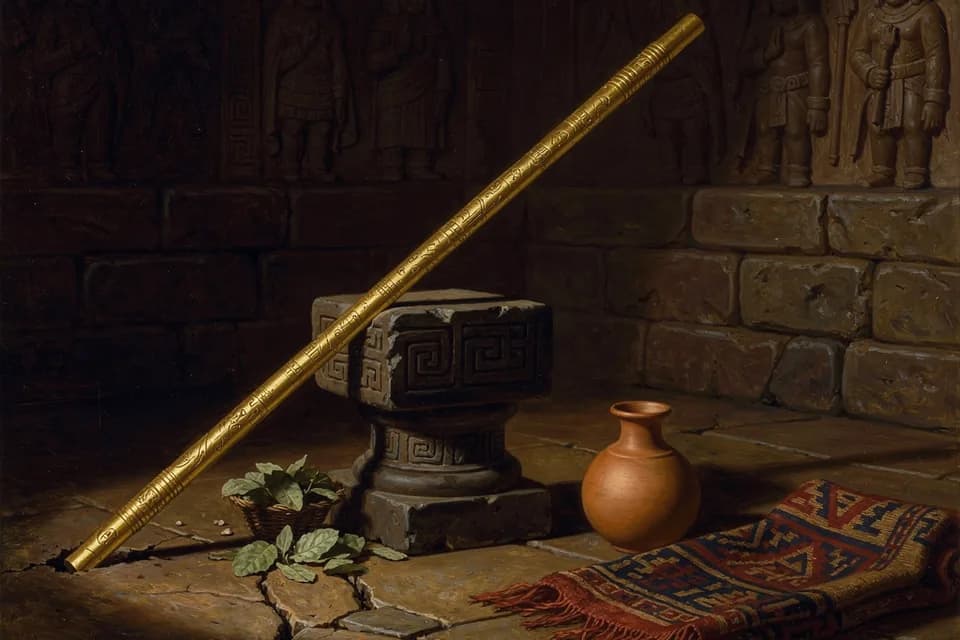
- Revealing fertile ground
- Choosing the site of Cusco
The rod of gold that the Sun gave to his children at Lake Titicaca, which would show them where to found their city by sinking into the ground at a single thrust; it vanished into the earth at Huanacauri above Cusco.
About Golden Rod of Manco Cápac
The test of the ground
In Garcilaso de la Vega's Royal Commentaries (1609), the Sun sends his son and daughter to civilize humanity with a single instrument: a rod of gold half a yard long and two fingers thick. Wherever they stopped, they were to push it into the ground, and where it sank in at one thrust they were to settle. It refused every resting place until Huanacauri, the hill above the Cusco valley, where it disappeared into the earth.
Meaning
The rod ties the Inca dynasty's claim to rule to both the Sun and the soil: the place of the capital is not chosen by conquest but revealed by the land's own depth and fertility. Sarmiento de Gamboa's rival Pacaritambo version includes a similar test of the valley soil with golden staffs, suggesting the motif was part of Cusco tradition rather than Garcilaso's invention.
Not an object in a museum
No actual rod associated with Manco Cápac is known to have survived or been displayed by the Incas; it belongs to the founding story. The Inca rulers did carry a royal staff as a sign of office, and the story's rod may reflect that regalia.
Origin
Given by the Sun to Manco Cápac and Mama Ocllo when he placed them in Lake Titicaca (Garcilaso, Comentarios Reales, Part I, Book 1).
Sources and further reading
Source notes
These references are recorded in the catalog. Their passage wording and translation have not been checked, so quotations are not displayed here.
- Garcilaso de la Vega, Comentarios Reales, Part I, Book 1, ch. 15 (paraphrase)
About this entry
By Elizabeth Stein for Mythos Atlas. About the author. Editorial notes are grounded in the site's cited sources and can be challenged through the contact page.