Inca and Andean Traditionrelic
Punchao
- Embodying the Sun
- Legitimizing Inca rule
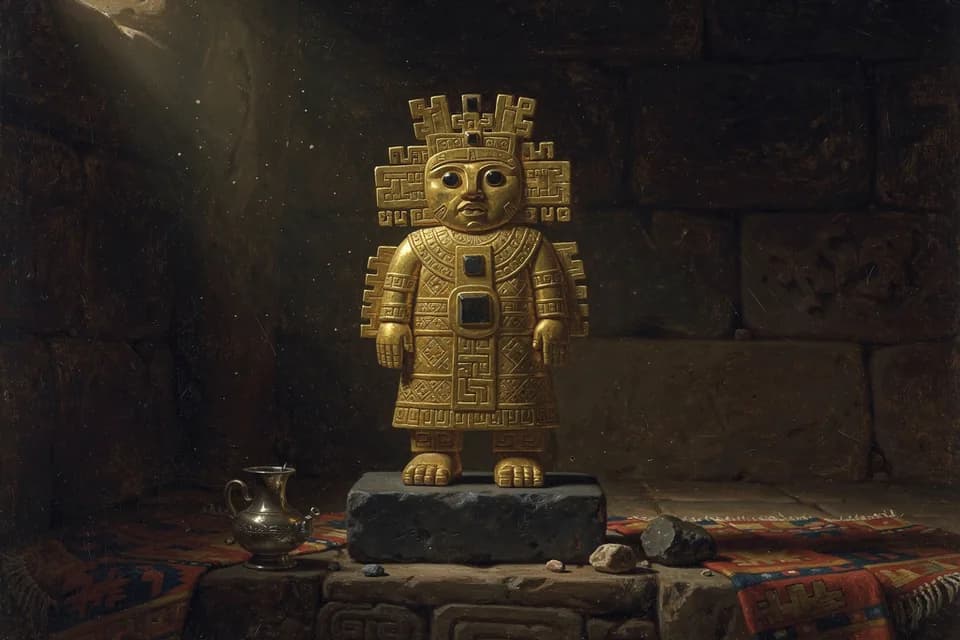
The golden image of the Sun ('Day') kept in the Coricancha, the most sacred object of the Inca state cult, carried into the Vilcabamba refuge after the conquest and captured by Spanish forces in 1572.
About Punchao
The Day
Punchao means 'day' or 'daylight'. Chroniclers describe it as a golden image of the Sun kept in the Coricancha and brought out into the main square of Cusco for major ceremonies; some later accounts describe it as a figure of a seated boy with rays, and say that a cavity in it held the powdered hearts of past Inca rulers. The descriptions differ and were written by people who had not all seen it.
Flight and capture
After the Spanish seizure of Cusco, the Inca rulers who resisted in the forested refuge of Vilcabamba kept the Punchao with them as the focus of their continuing cult. When Viceroy Francisco de Toledo's expedition overran Vilcabamba in 1572 and captured Túpac Amaru, the Punchao was also taken. Toledo proposed sending it to Spain, to the king or to the pope, and after that its trail is lost.
Why it matters
The Punchao was the Sun in visible form and the emblem of Inca legitimacy; its capture, together with Túpac Amaru's execution, marked the end of the independent Inca state. Its disappearance also means that everything said about its appearance rests on colonial description.
Origin
Made for the Sun's cult in Cusco; its date and maker are unknown.
Sources and further reading
Source notes
These references are recorded in the catalog. Their passage wording and translation have not been checked, so quotations are not displayed here.
- Documents on the 1572 Vilcabamba campaign, in Brian S. Bauer, Madeleine Halac-Higashimori, and Gabriel E. Cantarutti, Voices from Vilcabamba (2016) (paraphrase)
About this entry
By Elizabeth Stein for Mythos Atlas. About the author. Editorial notes are grounded in the site's cited sources and can be challenged through the contact page.