Inca and Andean TraditionTemple
Coricancha
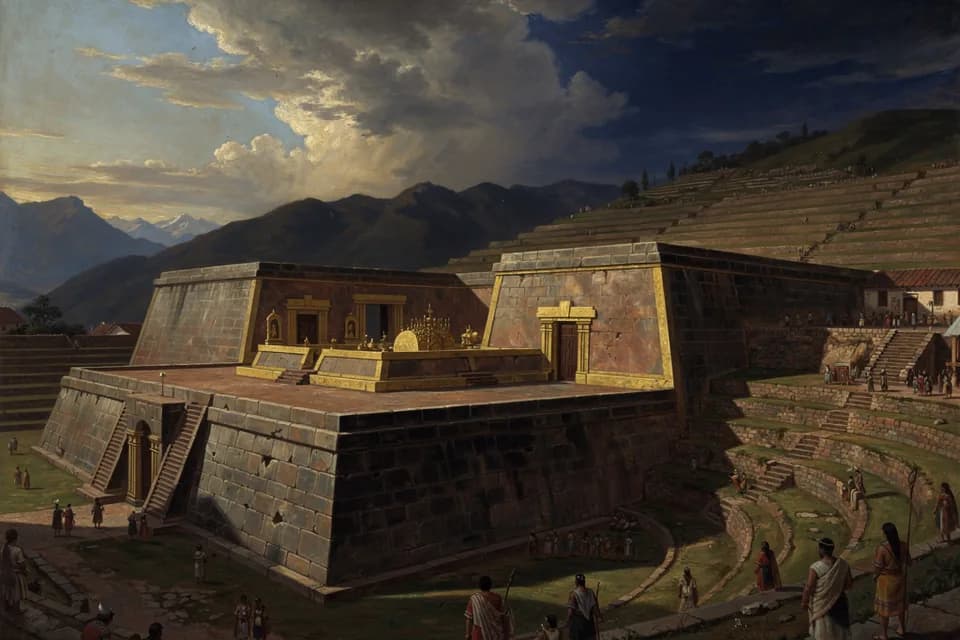
The 'golden enclosure', chief temple of the Sun in Cusco, where the images of the Creator, Sun, Moon, Thunder, and other powers were kept; its Inca stonework survives beneath the church and convent of Santo Domingo.
About Coricancha
The golden enclosure
The Coricancha (quri kancha, 'golden enclosure') was the religious center of the Inca empire. Garcilaso de la Vega describes a main temple of the Sun with walls covered in gold plates, a great golden image of the Sun, and surrounding chambers dedicated to the Moon (lined with silver), to Venus and the stars, to thunder and lightning, and to the rainbow. The mummified bodies of past kings sat in state before the Sun's image. Bernabé Cobo later described the ceque system: lines of shrines radiating out from the Coricancha across the Cusco valley.
Stripped and rebuilt
In 1533 Spanish agents sent to collect Atahualpa's ransom pried the gold plates from its walls. The temple was then given to the Dominican order, whose church and convent of Santo Domingo were built on top of it. Earthquakes in 1650 and 1950 damaged the colonial buildings and exposed more of the fine Inca masonry beneath, including the famous curved wall on the west side.
Today
The site combines a working Catholic convent with a museum of the Inca structures, and is a focal point of Cusco's annual Inti Raymi pageant, which begins there before moving to Sacsayhuamán.
On the map
Coricancha among other places of the Inca and Andean Tradition.
Sources and further reading
Source notes
These references are recorded in the catalog. Their passage wording and translation have not been checked, so quotations are not displayed here.
- Garcilaso de la Vega, Comentarios Reales, Part I, Book 3 (paraphrase)
About this entry
By Elizabeth Stein for Mythos Atlas. About the author. Editorial notes are grounded in the site's cited sources and can be challenged through the contact page.
Coordinates mark where the myths place a site, or where the tradition locates it today. Mythic realms are left off the map or marked as symbolic placements.