Inca and Andean TraditionMountain
Huanacauri
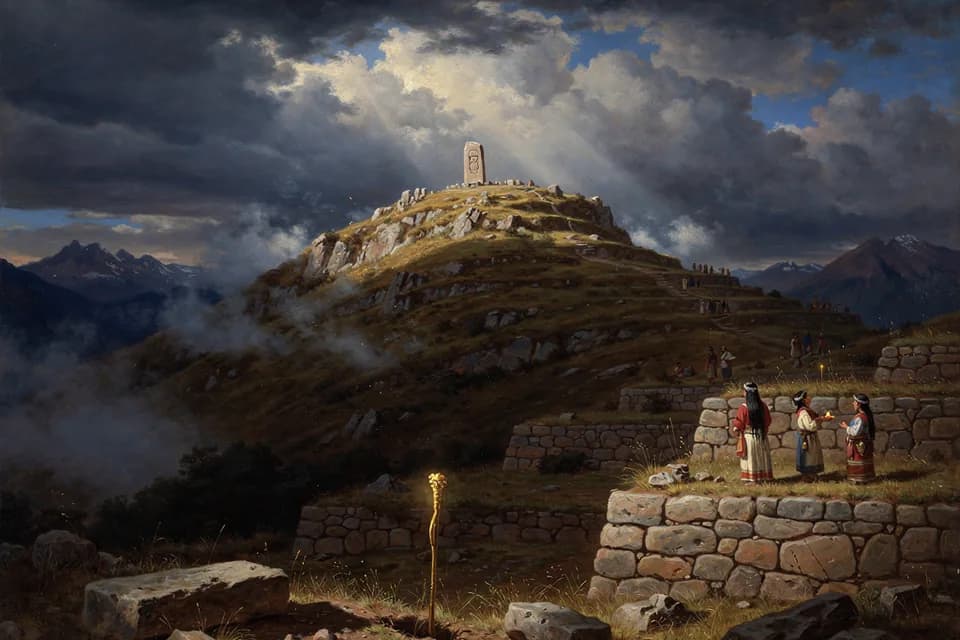
The sacred hill southeast of Cusco where, in Garcilaso's account, the Sun's golden rod sank into the earth, and where in the Pacaritambo tradition Ayar Uchu turned to stone; one of the holiest huacas of the Inca capital.
About Huanacauri
The founding hill
Huanacauri (Wanakawri) is a mountain south of Cusco visible from the city. Both major origin traditions of the Inca dynasty pass through it: in Garcilaso de la Vega's version, the golden rod given by the Sun to Manco Cápac and Mama Ocllo sinks into the ground here, showing them where to found Cusco; in the Pacaritambo version told by Betanzos and Sarmiento, Ayar Uchu, one of Manco's brothers, turns to stone on its summit and becomes a huaca, asking his siblings to honor him.
A huaca of the state
Huanacauri was among the most important shrines in the Cusco region. Cristóbal de Molina describes how young Inca nobles, in the initiation rites (huarachicoy) held during the month of Capac Raymi, made pilgrimages to Huanacauri with offerings before receiving the breechcloths and ear ornaments of adulthood. The stone of Ayar Uchu was also carried into war as a guarantor of victory, according to colonial reports.
Today
The summit, with Inca remains, is reached by hikers from the Cusco valley, and remains part of the sacred landscape of local communities.
On the map
Huanacauri among other places of the Inca and Andean Tradition.
Sources and further reading
Source notes
These references are recorded in the catalog. Their passage wording and translation have not been checked, so quotations are not displayed here.
- Garcilaso de la Vega, Comentarios Reales, Part I, Book 1, ch. 15 (paraphrase)
- Cristóbal de Molina, Relación de las fábulas y ritos de los Incas (paraphrase)
About this entry
By Elizabeth Stein for Mythos Atlas. About the author. Editorial notes are grounded in the site's cited sources and can be challenged through the contact page.
Coordinates mark where the myths place a site, or where the tradition locates it today. Mythic realms are left off the map or marked as symbolic placements.