Inca and Andean TraditionCity
Tiwanaku
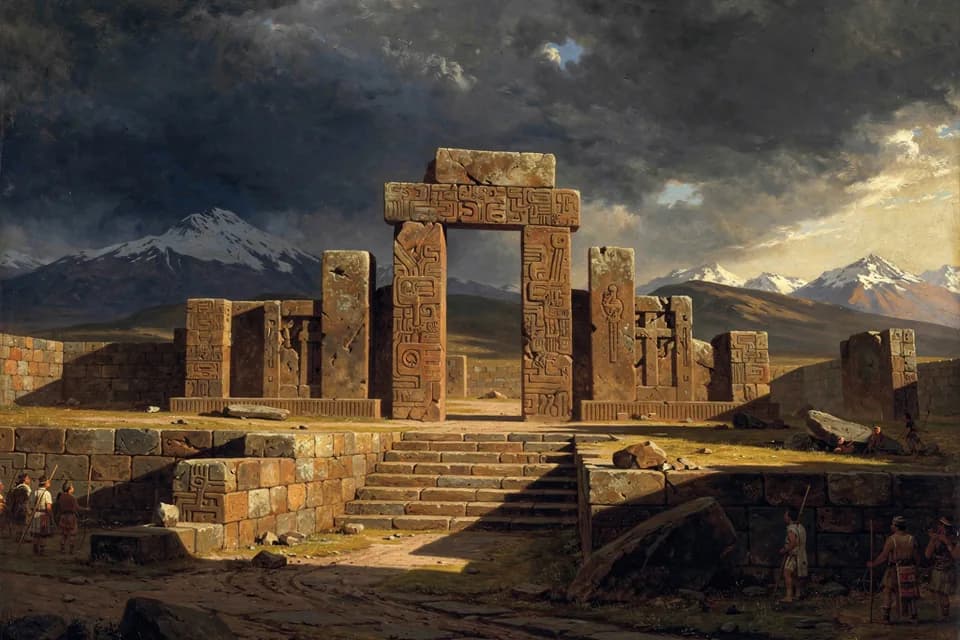
The ruined ceremonial city south of Lake Titicaca, capital of an Andean civilization of about 500-1000 CE, which the Incas claimed as the place where Viracocha made the sun, moon, and peoples.
About Tiwanaku
An older city
Tiwanaku, in the Bolivian altiplano near the southern shore of Lake Titicaca, was the center of a powerful state that flourished roughly between 500 and 1000 CE, centuries before the Incas. Its monuments include the stepped platform of Akapana, the sunken court, the Kalasasaya enclosure, and the monolithic Gateway of the Sun with its carved staff-bearing figure.
Claimed by the Incas
By the time the Incas incorporated the Titicaca basin in the fifteenth century, Tiwanaku was already in ruins. The Incas made it part of their own sacred history: in Betanzos's and Molina's accounts, it is at Tiwanaku that Viracocha makes the sun, moon, and stars and shapes the peoples in stone. Pedro Cieza de León, who visited in the 1540s, described the great stones and statues and recorded local claims that they had been made in a single night.
Today
Tiwanaku is a UNESCO World Heritage Site and a focus of Aymara cultural identity; Aymara New Year celebrations at the June solstice have been held there in recent decades.
On the map
Tiwanaku among other places of the Inca and Andean Tradition.
Sources and further reading
Source notes
These references are recorded in the catalog. Their passage wording and translation have not been checked, so quotations are not displayed here.
- Juan de Betanzos, Suma y narración de los Incas, Part 1, ch. 1 (paraphrase)
About this entry
By Elizabeth Stein for Mythos Atlas. About the author. Editorial notes are grounded in the site's cited sources and can be challenged through the contact page.
Coordinates mark where the myths place a site, or where the tradition locates it today. Mythic realms are left off the map or marked as symbolic placements.