Inca and Andean TraditionCreature
Amaru
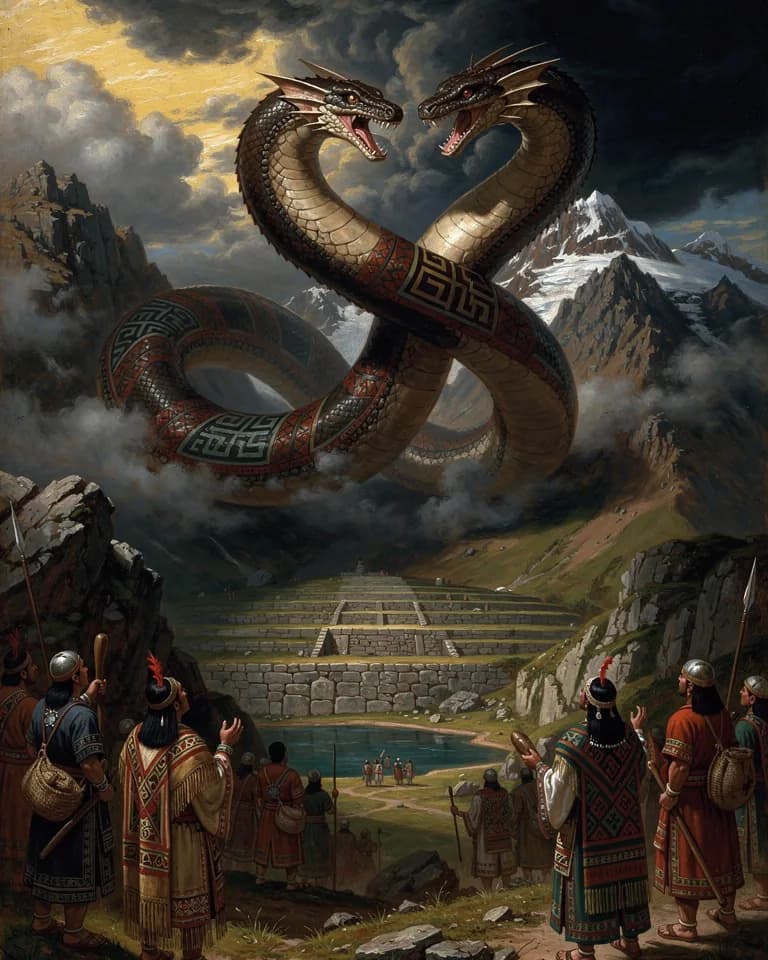
- emerging from the earth
- causing upheaval
- turning to stone when defeated
The great serpent of Andean tradition, linked with water, the underworld, and upheaval; in the Huarochirí stories Huallallo Carhuincho sends an amaru against Pariacaca, who turns it to stone with a golden staff.
About Amaru
In the Huarochirí stories
Amaru is the ordinary Quechua word for a large snake, and in Andean tradition it names a mighty serpent associated with water, the underworld, and violent change. In the Huarochirí Manuscript's account of the war between Pariacaca and Huallallo Carhuincho, Huallallo sends an amaru against the snow-mountain god; Pariacaca strikes it with a golden staff and it freezes into stone. Commentators note that the Huarochirí amaru is described with two heads, and two-headed serpents appear in older Andean art, on Moche and Chimú ceramics among others.
Serpent of power and rebellion
The serpent's name carried authority. A palace of the Inca Huayna Capac in Cusco was called Amarucancha, 'enclosure of the serpent' (its site is now occupied by the Jesuit church of La Compañía), and the last Inca ruler of Vilcabamba, executed in 1572, was Túpac Amaru, 'royal serpent'. In 1780 José Gabriel Condorcanqui took the name Túpac Amaru II when he led the great Andean rebellion against Spanish rule, and the name has remained a symbol of resistance.
Caution
Modern popular writing often presents the amaru as a fixed 'Inca dragon' with standard attributes. The colonial sources show a range of serpent beings rather than a single canonical monster; this entry keeps to the Huarochirí episode and the documented uses of the name.
Sources and further reading
Source notes
These references are recorded in the catalog. Their passage wording and translation have not been checked, so quotations are not displayed here.
- Huarochirí Manuscript, ch. 16 (paraphrase)
About this entry
By Elizabeth Stein for Mythos Atlas. About the author. Editorial notes are grounded in the site's cited sources and can be challenged through the contact page.
The danger rating is an editorial shorthand for how the myths portray the creature, not a claim made by the sources.