Inca and Andean Tradition
Pariacaca
Paria Caca
Also known as Paria Caca
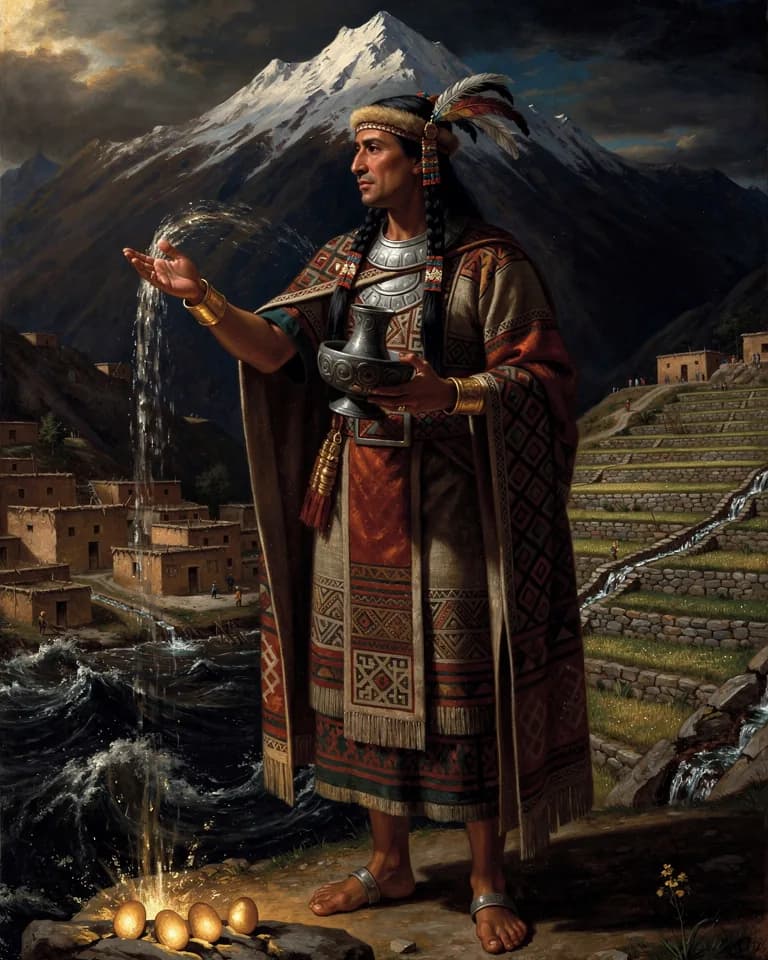
- rain and storm
- irrigation water
- the snow mountain
The snow-mountain god of the Huarochirí Manuscript, born from five eggs on Mount Condorcoto, who drowns a village that refused him drink, brings irrigation water to the fields of Cupara, and drives the fire-eating Huallallo Carhuincho out of the highlands.
About Pariacaca
Born from five eggs
The Quechua Huarochirí Manuscript (c. 1598-1608) makes Pariacaca the central huaca of the Checa and other peoples of Huarochirí province, in the mountains east of Lima. He appears on the mountain Condorcoto as five eggs; the eggs hatch as five falcons that become five persons, and the manuscript itself debates whether these were five brothers or Pariacaca and his children (ch. 16). His son Huatyacuri, a poor man who eats only half-cooked potatoes, prepares his coming by humbling a rich lord who claimed to be a god.
Storm, flood, and water
Pariacaca's power is the power of water: rain, hail, flood, and irrigation. When the people of a village feasting below Huarochirí ignore him, disguised as a poor stranger, except for one woman who offers him maize beer, he warns her to flee and destroys the village with a storm five days later. When the young woman Choque Suso weeps over her dry maize, he opens the channels that still water the fields of Cupara. And he drives out Huallallo Carhuincho, the earlier god of a hot lowland world, in a contest of water against fire.
A mountain and a cult
Pariacaca is also the glaciated peak of that name on the border of Lima and Junín regions, crossed by an Inca road from Jauja to the coast. The manuscript describes the annual gatherings in which his worshippers climbed toward him, and the priests and offerings of his cult, in the chapters the compiler titled on how he 'began to ordain his own cult' (ch. 9).
Origin story
Pariacaca appears on the mountain Condorcoto as five eggs, which hatch into five falcons and then five men (Huarochirí Manuscript, chs. 5-6).
Worship and cult
Temples, festivals, and practices recorded for Pariacaca
Offerings of llamas, coca, and maize beer; the stone forms of figures in his stories, such as Choque Suso at the head of the Cupara irrigation channel, received their own offerings into the seventeenth century, as Ávila complains.
Sacred sites
- Pariacaca mountain itself, on the watershed between the Lima and Junín regions of Peru, and shrines to his children and companions throughout Huarochirí province.
Festivals
- An annual festival of Pariacaca in which the Checa and other ayllus gathered with offerings, described in the Huarochirí Manuscript (ch. 9).
In the atlas
Where Pariacaca appears
Sources and further reading
Source notes
These references are recorded in the catalog. Their passage wording and translation have not been checked, so quotations are not displayed here.
- Francisco de Ávila, Tratado de los errores, ch. V (trans. Markham 1873)
- Francisco de Ávila, Tratado de los errores, ch. V (trans. Markham 1873)
About this entry
By Elizabeth Stein for Mythos Atlas. About the author. Editorial notes are grounded in the site's cited sources and can be challenged through the contact page.
Parallels are editorial comparisons across traditions: a shared role does not, by itself, establish a shared origin.
Genealogy
Family tree
Pariacaca's parents, consorts, children and rivals, as recorded in the atlas.