Inca and Andean Traditionwar
Pariacaca and Huallallo Carhuincho
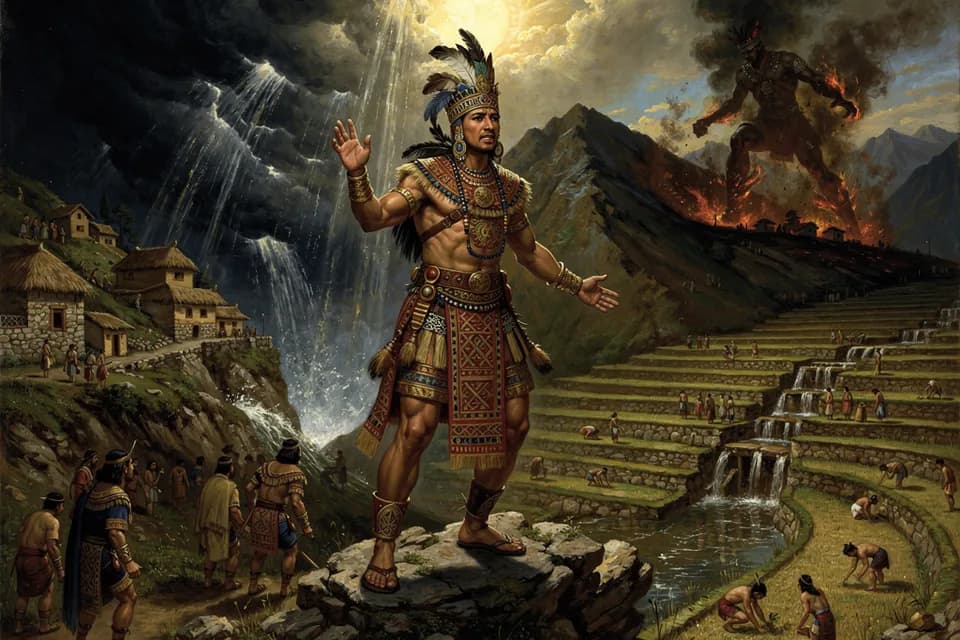
Born from five eggs, Pariacaca drowns a village that refused a stranger drink, brings irrigation water to the fields of Cupara for the woman Choque Suso, and at last drives the child-eating lord of the old hot world, Huallallo Carhuincho, out of the highlands in a war of water against fire.
An editorial retelling
The story
The old world of Huallallo
The Huarochirí stories remember a time when the province was hot lowland country, when the dead came back to life on the fifth day and crops ripened in five days. Its master was Huallallo Carhuincho, who had defeated the earlier huacas Yanamca and Tutañamca. He ordered that no woman should bear more than two children, one of whom was to be given to him to eat.
Pariacaca sets out
On the mountain Condorcoto five eggs hatched as five falcons that became five men: Pariacaca and his brothers. Having destroyed the rich man who called himself a god, Pariacaca resolved to confront Huallallo. On the way he came, dressed as a poor man, to a village where a great festival was under way. He sat at the end of the row as the uninvited do, and all day no one gave him anything to drink, except one young woman who took pity on him and brought him a large gourd of maize beer. He thanked her and told her that in five days something terrible would happen to the village; she must take her children and leave, and tell no one. On the fifth day, as the village went on drinking, Pariacaca climbed a mountain above it and sent down torrents of rain and hail, with yellow and white stones, that carried the whole village into the sea.
Water for Cupara
Crossing the river, Pariacaca met a beautiful young woman of the Cupara lineage, Choque Suso, weeping because her maize was drying up for lack of water. He stopped her little channel with his cloak, then offered to give her water in abundance if she would be his. When she had seen the water flow, and a new channel built from a ravine above by all the birds, snakes, pumas, and other animals he summoned, she kept her promise. The fox began to survey the line of the canal, but was startled by a partridge and let the water spill down the hill, and the break in the channel, people said, is still there. Choque Suso chose to stay at the head of the channel forever and turned to stone, and the Cupara people honored her there.
Water against fire
Then Pariacaca came against Huallallo Carhuincho. In the manuscript's accounts of their struggle (chs. 8 and 16), Pariacaca fights with rain, hail, and lightning, and Huallallo with fire that blazes up toward the sky. Huallallo sends monsters against him, among them an amaru, a great serpent; Pariacaca pierces it with a golden staff and it turns to stone. Pariacaca's rains overcome the fire, and Huallallo, defeated, flees toward the Antis, the hot forested lowlands to the east. The hot world of the old age gives way to the cold highland world of the present, ruled by the snow mountain.
Reading the war
The manuscript itself notes that different peoples told these episodes differently and even argues over whether Pariacaca's five were brothers or a father and sons (ch. 16). Modern scholars read the struggle as a charter for the highland peoples who worshipped Pariacaca, set against lowland-linked groups associated with Huallallo, and connect Pariacaca's victories with the practical importance of snowmelt and irrigation in the valleys below his peak.
Listen or change reading mode
Highlights
Pariacaca, snubbed at a village feast, warns the one kind woman and destroys the village by storm; he waters the fields of Cupara for Choque Suso, who becomes stone at the head of the channel; and he defeats the child-eating Huallallo Carhuincho, turning his serpent to stone and driving him into the lowlands.
Why it matters
The foundational struggle of the Huarochirí corpus, explaining the landscape, irrigation works, and religious geography of the province, and the supremacy of Pariacaca's cult among the Checa and neighboring peoples.
Sources and further reading
By Elizabeth Stein for Mythos Atlas. About the author. Editorial notes are grounded in the site's cited sources and can be challenged through the contact page.
Works cited
The Huarochirí Manuscript, chs. 1, 6-8, and 16
Anonymous; trans. Frank Salomon and George L. Urioste
Narrative of the Errors, False Gods, and Other Superstitions, chs. I, VI-VII
Francisco de Ávila; trans. Clements Markham