Inca and Andean TraditionCreature
Urcuchillay
- protecting llama and alpaca herds
- promoting the increase of flocks
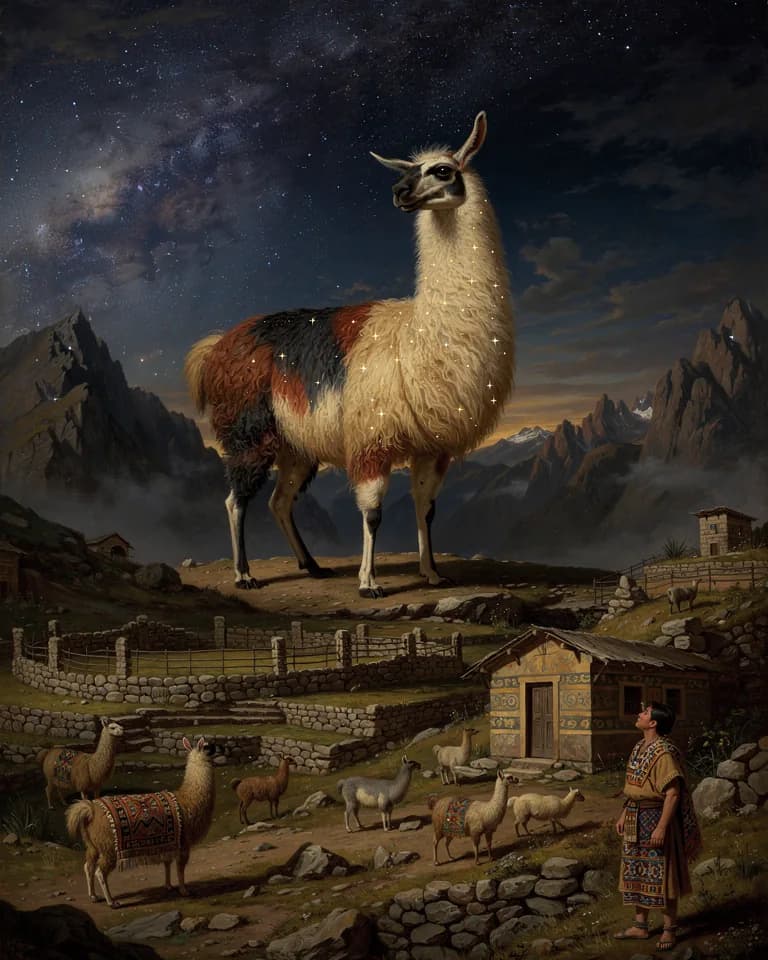
The many-colored male llama of the stars, reported by colonial writers as the celestial guardian that herders prayed to for the increase and protection of their flocks.
About Urcuchillay
A star for herders
The jurist Juan Polo de Ondegardo, investigating Andean religion in Cusco in the 1550s-1570s, reported that herders worshipped a star they called Urcuchillay, which they imagined as a male llama of many colors and credited with the protection and increase of the flocks; the Jesuit José de Acosta (1590) repeated his account. Polo reported similar star-guardians for other animals and for particular human activities, suggesting a general Andean idea that each kind of creature had a celestial prototype watching over it.
Herding and the sky
Llamas and alpacas were the basis of Andean wealth: food, wool for cloth, transport, and the most important sacrificial animals of the state cult. It is no surprise that the sky itself held llamas, from the dark-cloud Yacana of the Huarochirí Manuscript to Urcuchillay's bright star. The urku in the name means 'male' (used of animals).
Identification
Polo and Acosta do not say which star Urcuchillay was. The Jesuit Bernabé Cobo (1653) identifies it with the constellation European astronomers call Lyra, and says the herders also honoured two smaller stars below it. Whether Cobo's identification reflects Andean usage or his own reading of the sky cannot be checked, so this entry records it as Cobo's.
Sources and further reading
Source notes
These references are recorded in the catalog. Their passage wording and translation have not been checked, so quotations are not displayed here.
- José de Acosta, Historia natural y moral de las Indias, Book 5, following Polo de Ondegardo (paraphrase)
- Bernabé Cobo, Historia del Nuevo Mundo, Book 13 (paraphrase)
About this entry
By Elizabeth Stein for Mythos Atlas. About the author. Editorial notes are grounded in the site's cited sources and can be challenged through the contact page.
The danger rating is an editorial shorthand for how the myths portray the creature, not a claim made by the sources.