Inca and Andean TraditionCreature
Yacana
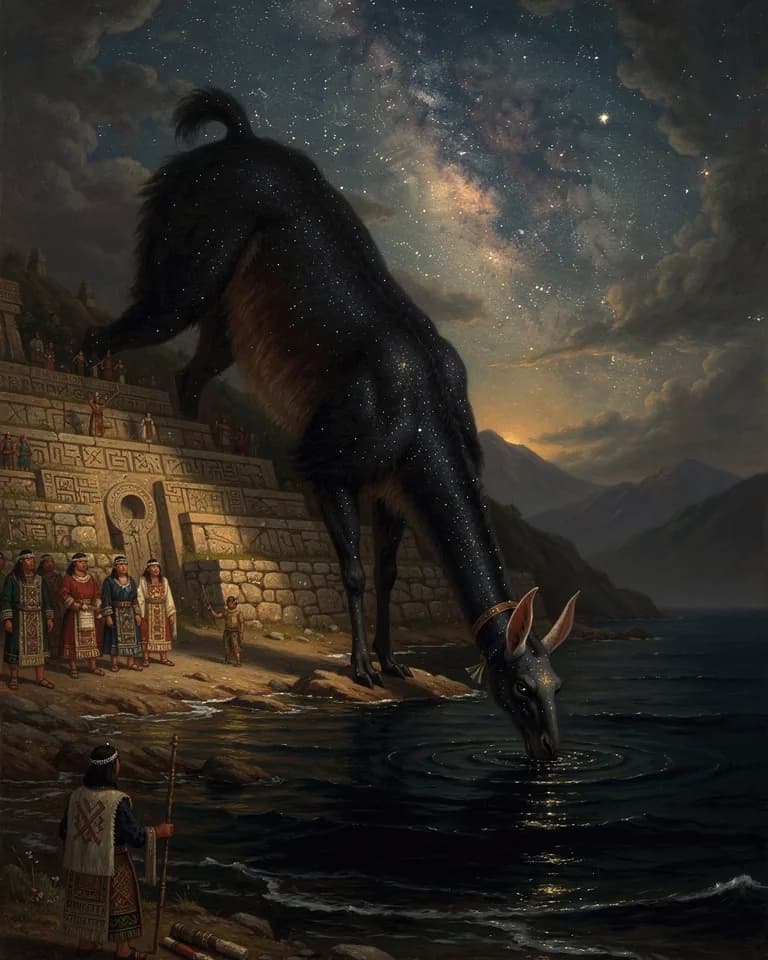
- drinking the ocean to keep it from flooding the world
- moving along the river of the sky
- bestowing good fortune in herds
The celestial llama of the Huarochirí Manuscript, a dark shape in the Milky Way that walks down at midnight to drink from the sea; if it did not drink, the ocean would flood the world.
About Yacana
The llama in the Milky Way
Chapter 29 of the Huarochirí Manuscript describes the Yacana as a llama-shaped being that moves through the middle of the sky along the Milky Way, which Andean people called Mayu, 'the river'. It has two eyes and a long neck, and it walks down at midnight, unseen, to drink water from the sea; if it did not, the manuscript says, the sea would flood the whole world. The same chapter names other stars and star groups, among them a smaller llama (the Yacana's young) and figures associated with herds.
Dark-cloud constellations
Unlike most European constellations, which join bright stars, the Yacana is a shape made by dark dust lanes against the bright band of the Milky Way. The anthropologist Gary Urton, working in the Quechua community of Misminay near Cusco in the 1970s, documented a living system of such dark-cloud animals, including a llama whose eyes are the bright stars Alpha and Beta Centauri, closely matching the Huarochirí description written nearly four centuries earlier.
Water and the cosmos
The Yacana belongs to an Andean picture of water circulating between the sea, the sky, and the earth: the celestial river carries water across the sky, and the llama's drinking keeps the balance. Herders associated it with the fertility of their animals, and the manuscript connects its descent with good fortune for the llama flocks.
Sources and further reading
Source notes
These references are recorded in the catalog. Their passage wording and translation have not been checked, so quotations are not displayed here.
- Huarochirí Manuscript, ch. 29 (paraphrase)
About this entry
By Elizabeth Stein for Mythos Atlas. About the author. Editorial notes are grounded in the site's cited sources and can be challenged through the contact page.
The danger rating is an editorial shorthand for how the myths portray the creature, not a claim made by the sources.