Inca and Andean TraditionTrickster Creator
Cuniraya Viracocha
Cuni Raya Vira Cocha
Also known as Coniraya, Cuni Raya
- irrigation and terraces
- trickery
- the ordering of animals
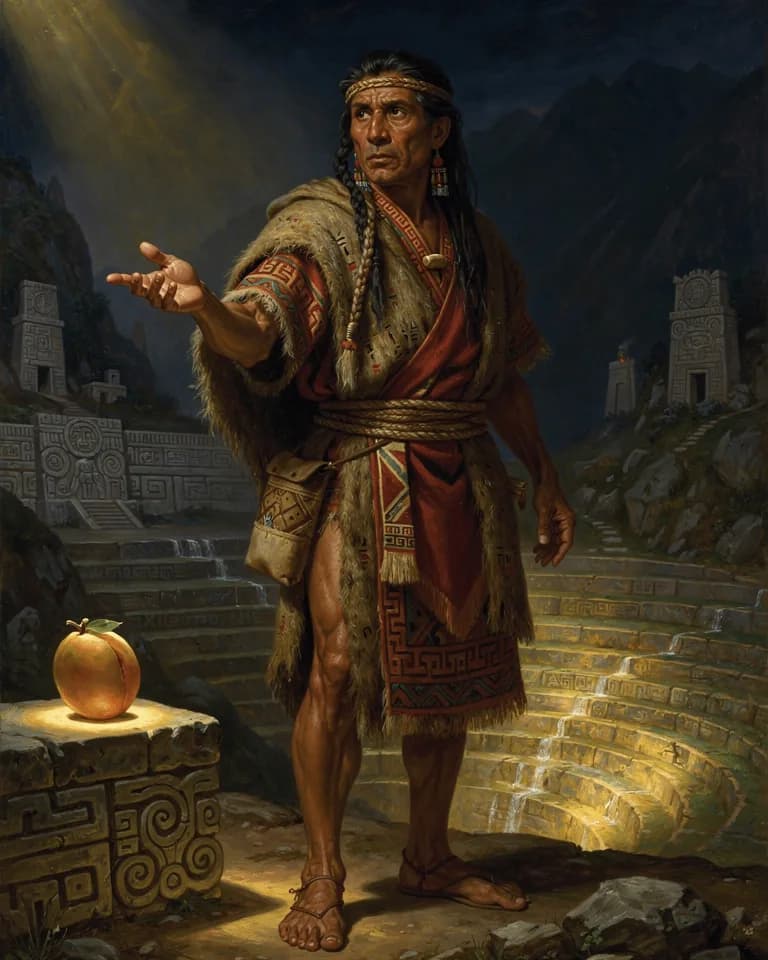
The ragged trickster-creator of the Huarochirí stories, who makes terraces and canals with a word, fathers a child on the proud huaca Cavillaca through a fruit, and blesses or curses each animal he meets as he chases her to the sea.
About Cuniraya Viracocha
A creator in rags
The Huarochirí Manuscript (ch. 2) and Francisco de Ávila's Spanish retelling (1608) describe Cuniraya wandering the land as a lice-ridden beggar whom people mock. Yet with a word he makes terraces rise on the ravine sides and, by throwing a cane, sets irrigation channels flowing. In the most famous story he fathers a child on the beautiful and aloof huaca Cavillaca by placing his seed in a ripe lúcuma fruit, then pursues her to the sea at Pachacamac, rewarding the condor, puma, and falcon that give him hopeful news and cursing the skunk, fox, and parrots that do not.
Cuniraya and Viracocha
The manuscript and Ávila both report that people invoked him as 'Cuniraya Viracocha' and called him lord of all, and Ávila, who was trying to prove the invocation older than the Spaniards, insists it was used 'long before there were any tidings of Spaniards'. Whether Cuniraya was originally a local deity later identified with the Inca state's Creator, or a local form of the same Creator, is debated; Ávila's retelling admits it is not certain whether he came before or after Pariacaca. This site links the two through an 'aspect of' relationship marked as disputed.
Explaining the world
Many of Cuniraya's acts explain features of the world: why condors eat carrion unharmed, why the puma's skin is worn with its head in festival dances, why foxes stink and are hunted, and why there are fish in the sea (he tips them out of Urpay Huachac's pond in revenge). Ávila records that people in his parishes still acted on these blessings and curses in the early 1600s.
Origin story
No birth is told; he simply 'appeared in the form and dress of a very poor Indian' in the most ancient times (Ávila, ch. II).
Across traditions
Parallel figures
Figures who play a role like Cuniraya Viracocha's in other traditions.
 Tlingit HaidaRaven
Both are trickster-transformers whose travels and appetites account for features of the world and the habits of animals, creating by redistributing things as much as by making them.
Compare Cuniraya Viracocha and Raven side by side
Worship and cult
Temples, festivals, and practices recorded for Cuniraya Viracocha
Invoked before difficult work, especially by weavers, with a leaf of coca thrown on the ground as an offering, according to Ávila; Ávila also reports a stone into which Cuniraya was said to have been turned, above the Cupara irrigation channel.
In the atlas
Where Cuniraya Viracocha appears
Stories
Sources and further reading
Source notes
These references are recorded in the catalog. Their passage wording and translation have not been checked, so quotations are not displayed here.
- Francisco de Ávila, Tratado de los errores, ch. II (trans. Markham 1873)
- Francisco de Ávila, Tratado de los errores, ch. I (trans. Markham 1873)
About this entry
By Elizabeth Stein for Mythos Atlas. About the author. Editorial notes are grounded in the site's cited sources and can be challenged through the contact page.
Parallels are editorial comparisons across traditions: a shared role does not, by itself, establish a shared origin.
Genealogy
Family tree
Cuniraya Viracocha's parents, consorts, children and rivals, as recorded in the atlas.