Hittite Pantheontool
The Ancient Copper Cutter
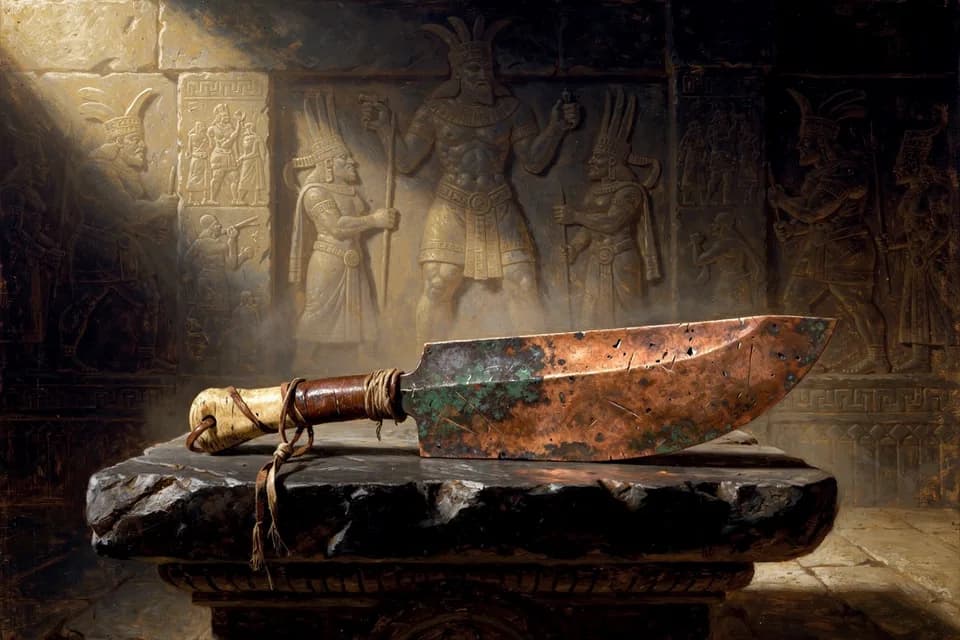
- separated heaven from earth at the beginning
- cuts what no weapon can
The primeval copper cutting tool with which heaven and earth were once separated, brought out of the ancient storehouses so that Ea can sever the stone giant Ullikummi from Upelluri's shoulder.
About The Ancient Copper Cutter
A tool from the making of the world
In the Song of Ullikummi, when the storm-god Teššub has been beaten and the stone giant is still growing, the wise god Ea goes to the Former Gods, the primeval deities of the underworld, and asks them to open the old storehouses of their fathers and bring out the ancient copper cutting tool, the one with which heaven and earth were separated. With it he cuts Ullikummi's feet away from the shoulder of Upelluri, and the giant loses the strength that came from his footing.
What the story assumes
The episode assumes a cosmology in which heaven and earth were once joined and had to be cut apart, and in which the cutting tool still exists, stored away. Upelluri himself says that he felt nothing when heaven and earth were built on him and nothing when they were cut apart. The idea of a primeval separation of heaven and earth is widespread in Near Eastern and other traditions; the Hurrian song is distinctive in making the separating tool a physical object that can be brought out again.
Nothing more is known
The text does not describe the tool's shape beyond calling it a copper cutter, and it has no life outside this one scene. It is not an archaeological object, and this site does not attach it to any real find.
Origin
Song of Ullikummi (CTH 345): the tool used when heaven and earth were separated, kept by the Former Gods.
Sources and further reading
Source notes
These references are recorded in the catalog. Their passage wording and translation have not been checked, so quotations are not displayed here.
- Song of Ullikummi, CTH 345, trans. H. A. Hoffner Jr., Hittite Myths
About this entry
By Elizabeth Stein for Mythos Atlas. About the author. Editorial notes are grounded in the site's cited sources and can be challenged through the contact page.