Hittite PantheonCreature
Ullikummi
- grows without limit
- immune to seduction, being deaf and blind
- defeats Teššub and seventy gods in the first battle
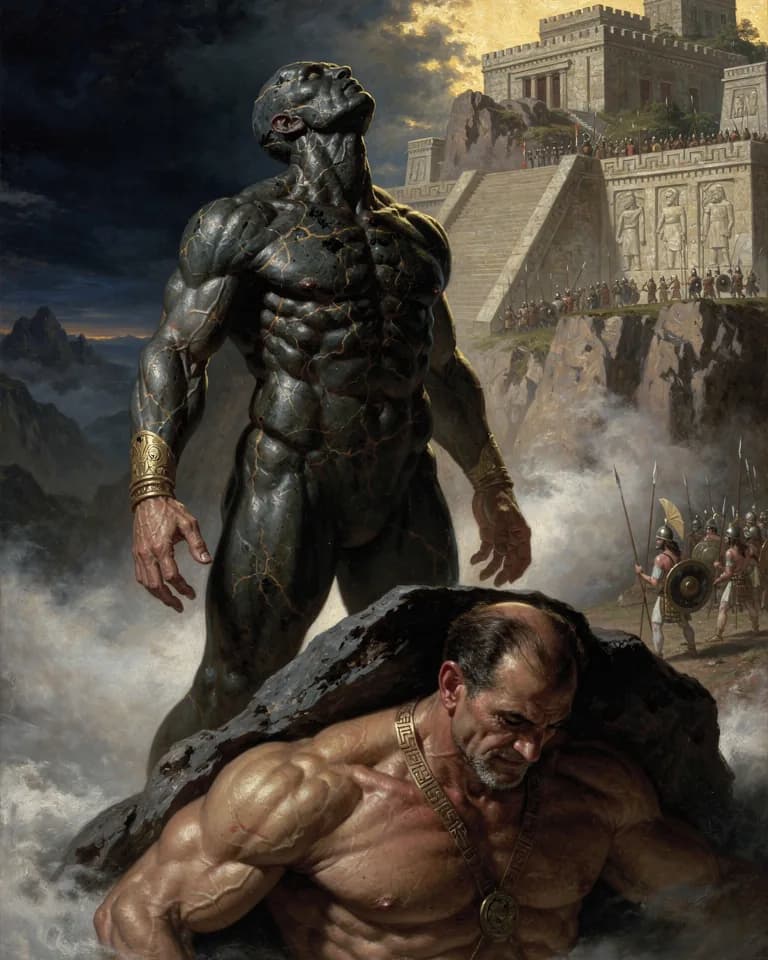
A deaf and blind giant of basalt, fathered by Kumarbi on a great rock and grown on the shoulder of the world-bearing giant Upelluri until it reaches heaven, to destroy the storm-god's city of Kummiya.
About Ullikummi
A weapon, not a person
Ullikummi is the monstrous son of Kumarbi in the Hurrian Song of Ullikummi (CTH 345). Kumarbi fathers him on a great rock so that he will be a rival to the storm-god Teššub, and names him for his purpose: the name is understood to mean something like "destroy Kummiya", Teššub's city. He is made of basalt (Hittite kunkunuzzi), and he has no inner life in the text at all: a great wave tells the goddess Šauška that he is deaf, blind, and without compassion.
Growing on Upelluri
Kumarbi hides the stone child by having him set on the right shoulder of Upelluri, the giant in the sea who bears heaven and earth, where he grows every day until he stands out of the water and reaches the sky. He defeats Teššub's first attack and pushes up to the gates of Kummiya, forcing the goddess Hebat out of her temple.
Cut from his base
The wise god Ea finds the weakness: Ullikummi's strength depends on his footing. Ea has the Former Gods bring out the ancient copper tool that once separated heaven from earth, and with it he cuts Ullikummi's feet from Upelluri's shoulder. The final battle is lost from the surviving tablets, but the song was clearly heading for Teššub's victory.
Sources and further reading
Source notes
These references are recorded in the catalog. Their passage wording and translation have not been checked, so quotations are not displayed here.
- Song of Ullikummi, CTH 345, trans. H. A. Hoffner Jr., Hittite Myths
About this entry
By Elizabeth Stein for Mythos Atlas. About the author. Editorial notes are grounded in the site's cited sources and can be challenged through the contact page.
The danger rating is an editorial shorthand for how the myths portray the creature, not a claim made by the sources.