Hittite Pantheon
Šauška
dIŠTAR (read Šauška)(Šauška)
Also known as Shaushka, Šawuška, Ištar of Nineveh (by equation)
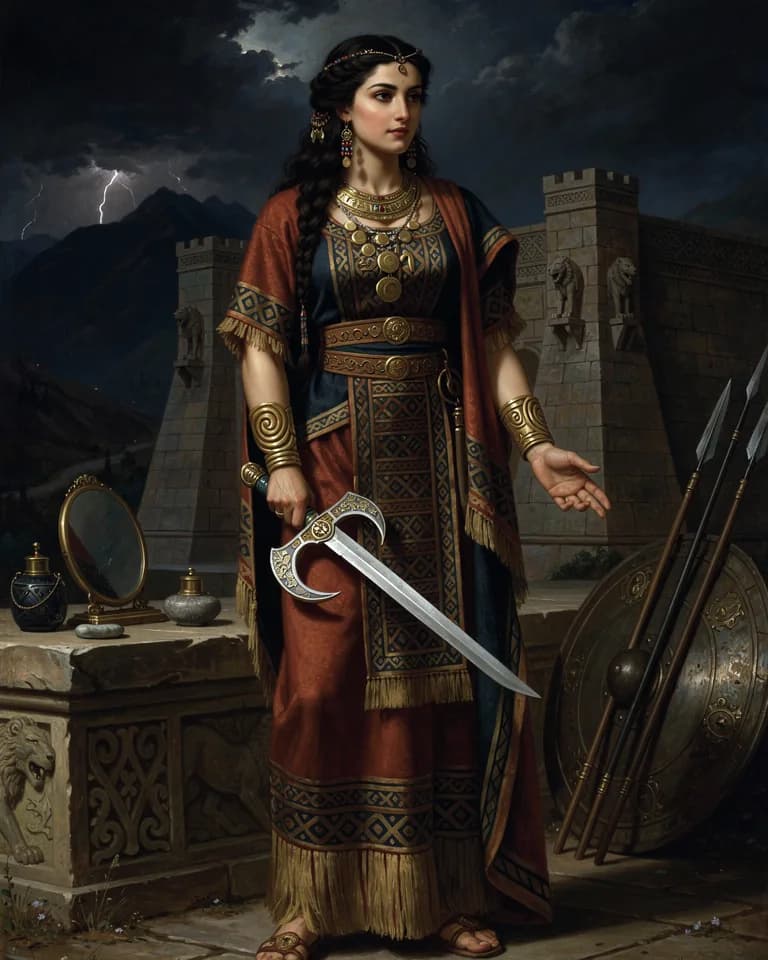
- love and sexuality
- war
- healing
Hurrian goddess of love and war and sister of the storm-god Teššub, who in the Kumarbi cycle tries to overcome her brother's monstrous enemies by seduction.
About Šauška
A Hurrian Ištar
Šauška is the Hurrian goddess whom Hittite scribes wrote with the sign for the Mesopotamian Ištar; her most famous cult was at Nineveh. She was a goddess of both love and war and could appear in male as well as female form. She became personally important to the Hittite royal family: King Hattusili III named her as his protective goddess in his autobiographical Apology.
Teššub's sister
In the Kumarbi cycle she is Teššub's sister and one of his closest allies. In the Song of Hedammu she confronts the sea-serpent by bathing, adorning herself, and displaying her beauty, drawing the monster out of the sea; the text is fragmentary but implies that she overcomes it by seduction and drugged drink. In the Song of Ullikummi she tries the same tactic against the stone giant and fails, because, as a great wave tells her, Ullikummi is deaf and blind and cannot be moved by beauty.
At Yazılıkaya
Šauška appears twice in the relief procession of the rock sanctuary of Yazılıkaya near Hattusa, once among the male gods (reflecting her dual aspect) and once among the goddesses, accompanied by her attendants Ninatta and Kulitta.
Across traditions
Parallel figures
Figures who play a role like Šauška's in other traditions.
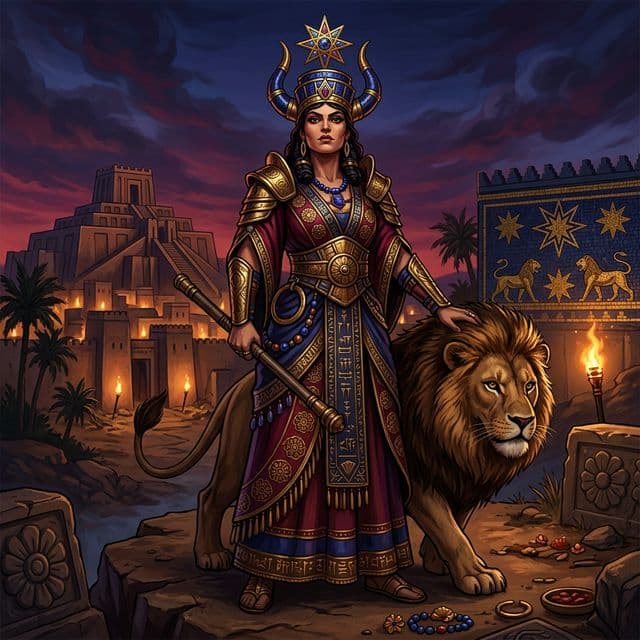 MesopotamianInanna
Hittite scribes wrote Šauška's name with the Ištar sign, and ancient god-lists equate her with the Mesopotamian goddess of love and war.
Compare Šauška and Inanna side by side
Worship and cult
Temples, festivals, and practices recorded for Šauška
Hattusili III credited her with his rise to power; her statue from Nineveh was sent to Egypt to heal the pharaoh in the Amarna letters, showing her healing role.
Sacred sites
- Nineveh (her principal Hurrian cult centre)
- Šamuḫa, where Hattusili III served her
Family
Šauška's family at a glance
- Who are Šauška's siblings?
- Siblings of Šauška recorded in the atlas: Tarhunna (the Storm-god of Hatti).
In the atlas
Where Šauška appears
Stories
Sources and further reading
Source notes
These references are recorded in the catalog. Their passage wording and translation have not been checked, so quotations are not displayed here.
- Song of Ullikummi, CTH 345, trans. H. A. Hoffner Jr., Hittite Myths
Appears in
Ancient and classical works featuring this figure.
The Kumarbi Cycle (Song of Kumarbi, Song of Hedammu, Song of Ullikummi)
Teššub's sister, who tries to seduce Hedammu and Ullikummi (Song of Hedammu (CTH 348); Song of Ullikummi (CTH 345))
Further reading
The Kumarbi Cycle (Song of Kumarbi, Song of Hedammu, Song of Ullikummi)
Šauška against Hedammu and Ullikummi
- Wegner, Ilse. Gestalt und Kult der Ištar-Šawuška in Kleinasien (Butzon & Bercker, 1981).
About this entry
By Elizabeth Stein for Mythos Atlas. About the author. Editorial notes are grounded in the site's cited sources and can be challenged through the contact page.
Parallels are editorial comparisons across traditions: a shared role does not, by itself, establish a shared origin.
Family relationships come from the atlas's kinship records. Ancient sources often disagree on divine genealogy.
Genealogy
Family tree
Šauška's parents, consorts, children and rivals, as recorded in the atlas.