Hittite Pantheon
Tarhunna (the Storm-god of Hatti)
dU / dIŠKUR (read Tarḫunna)(Tarḫunna)
Also known as Storm-god of Hatti, Teššub (Hurrian), Taru (Hattian), Tarḫunt (Luwian), Teshub
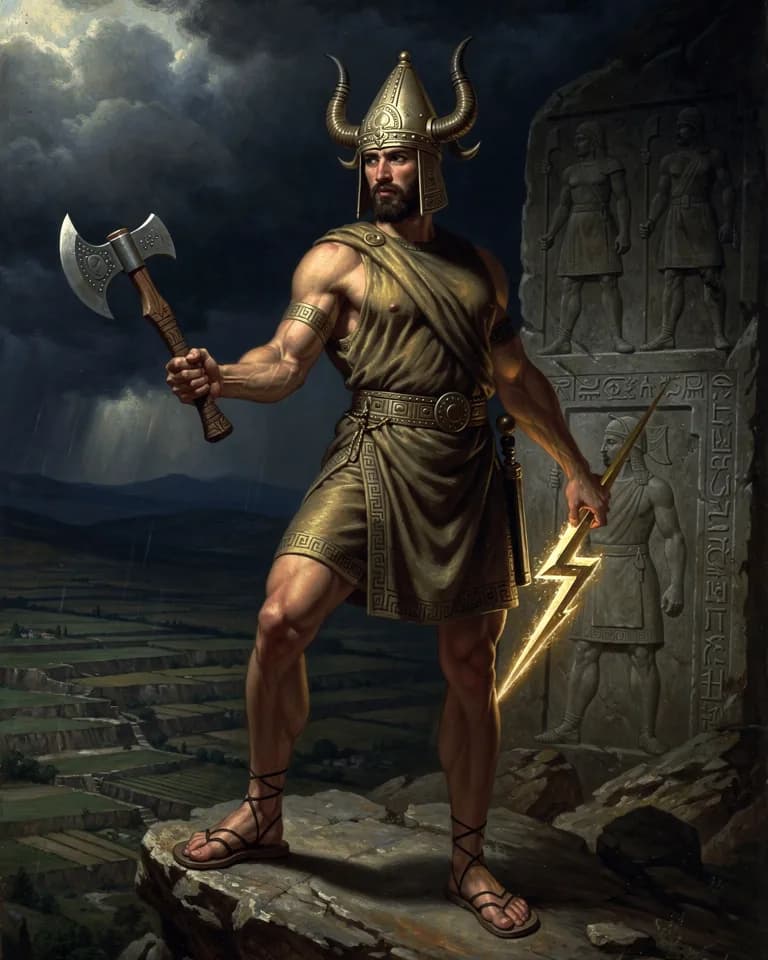
- storms
- rain
- kingship
- the fertility of the land
The chief god of the Hittite state: a storm-god of rain and thunder who gives the land its fertility, fights the serpent Illuyanka, and, under his Hurrian name Teššub, wins kingship in heaven in the Kumarbi cycle.
About Tarhunna (the Storm-god of Hatti)
One god, several names
Hittite scribes usually wrote the storm-god's name with a Sumerian word-sign (dU or dIŠKUR, "the Storm-god"), so the Hittite reading is partly reconstructed; Tarḫunna is the most widely accepted reading, and the Luwian form Tarḫunt survived into the first millennium BCE. The same logogram covered the Hattian storm-god Taru and, from the fifteenth century onward, the Hurrian storm-god Teššub, whom the later Hittite royal family, closely tied to Hurrian Kizzuwatna, promoted to the head of the state cult. On this site these are treated as one entry because the Hittite sources themselves write them with one sign, but readers should know that the Hattian, Hittite, and Hurrian storm-gods had separate origins and were brought together by scribes and kings.
Storm-god of Hatti and local storm-gods
The Storm-god of Hatti was the king's divine lord; the king called himself the god's administrator, and treaties invoked the storm-god first among the divine witnesses. Alongside him, dozens of local storm-gods had their own cult cities, the most important being the Storm-god of Nerik and the Storm-god of Zippalanda, both regarded as his sons in cult texts. His sacred animals were two bulls, named Šeri and Hurri in Hurrian tradition, which draw his chariot.
In the myths
In the Anatolian Illuyanka tales, recited at the Purulli festival of Nerik, the storm-god is first defeated by the serpent Illuyanka and wins only with the help of others: the goddess Inara and her mortal helper Hupašiya in one version, and his own mortal son in the other. In the Hurrian Kumarbi cycle he appears as Teššub, conceived when Kumarbi swallows the seed of the sky-god Anu, born out of Kumarbi's body, and victorious in the struggle for kingship in heaven, though he loses his first battle against the stone giant Ullikummi and needs the wisdom of Ea to win. That pattern, a storm-king who is beaten before he triumphs, runs through both strands of his mythology.
Across traditions
Parallel figures
Figures who play a role like Tarhunna (the Storm-god of Hatti)'s in other traditions.
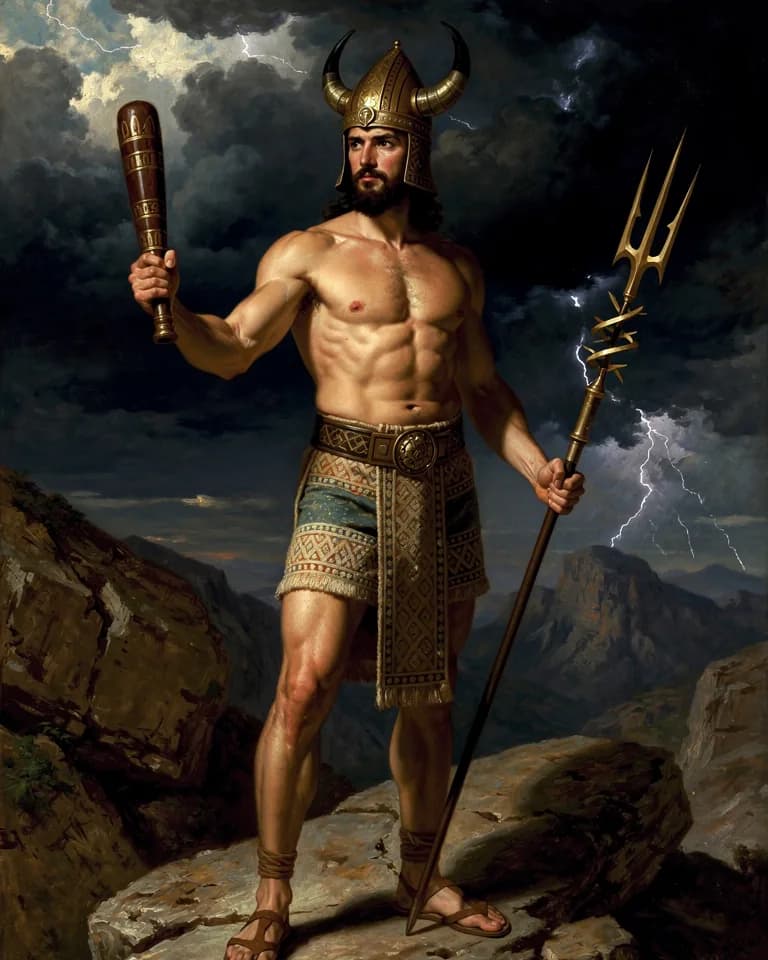 CanaaniteBaal (Baʿlu Haddu)
Both storm-gods have their mountain at Jebel Aqra, Hurrian-Hittite Hazzi and Ugaritic Zaphon, and both defeat a sea or serpent enemy; Ugaritic god-lists equate Teššub with Baal.
Compare Tarhunna (the Storm-god of Hatti) and Baal (Baʿlu Haddu) side by side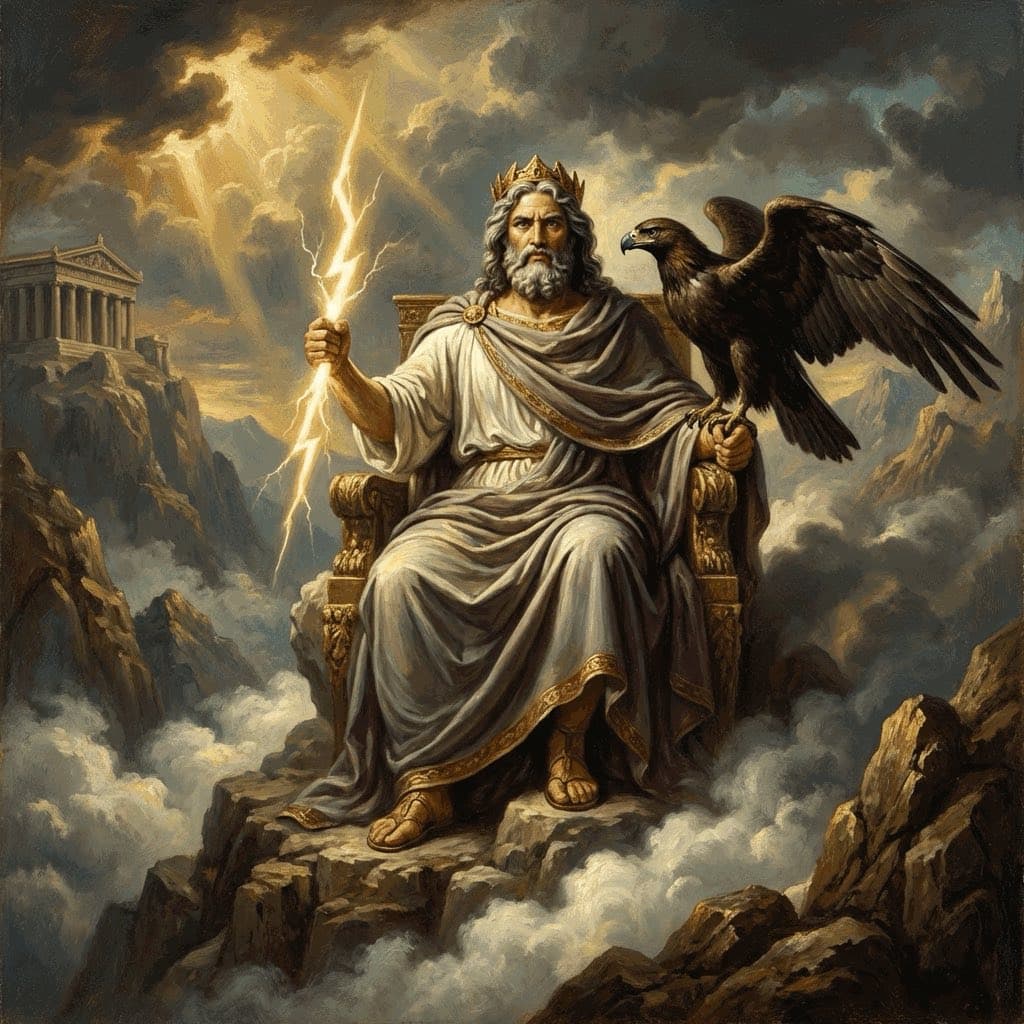 GreekZeus
Both are storm-kings who win rule in heaven after a succession struggle; the Kumarbi cycle is the closest Near Eastern parallel to the succession myth of Hesiod's Theogony.
Compare Tarhunna (the Storm-god of Hatti) and Zeus side by side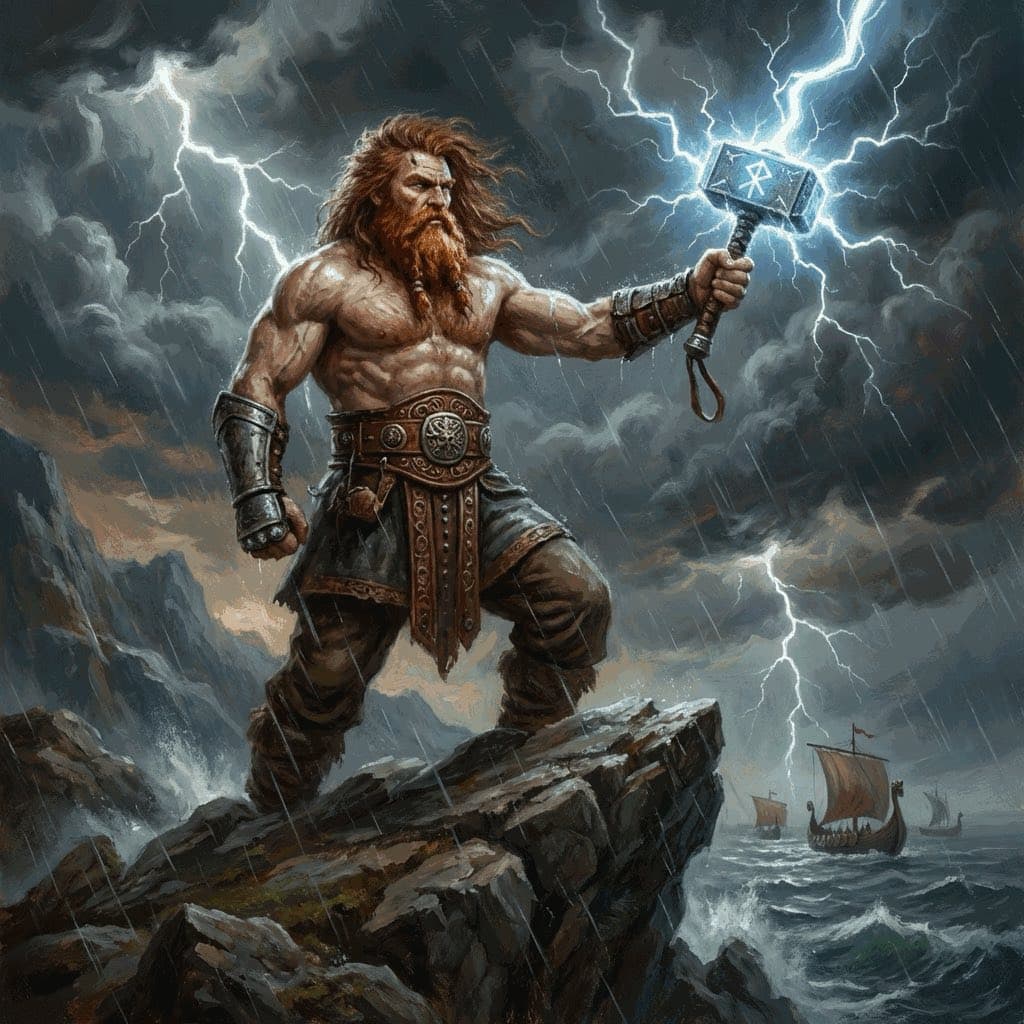 NorseThor
Both are storm-gods whose defining myth is combat with a great serpent (Illuyanka, Jörmungandr); the resemblance belongs to a widespread storm-god-versus-serpent pattern, not a shared text.
Compare Tarhunna (the Storm-god of Hatti) and Thor side by side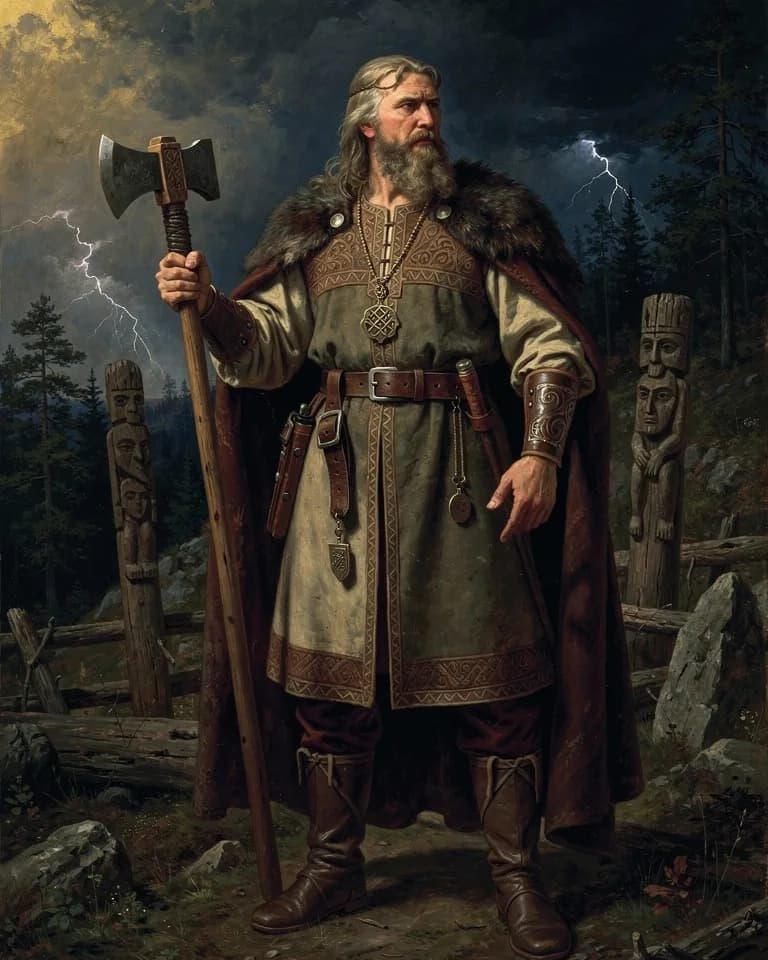 SlavicPerun
Comparative mythologists group the Illuyanka combat with the reconstructed Perun-Veles conflict as storm-god-versus-serpent myths; for Perun the combat is a scholarly reconstruction, while for the Hittite storm-god it is attested in text.
Compare Tarhunna (the Storm-god of Hatti) and Perun side by side
Worship and cult
Temples, festivals, and practices recorded for Tarhunna (the Storm-god of Hatti)
The king served as the storm-god's priest and steward, offering bread, beer, and animals at state festivals; the Illuyanka story was recited at the Purulli festival of Nerik.
Sacred sites
- Great Temple (Temple 1) at Hattusa, shared with the Sun-goddess of Arinna
- Temple of the Storm-god of Nerik at Oymaağaç Höyük
Festivals
- Purulli festival at Nerik
- AN.TAḪ.ŠUM (spring) and nuntarriyašḫa (autumn) state festivals
Family
Tarhunna (the Storm-god of Hatti)'s family at a glance
- Who are Tarhunna (the Storm-god of Hatti)'s parents?
- The atlas's kinship records name one parent of Tarhunna (the Storm-god of Hatti): Kumarbi. Ancient accounts do not always agree on divine parentage.
- Who are Tarhunna (the Storm-god of Hatti)'s children?
- Children of Tarhunna (the Storm-god of Hatti) recorded in the atlas: Telipinu.
- Who were Tarhunna (the Storm-god of Hatti)'s spouses and consorts?
- Spouses and consorts of Tarhunna (the Storm-god of Hatti) recorded in the atlas: Sun-goddess of Arinna.
- Who are Tarhunna (the Storm-god of Hatti)'s siblings?
- Siblings of Tarhunna (the Storm-god of Hatti) recorded in the atlas: Šauška.
In the atlas
Where Tarhunna (the Storm-god of Hatti) appears
Sources and further reading
Source notes
These references are recorded in the catalog. Their passage wording and translation have not been checked, so quotations are not displayed here.
- Illuyanka tales, CTH 321, trans. H. A. Hoffner Jr., Hittite Myths
- Song of Kumarbi, CTH 344, trans. H. A. Hoffner Jr., Hittite Myths
Appears in
Ancient and classical works featuring this figure.
the Storm-god, defeated and then victorious against the serpent; the Hurrian Teššub of the Kumarbi cycle (Illuyanka tales (CTH 321); Kumarbi cycle (CTH 344-348))
The Kumarbi Cycle (Song of Kumarbi, Song of Hedammu, Song of Ullikummi)
Teššub, the storm-god born from Kumarbi, who wins kingship (throughout the cycle)
Further reading
The Kumarbi Cycle (Song of Kumarbi, Song of Hedammu, Song of Ullikummi)
The Hurrian songs in which the storm-god wins kingship in heaven
Translations of the Illuyanka tales and the Kumarbi cycle
- Collins, Billie Jean. The Hittites and Their World (Society of Biblical Literature, 2007).
- Schwemer, Daniel. "The Storm-Gods of the Ancient Near East: Summary, Synthesis, Recent Studies." Journal of Ancient Near Eastern Religions 7-8 (2007-2008).
About this entry
By Elizabeth Stein for Mythos Atlas. About the author. Editorial notes are grounded in the site's cited sources and can be challenged through the contact page.
Parallels are editorial comparisons across traditions: a shared role does not, by itself, establish a shared origin.
Family relationships come from the atlas's kinship records. Ancient sources often disagree on divine genealogy.
Genealogy
Family tree
Tarhunna (the Storm-god of Hatti)'s parents, consorts, children and rivals, as recorded in the atlas.