Hittite Pantheon
Hannahanna
dḪannaḫanna (often written dNIN.TU or dMAḪ)(Ḫannaḫanna)
Also known as The Grandmother, Mother goddess
- birth
- motherhood
- wise counsel
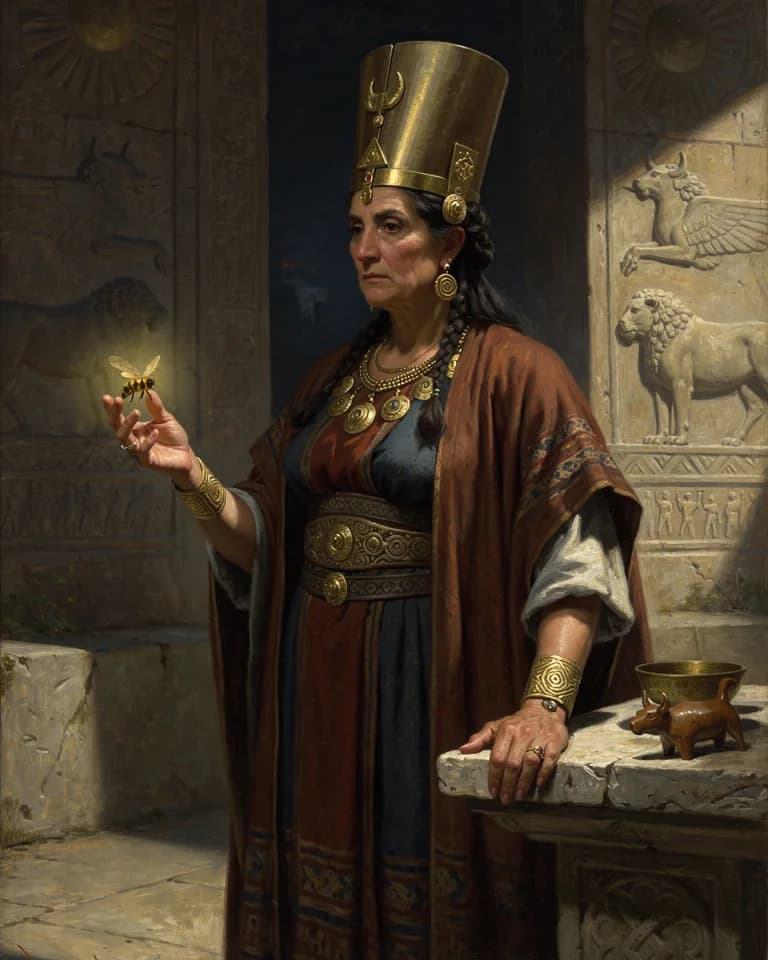
The Hittite mother goddess, 'the Grandmother', who when every other god has failed sends a bee to find the missing Telipinu.
About Hannahanna
The Grandmother
Hannahanna's name simply means "grandmother", and scribes often wrote it with Sumerian signs used for Mesopotamian birth and mother goddesses. She is a figure of wisdom and authority among the gods: in the Disappearance of Telipinu it is she who tells the Storm-god to go and look for his son, and she who, when he returns empty-handed, sends the bee.
The bee
The scene is one of the most memorable in Hittite literature. The Storm-god objects that the bee is small and its wings are small; Hannahanna sends it anyway, telling it to find Telipinu, sting his hands and feet to wake him, and smear him with wax. The bee finds him asleep in a meadow near the town of Lihzina and does exactly that, though waking Telipinu only makes him angrier, and a further ritual is needed.
A vanishing goddess herself
Like several Hittite deities, Hannahanna has her own fragmentary "disappearance" myth, in which she too departs in anger and must be brought back, again with the help of a bee. The recurrence of the bee as the messenger who finds hidden gods is one of the distinctive features of this Anatolian tradition.
Worship and cult
Temples, festivals, and practices recorded for Hannahanna
She appears in birth rituals and in the vanishing-god rituals; no major temple of hers has been identified archaeologically.
In the atlas
Where Hannahanna appears
Sources and further reading
Source notes
These references are recorded in the catalog. Their passage wording and translation have not been checked, so quotations are not displayed here.
- Disappearance of Telipinu, CTH 324, trans. H. A. Hoffner Jr., Hittite Myths
Appears in
Ancient and classical works featuring this figure.
the mother goddess who sends the bee to find Telipinu (The Disappearance of Telipinu (CTH 324))
Further reading
Includes both the Telipinu myth and the fragmentary myth of Hannahanna's own disappearance
About this entry
By Elizabeth Stein for Mythos Atlas. About the author. Editorial notes are grounded in the site's cited sources and can be challenged through the contact page.
Parallels are editorial comparisons across traditions: a shared role does not, by itself, establish a shared origin.
Genealogy
Family tree
Hannahanna's parents, consorts, children and rivals, as recorded in the atlas.