Hittite Pantheonmyth
The Disappearance of Telipinu
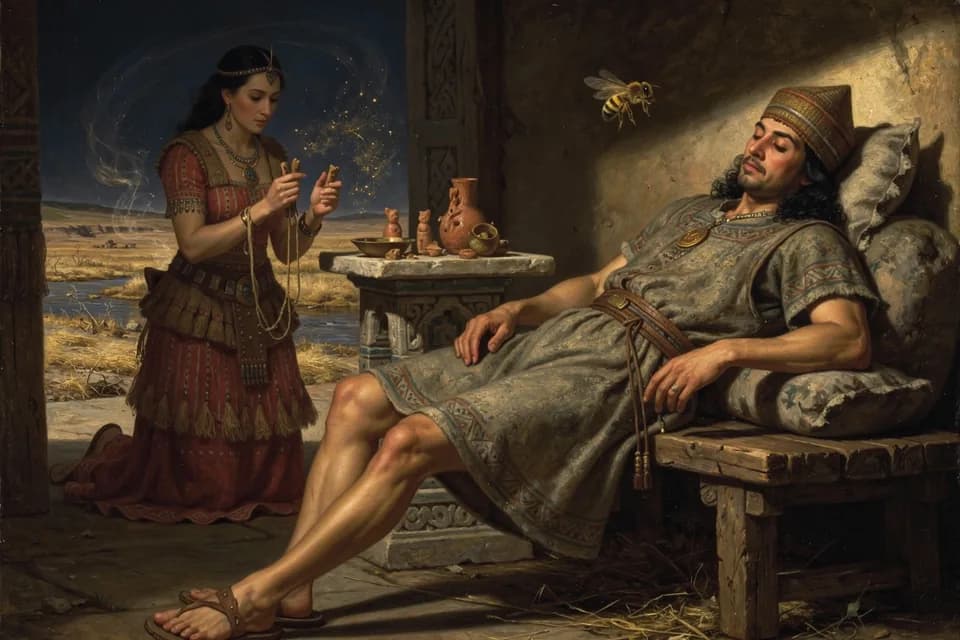
The farming god Telipinu leaves in anger and the land withers; after the gods' searches fail, Hannahanna's bee finds him asleep, and the goddess Kamrušepa's ritual locks his rage away in the Dark Earth.
An editorial retelling
The story
A myth used as a ritual
The Disappearance of Telipinu (CTH 324) is the best preserved of several Hittite "vanishing god" texts. It is Anatolian in origin and written in Hittite; its god, Telipinu, was originally Hattian. It survives not as literature for its own sake but as the narrative part of an invocation ritual meant to bring an angry god home and restore the land's fertility. The beginning of the text is damaged.
The god walks out
Telipinu became angry; the reason is lost in the damaged opening. In his rage he put his right shoe on his left foot and his left shoe on his right, and he left. Mist seized the windows, smoke seized the house. On the hearth the logs were stifled; on the altars the gods were stifled; in the fold the sheep were stifled, and in the pen the cattle. The sheep refused her lamb and the cow refused her calf. Telipinu went off and took with him grain, the fertility of the herds, growth and plenty, into the steppe and the meadow, and lay down in a meadow, where he was overcome with sleep.
Barley and wheat no longer grew. Cattle, sheep, and people no longer conceived, and those already pregnant could not give birth. The mountains and trees dried up, the springs dried up, and famine came to the land. Gods and people alike were dying of hunger.
The search
The great Sun-god gave a feast and invited the thousand gods, but they ate and were not satisfied, drank and did not quench their thirst. The Storm-god realised that his son Telipinu was gone, and the gods began to search. The Sun-god sent out the swift eagle to look over the high mountains, the deep valleys, and the dark waters; the eagle came back without finding him. The Storm-god then spoke to Hannahanna, the Grandmother, who told him to go and look himself. He went to Telipinu's city and knocked at the gate, but he could not find him either, and he sat down to rest.
The bee
Hannahanna then sent a bee. The Storm-god objected that the bee was small and its wings were small, and that the great gods had already searched in vain. But Hannahanna told the bee to find Telipinu, sting his hands and feet to make him stand up, and wipe his eyes and feet with wax to purify him, and then bring him back. The bee searched the high mountains, the deep valleys, and the dark waters, until at last it found Telipinu asleep in a meadow in the grove of Lihzina. It stung his hands and feet, and he got up.
Worse before better
Waking only made Telipinu angrier. He complained that he had been sleeping in his rage and that they had woken him and forced him to speak, and in his fury he began to destroy the land, flooding rivers and knocking down houses. So the gods turned to Kamrušepa, the goddess of magic, and a ritual began: the anger, rage, and sullenness of Telipinu were drawn out and taken away. The doorkeeper of the Dark Earth opened the seven doors and drew back the seven bolts, and down in the Dark Earth stood bronze vessels with lids of lead. Whatever goes into them does not come back out; it perishes there. So Telipinu's anger was shut away.
Home again
Telipinu came back to his house and cared once more for his land. The mist left the windows and the smoke left the house; the altars and the hearth were restored; the sheep took back her lamb and the cow her calf. Before Telipinu stood an evergreen eya tree, and from it hung a hunting bag of sheep's fleece holding sheep fat, grain, wine, cattle and sheep, and long life and offspring.
What the story shows
The text lets us see how Hittites thought about blight and famine: as the absence of a god whose presence keeps life going, which could be repaired by finding, soothing, and honouring him. The ritual words that follow the story were meant to do exactly that for a real community in a real bad year.
Listen or change reading mode
Highlights
Telipinu storms off with his shoes on the wrong feet; the land withers, the eagle and the Storm-god fail to find him, and only Hannahanna's small bee succeeds, before Kamrušepa's rite locks his anger in bronze vessels in the Dark Earth.
Why it matters
The best preserved Hittite vanishing-god myth, embedded in a ritual meant for use in real crises of blight or famine; its evergreen tree hung with a fleece reflects actual Hittite cult practice.
Other versions
1 alternate account in the catalog.
Other Hittite vanishing-god texts (CTH 323-336)
Similar stories are told of the Storm-god, the Sun-god, Hannahanna, and other deities; in several of them the bee again finds the missing god.
Note: Telipinu's is the best preserved example of a recurring Anatolian ritual pattern.
Sources and further reading
By Elizabeth Stein for Mythos Atlas. About the author. Editorial notes are grounded in the site's cited sources and can be challenged through the contact page.
Works cited
Hittite Myths (2nd ed., SBL Writings from the Ancient World 2)
Harry A. Hoffner Jr. (translator) · The Disappearance of Telipinu, CTH 324
The Wrath of Telipinu
Gary Beckman, in The Context of Scripture vol. 1 (ed. W. W. Hallo)
Further reading
The Telipinu text and the other vanishing-god myths