Hittite PantheonCity
Hattusa
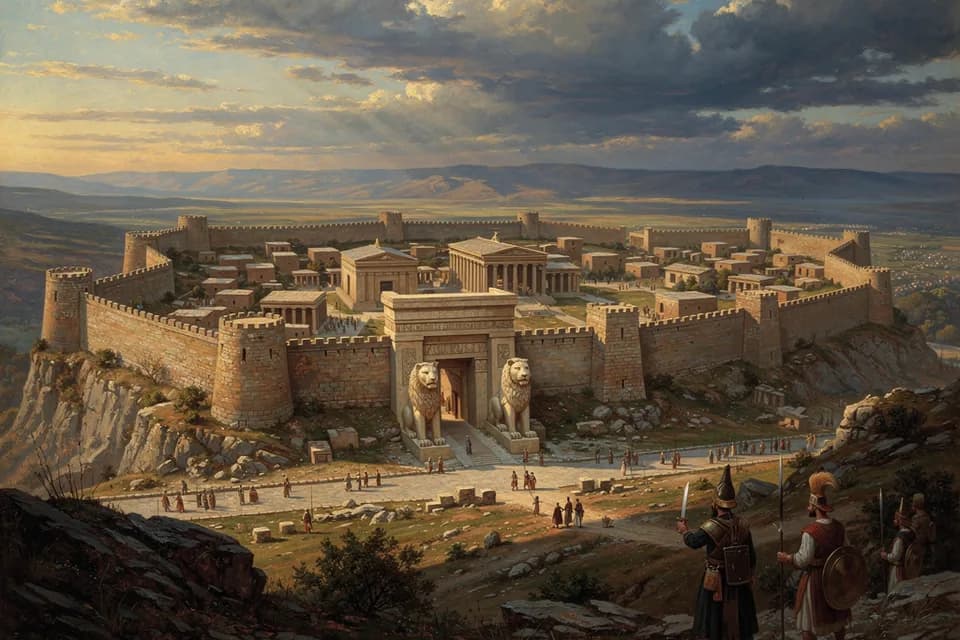
The Hittite capital near modern Boğazkale in central Türkiye, whose temple archives preserved almost every Hittite myth known today.
About Hattusa
Capital and archive
Hattusa was the capital of the Hittite kingdom for most of its history, from the reign of Hattusili I in the seventeenth century BCE until the city was abandoned around 1180 BCE. Its ruins, near the village of Boğazkale (formerly Boğazköy) in Çorum Province, include massive fortification walls, gates carved with lions and sphinxes, and dozens of temples. The site is a UNESCO World Heritage Site.
Where the myths were found
German excavations beginning in 1906 recovered tens of thousands of clay tablet fragments from the temples and palace archives. Among them were treaties, prayers, festival texts, and the mythological texts on this site: the Illuyanka tales, the Disappearance of Telipinu, and the Hittite translations of the Hurrian Kumarbi cycle. It was on the basis of these tablets that Bedřich Hrozný identified Hittite as an Indo-European language in 1915.
The Great Temple
The largest temple in the lower city, often called Temple 1, is generally thought to have been dedicated to the Storm-god of Hatti and the Sun-goddess of Arinna, the two chief deities of the state. Its storerooms held large numbers of tablets and storage vessels.
On the map
Hattusa among other places of the Hittite Pantheon.
Sources and further reading
Source notes
These references are recorded in the catalog. Their passage wording and translation have not been checked, so quotations are not displayed here.
- H. A. Hoffner Jr., Hittite Myths (introduction and text notes)
About this entry
By Elizabeth Stein for Mythos Atlas. About the author. Editorial notes are grounded in the site's cited sources and can be challenged through the contact page.
Coordinates mark where the myths place a site, or where the tradition locates it today. Mythic realms are left off the map or marked as symbolic placements.