Hittite PantheonSacred Site
Yazılıkaya
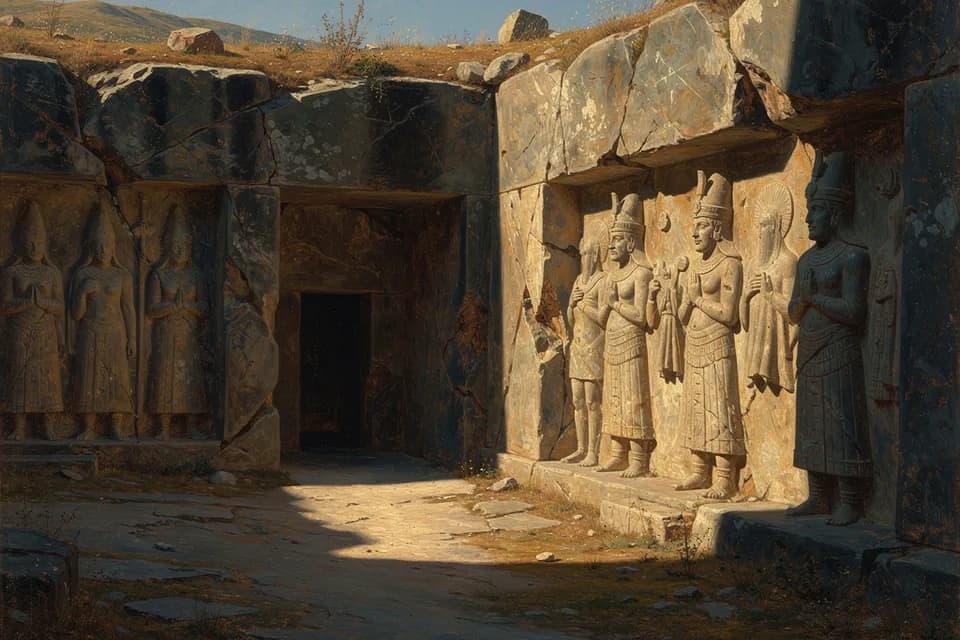
An open-air rock sanctuary just outside Hattusa whose carved procession of gods and goddesses, labelled in Hieroglyphic Luwian, shows the Hurrian-influenced pantheon of the thirteenth century BCE.
About Yazılıkaya
A gallery of the gods
Yazılıkaya ("inscribed rock" in Turkish) is a natural rock sanctuary about a kilometre and a half northeast of Hattusa. In its main chamber, reliefs carved mostly in the thirteenth century BCE show two processions converging on the back wall: gods on the left and goddesses on the right, each labelled with a name in Hieroglyphic Luwian.
The meeting of Teššub and Hebat
At the centre, the storm-god Teššub, standing on two mountain-gods, faces the goddess Hebat, who stands on a panther; behind her comes their son Šarruma. The names are Hurrian, reflecting the Hurrian theology promoted by the royal family in the thirteenth century, and the procession is often compared with the Hurrian offering lists (kaluti) that rank gods in the same order. Šauška appears on both sides of the procession.
King Tudhaliya IV
A large relief shows King Tudhaliya IV, who is usually credited with the sanctuary's final form, and a smaller chamber holds a relief of Šarruma embracing the king, along with the enigmatic "sword god". The sanctuary may have been used for the spring festival; its exact function is still debated.
On the map
Yazılıkaya among other places of the Hittite Pantheon.
Sources and further reading
Source notes
These references are recorded in the catalog. Their passage wording and translation have not been checked, so quotations are not displayed here.
- E. Laroche, 'Le panthéon de Yazılıkaya', Journal of Cuneiform Studies 6
About this entry
By Elizabeth Stein for Mythos Atlas. About the author. Editorial notes are grounded in the site's cited sources and can be challenged through the contact page.
Coordinates mark where the myths place a site, or where the tradition locates it today. Mythic realms are left off the map or marked as symbolic placements.