Hittite Pantheon
Kumarbi
dKumarbi(Kumarbi)
Also known as Father of the gods (Hurrian)
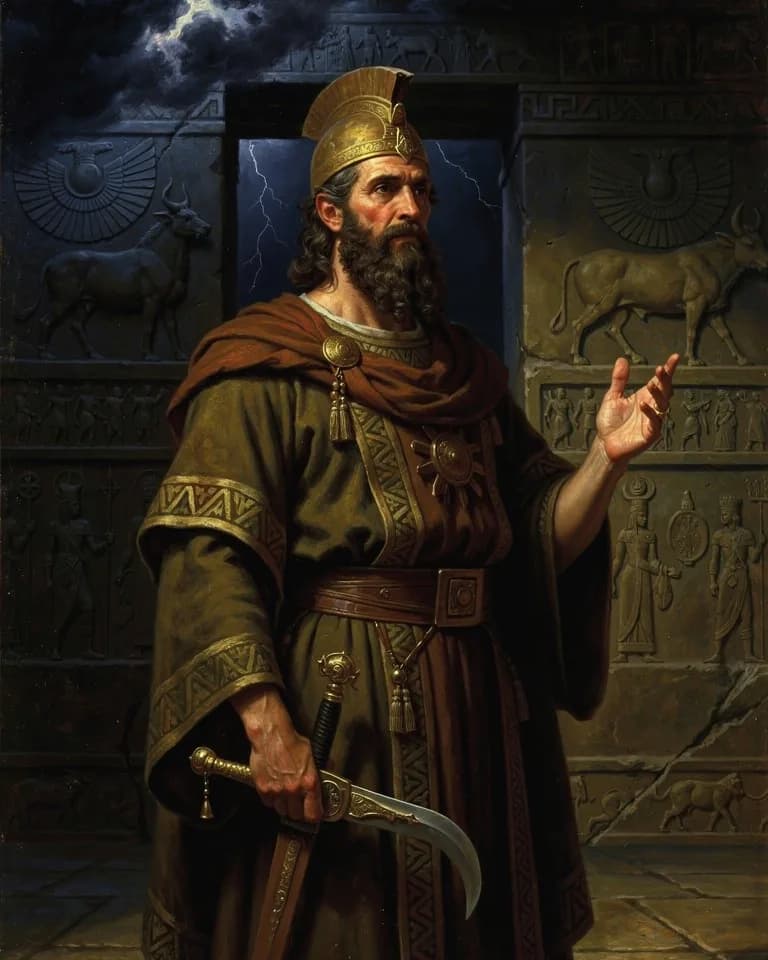
- the older order of gods
- grain
- kingship in heaven
Hurrian father of the gods who seizes kingship in heaven by biting off the sky-god Anu's loins, unwittingly conceives the storm-god Teššub, and spends the rest of the Kumarbi cycle fathering monsters to overthrow him.
About Kumarbi
A Hurrian god in Hittite translation
Kumarbi belongs to the Hurrian pantheon of northern Syria and Upper Mesopotamia. His city was Urkeš (modern Tell Mozan in northeastern Syria), one of the oldest Hurrian centres, and he was equated in god-lists with the Mesopotamian grain-god Dagan and with Enlil. Everything known of his mythology comes from Hurrian songs preserved mainly in Hittite translation at Hattusa: the Song of Kumarbi (CTH 344), the Song of Hedammu (CTH 348), and the Song of Ullikummi (CTH 345).
Kingship in heaven
In the Song of Kumarbi, kingship in heaven passes through three generations. Alalu reigns nine years until his cup-bearer Anu, the sky, overthrows him; Anu reigns nine years until his cup-bearer Kumarbi, described as the offspring of Alalu, rebels. Kumarbi chases Anu into the sky, drags him down by the feet, and bites off his loins; Anu warns him that he has swallowed the seed of three powerful gods, among them the storm-god. Kumarbi spits out what he can but remains pregnant, and the storm-god is eventually born out of his body. The text is badly broken at this point; it appears that Kumarbi tries to devour the child and is given a stone instead, an episode widely compared with Rhea's stone in Hesiod.
The plotter
In the later songs Kumarbi, deposed, keeps plotting: he marries the daughter of the Sea and fathers the sea-serpent Hedammu, and he fathers the basalt giant Ullikummi on a great rock, sending both against Teššub. Neither succeeds. He is not presented as simply evil; he is the displaced older king of an older order, and the songs follow his schemes with some sympathy.
Across traditions
Parallel figures
Figures who play a role like Kumarbi's in other traditions.
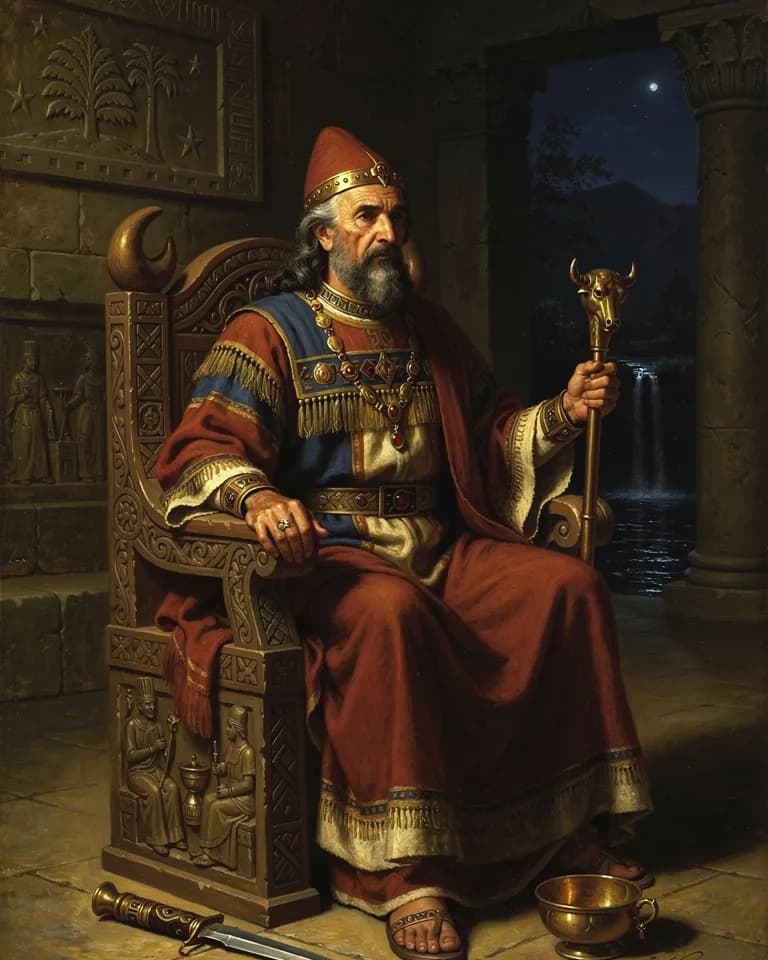 CanaaniteEl (Ilu)
Ugaritic multilingual god-lists equate Kumarbi with El, the aged father of the gods.
Compare Kumarbi and El (Ilu) side by side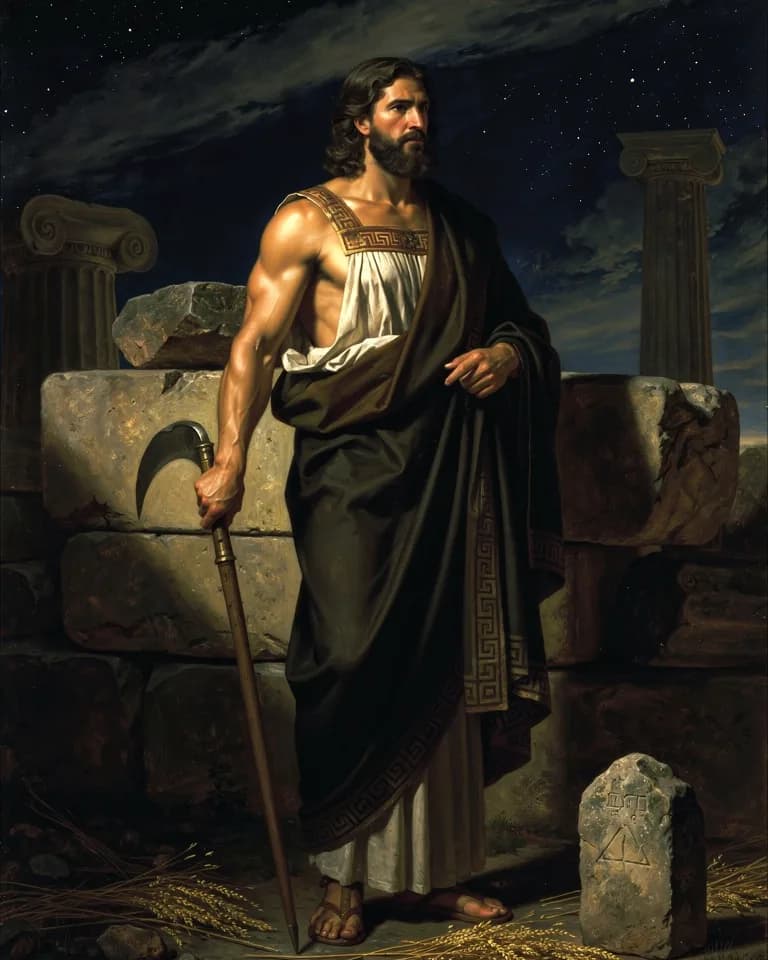 GreekCronus
Both are second-generation sky-kings who mutilate their predecessor, swallow what they should not, and are displaced by a storm-god; Güterbock's 1948 study made this the best-known Near Eastern parallel to Hesiod.
Compare Kumarbi and Cronus side by side
Worship and cult
Temples, festivals, and practices recorded for Kumarbi
Kumarbi received offerings in Hurrian cult lists (kaluti) alongside other gods of the Hurrian pantheon; he is far more prominent in myth than in recorded Hittite state ritual.
Sacred sites
- Urkeš (Tell Mozan), his traditional Hurrian cult city
Family
Kumarbi's family at a glance
- Who are Kumarbi's parents?
- The atlas's kinship records name one parent of Kumarbi: Alalu. Ancient accounts do not always agree on divine parentage.
- Who are Kumarbi's children?
- Children of Kumarbi recorded in the atlas: Tarhunna (the Storm-god of Hatti).
In the atlas
Where Kumarbi appears
Sources and further reading
Source notes
These references are recorded in the catalog. Their passage wording and translation have not been checked, so quotations are not displayed here.
- Song of Kumarbi, CTH 344, trans. H. A. Hoffner Jr., Hittite Myths
- Song of Ullikummi, CTH 345, trans. H. A. Hoffner Jr., Hittite Myths
Appears in
Ancient and classical works featuring this figure.
The Kumarbi Cycle (Song of Kumarbi, Song of Hedammu, Song of Ullikummi)
father of the gods, who seizes kingship from Anu and plots against Teššub (Song of Kumarbi (CTH 344); Song of Ullikummi (CTH 345))
Further reading
The Kumarbi Cycle (Song of Kumarbi, Song of Hedammu, Song of Ullikummi)
The songs in which Kumarbi seizes and loses kingship in heaven
- Güterbock, Hans G. "The Hittite Version of the Hurrian Kumarbi Myths: Oriental Forerunners of Hesiod." American Journal of Archaeology 52 (1948).
- López-Ruiz, Carolina. When the Gods Were Born: Greek Cosmogonies and the Near East (Harvard University Press, 2010).
About this entry
By Elizabeth Stein for Mythos Atlas. About the author. Editorial notes are grounded in the site's cited sources and can be challenged through the contact page.
Parallels are editorial comparisons across traditions: a shared role does not, by itself, establish a shared origin.
Family relationships come from the atlas's kinship records. Ancient sources often disagree on divine genealogy.
Genealogy
Family tree
Kumarbi's parents, consorts, children and rivals, as recorded in the atlas.