Hittite Pantheon
Alalu
dAlalu(Alalu)
Also known as Alalus
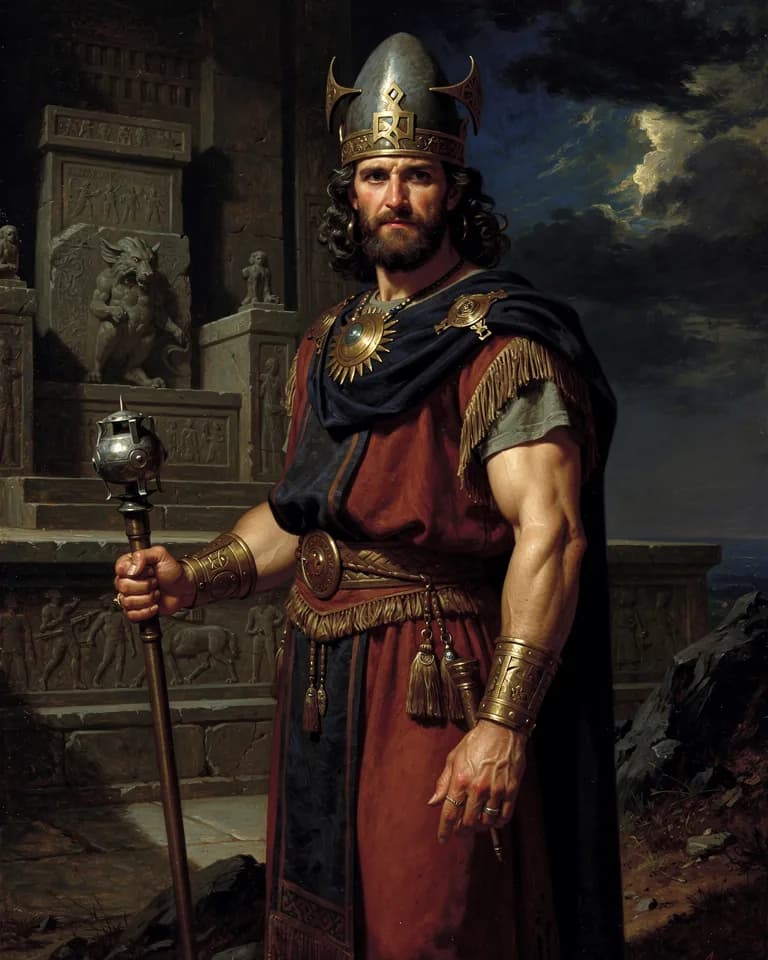
- the first kingship in heaven
- the Former Gods
The first king in heaven in the Hurrian Song of Kumarbi, overthrown by his cup-bearer Anu after nine years and driven down to the Dark Earth; Kumarbi is called his offspring.
About Alalu
The first king
The Song of Kumarbi opens by calling on the Former Gods to listen, and then tells how, in earlier years, Alalu was king in heaven. Anu, the mightiest of the gods, served him as cup-bearer, bowing at his feet and handing him his drink. After nine years Anu rebelled and defeated him, and Alalu fled down to the Dark Earth.
Father of the plotter
Kumarbi, who later overthrows Anu, is described as Alalu's offspring, so the struggle for kingship in heaven becomes a feud between two lineages: Alalu and his descendant Kumarbi on one side, Anu and the storm-god conceived from his seed on the other. Alalu himself plays no further part in the surviving text.
Among the Former Gods
Alalu belongs to the group Hittite texts call the Former Gods (karuileš šiuneš), primeval deities who were banished to the underworld and who are invoked in rituals as a group. The idea of a whole older generation of gods deposed and confined below the earth is another point of contact with the Greek Titans, but Alalu himself has no clear Greek equivalent.
Family
In the atlas
Where Alalu appears
Sources and further reading
Source notes
These references are recorded in the catalog. Their passage wording and translation have not been checked, so quotations are not displayed here.
- Song of Kumarbi, CTH 344, trans. H. A. Hoffner Jr., Hittite Myths
Appears in
Ancient and classical works featuring this figure.
The Kumarbi Cycle (Song of Kumarbi, Song of Hedammu, Song of Ullikummi)
the first king in heaven, overthrown by Anu (Song of Kumarbi (CTH 344), opening)
Further reading
The Kumarbi Cycle (Song of Kumarbi, Song of Hedammu, Song of Ullikummi)
The opening of the Song of Kumarbi
About this entry
By Elizabeth Stein for Mythos Atlas. About the author. Editorial notes are grounded in the site's cited sources and can be challenged through the contact page.
Parallels are editorial comparisons across traditions: a shared role does not, by itself, establish a shared origin.
Family relationships come from the atlas's kinship records. Ancient sources often disagree on divine genealogy.
Genealogy
Family tree
Alalu's parents, consorts, children and rivals, as recorded in the atlas.