Hittite Pantheoncosmology
The Song of Kumarbi: Kingship in Heaven
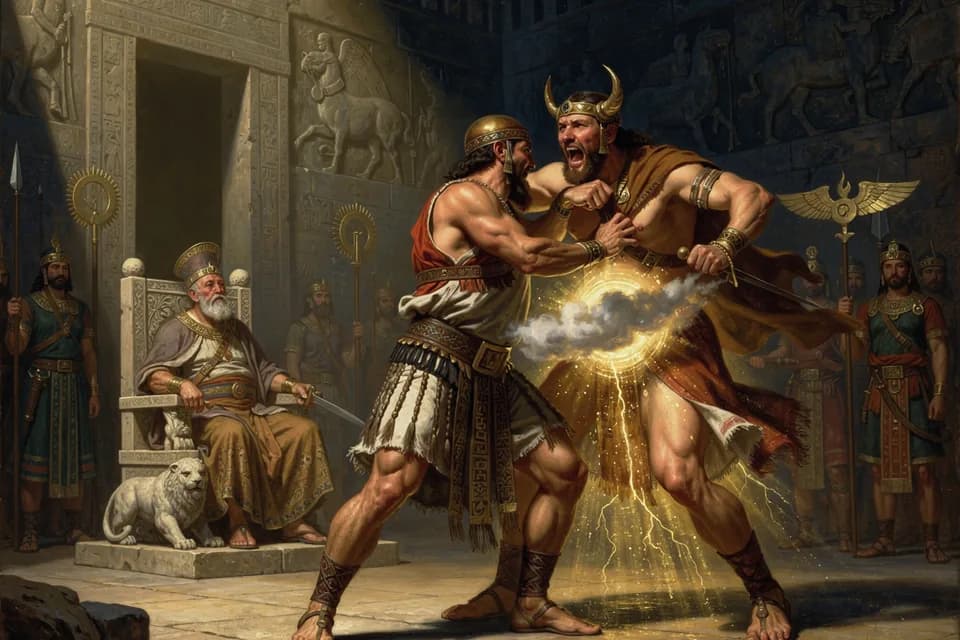
A Hurrian song, preserved in Hittite translation, in which kingship in heaven passes from Alalu to Anu to Kumarbi, who bites off Anu's loins and finds himself pregnant with the storm-god who will overthrow him.
An editorial retelling
The story
A Hurrian song, not a Hittite one
This story comes from the Song of Kumarbi (CTH 344), the opening song of a Hurrian cycle about kingship among the gods. It survives in Hittite translation on tablets from Hattusa; its gods (Kumarbi, Teššub, Tašmišu) and places (Urkeš, the Hurrian cities of the east) are Hurrian, not native Hittite. The tablets are badly damaged, and the second half of the story in particular is full of gaps. What follows keeps close to Hoffner's translation and says so where the text is broken.
Nine years, and nine years
The singer calls on the Former Gods, the primeval deities of the underworld, to listen. Long ago, Alalu was king in heaven. Anu, the mightiest of the gods, served him as cup-bearer, bowing at his feet and putting the drinking cup in his hand. For nine years Alalu reigned. In the ninth year Anu went to war against him, defeated him, and Alalu fled down to the Dark Earth. Anu took the throne, and now Kumarbi, the offspring of Alalu, served Anu as cup-bearer, bowing at his feet in turn.
For nine years Anu reigned. In the ninth year Kumarbi rose against him. Anu could not withstand him; he slipped from Kumarbi's grasp and fled upward into the sky like a bird. Kumarbi rushed after him, seized him by the feet, and dragged him down from the sky. Then he bit off Anu's loins, and Anu's manhood went into Kumarbi's insides.
Anu's warning
Kumarbi rejoiced and laughed, but Anu turned to him and told him not to celebrate. By swallowing his manhood, Anu said, Kumarbi had become pregnant with a heavy burden: the Storm-god, the river Aranzah (the Tigris), and the god Tašmišu. Kumarbi, alarmed, spat out what he could; the text says that some of what he spat fell on a mountain, Kanzura, and grew there. Anu went back up to the sky, and Kumarbi went away to the city of Nippur.
The difficult birth
The following columns are the most broken part of the song. They seem to describe the gods inside Kumarbi discussing how to get out of him, and the problem of which part of his body they could leave through. At one point Kumarbi asks to be given his child to eat, and is given a stone instead, which hurts his teeth; the stone is then set up as an object of worship. The Storm-god is eventually born, and the song seems to have gone on to describe his coming to power, but the details are lost.
What the story does
The song explains how the storm-god Teššub came to rule the gods: not as the son of the reigning king, but as a child carried by his father's enemy, born out of that enemy's body, and destined to take his throne. The pattern of succession (a first king overthrown by his cup-bearer, who is overthrown in turn, until a storm-god rules) sets up the conflict of the rest of the cycle, in which the deposed Kumarbi fathers monsters to take kingship back.
The Hesiod question
When the Hittite tablets were first published, scholars immediately noticed how closely this story resembles Hesiod's Theogony, composed centuries later in Greece: the succession of sky-kings, the mutilation of the sky-god, the swallowing, and the stone given in place of a child. Hans Güterbock's 1948 study made the comparison famous, and most scholars now accept that some version of this Near Eastern succession myth reached early Greek poets, probably through Syria and the eastern Mediterranean. The two stories are not the same, however: Kumarbi swallows Anu's seed, not his own children, and the stone episode belongs to a different moment. This site keeps them apart as related but distinct traditions.
Listen or change reading mode
Highlights
Alalu reigns in heaven until Anu overthrows him; Anu reigns until Kumarbi drags him from the sky and bites off his loins, becoming pregnant with the Storm-god who will one day take his throne.
Why it matters
The central succession myth of the Hurrian pantheon as the Hittites received it, and the closest known Near Eastern parallel to Hesiod's Theogony; its discovery reshaped the study of early Greek myth.
Other versions
1 alternate account in the catalog.
Hesiod, Theogony
In Hesiod the succession runs Ouranos, Kronos, Zeus; Kronos castrates Ouranos with a sickle and swallows his own children, and Rhea gives him a stone in place of Zeus.
Note: Related but distinct: the Hurrian song has Kumarbi swallow Anu's seed and bear the storm-god himself.
Sources and further reading
By Elizabeth Stein for Mythos Atlas. About the author. Editorial notes are grounded in the site's cited sources and can be challenged through the contact page.
Works cited
Song of Kumarbi (CTH 344)
Hurrian composition in Hittite translation · Song of Kumarbi, CTH 344
Hittite Myths (2nd ed., SBL Writings from the Ancient World 2)
Harry A. Hoffner Jr. (translator) · The Song of Kumarbi
The Hittite Version of the Hurrian Kumarbi Myths: Oriental Forerunners of Hesiod
Hans G. Güterbock, American Journal of Archaeology 52
Further reading
The Kumarbi Cycle (Song of Kumarbi, Song of Hedammu, Song of Ullikummi)
The whole Hurrian cycle in Hittite translation
The Greek succession myth for comparison
Read online: Theogony (opens in new tab)Hoffner's translation, with gaps marked