Hittite Pantheon
Sun-goddess of Arinna
dUTU URUArinna(Arinnitti (reading uncertain); Hattian Wurunšemu)
Also known as Wurunšemu (Hattian), Arinnitti, Hebat (by royal equation)
- the sun
- kingship
- the protection of the Hittite state
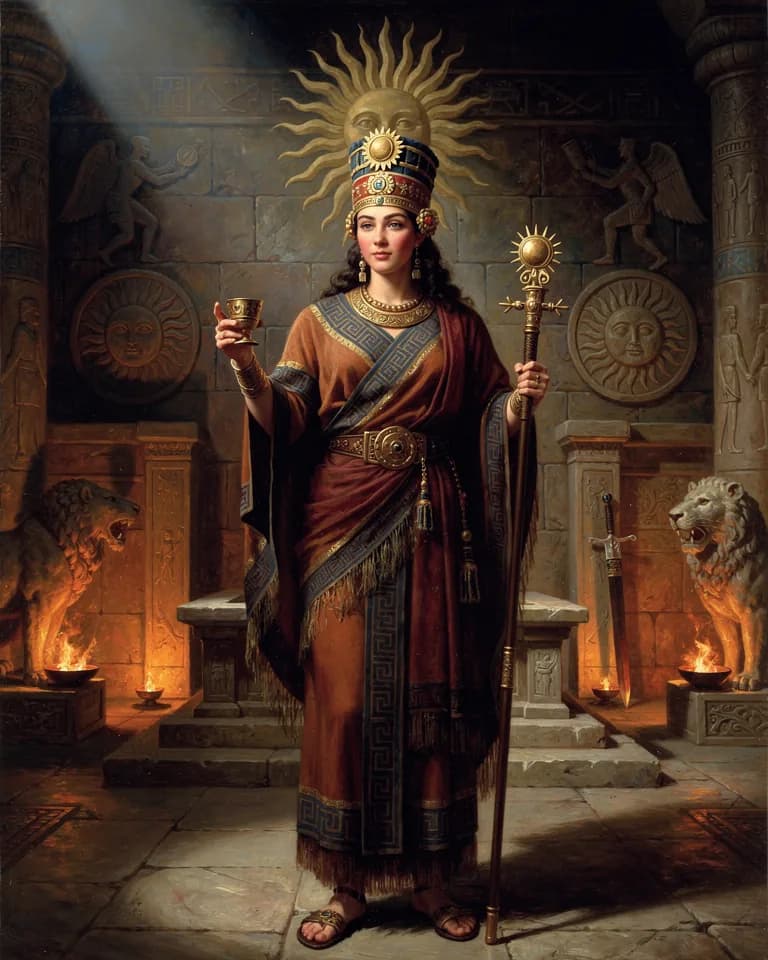
The Hattian sun-goddess of the holy city of Arinna, queen of the land of Hatti and, with the Storm-god, the highest deity of the Hittite state cult; Queen Puduhepa's prayer equates her with the Hurrian goddess Hebat.
About Sun-goddess of Arinna
Queen of the land of Hatti
The Sun-goddess of Arinna was a Hattian deity (her Hattian name was Wurunšemu) whom the Hittite kings made one of the two heads of their state religion. Royal prayers address her as the queen of the land of Hatti, and kings described the land and kingship as belonging to her and the Storm-god, who was regarded as her husband. Her holy city, Arinna, lay within a day's journey of Hattusa, but its site has never been securely identified; this site therefore does not give it a map location.
Hebat of the cedar land
In a well-known prayer (CTH 384), Queen Puduhepa, the Hurrian-born wife of King Hattusili III in the thirteenth century BCE, tells the goddess that in the land of Hatti she took the name Sun-goddess of Arinna, while in the land of cedars she took the name Hebat (paraphrase). The prayer is a deliberate theological equation by a Hurrian queen, bringing her native goddess, Teššub's consort, into line with the goddess of the Hittite state cult; it is evidence of how the pantheon was merged, not proof that the two goddesses were originally one.
Not the only sun deity
Hittite religion distinguished several solar deities: the Sun-goddess of Arinna; the male Sun-god of Heaven (Ištanu, Hurrian Šimige), who plays a role in myths such as the Disappearance of Telipinu; and the Sun-goddess of the Earth, an underworld goddess. This site keeps them apart, following the texts.
Across traditions
Parallel figures
Figures who play a role like Sun-goddess of Arinna's in other traditions.
 JapaneseAmaterasu
Both are female sun deities at the head of a royal state cult; the traditions are historically unrelated, and the comparison is typological only.
Compare Sun-goddess of Arinna and Amaterasu side by side
Worship and cult
Temples, festivals, and practices recorded for Sun-goddess of Arinna
Kings and queens addressed her in written prayers in times of plague and crisis, and royal journeys to Arinna were part of the great state festivals.
Sacred sites
- Temple at Arinna (site unidentified)
- Great Temple at Hattusa, shared with the Storm-god
Festivals
- Royal festival visits to Arinna during the AN.TAḪ.ŠUM spring festival
Family
Sun-goddess of Arinna's family at a glance
- Who were Sun-goddess of Arinna's spouses and consorts?
- Spouses and consorts of Sun-goddess of Arinna recorded in the atlas: Tarhunna (the Storm-god of Hatti).
Sources and further reading
Source notes
These references are recorded in the catalog. Their passage wording and translation have not been checked, so quotations are not displayed here.
- Prayer of Puduhepa to the Sun-goddess of Arinna, CTH 384, trans. I. Singer, Hittite Prayers
Further reading
- Singer, Itamar. Hittite Prayers (Society of Biblical Literature, 2002), prayers of Muršili II and Puduhepa.
About this entry
By Elizabeth Stein for Mythos Atlas. About the author. Editorial notes are grounded in the site's cited sources and can be challenged through the contact page.
Parallels are editorial comparisons across traditions: a shared role does not, by itself, establish a shared origin.
Family relationships come from the atlas's kinship records. Ancient sources often disagree on divine genealogy.
Genealogy
Family tree
Sun-goddess of Arinna's parents, consorts, children and rivals, as recorded in the atlas.