Hittite Pantheon
Kamrušepa
dKamrušepa(Kamrušepa)
Also known as Kamrusepa, Katahzipuri (Hattian counterpart)
- magic
- healing
- ritual purification
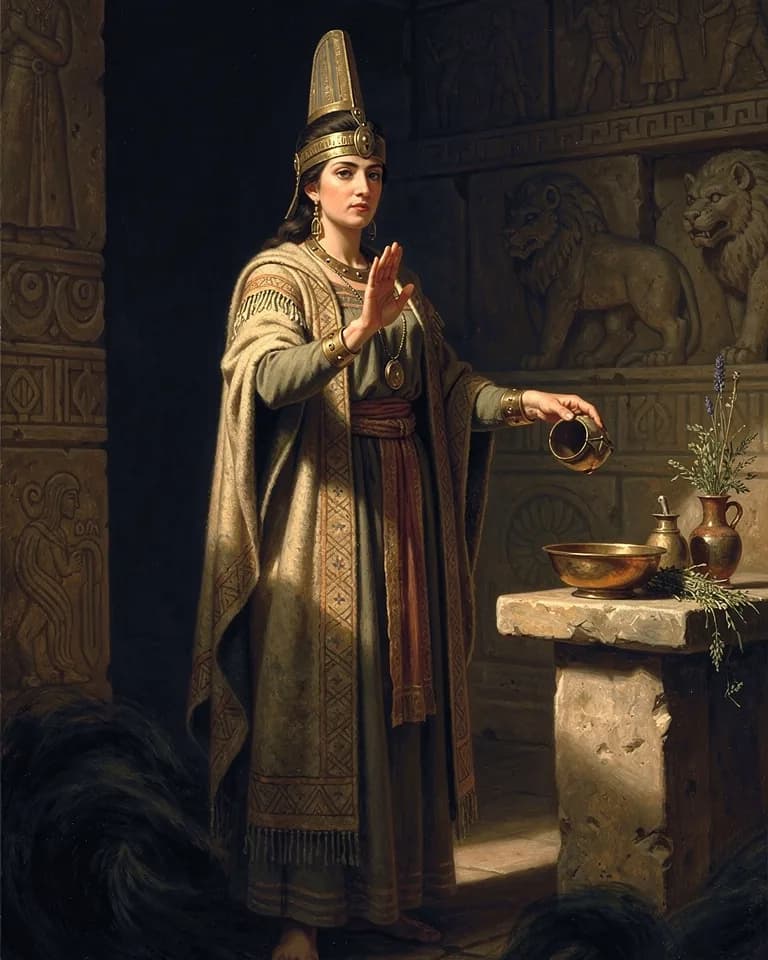
Goddess of magic and healing rites, who in the Telipinu myth performs the ritual that draws out the angry god's rage and sends it to the Dark Earth.
About Kamrušepa
The divine ritual expert
Kamrušepa is the goddess of magic in the Hittite texts, the divine model for human ritual practitioners. In incantations the healer often describes a problem and then says what Kamrušepa did about it, so that the human rite repeats a divine precedent. Her Hattian counterpart is Katahzipuri.
Soothing Telipinu
In the Disappearance of Telipinu, waking the god by the bee's sting only makes his anger worse, and he begins to destroy the land. The gods then turn to Kamrušepa, who performs a purification: she takes away his anger, rage, and sullenness, and the ritual sends them down to the Dark Earth, where they are locked in bronze vessels with lids of lead so that they cannot return. The text alternates between her actions and the words of a mortal ritualist, which shows how the myth was used: the human performer repeats what the goddess once did.
Other texts
Kamrušepa also appears in Luwian incantations and in rituals for healing people and animals; she is associated with the Sun-god and with the gate of the gods. She is known almost entirely from ritual literature, not from temples or state festivals.
In the atlas
Where Kamrušepa appears
Sources and further reading
Source notes
These references are recorded in the catalog. Their passage wording and translation have not been checked, so quotations are not displayed here.
- Disappearance of Telipinu, CTH 324, trans. H. A. Hoffner Jr., Hittite Myths
Appears in
Ancient and classical works featuring this figure.
performs the rite that soothes Telipinu's anger (The Disappearance of Telipinu (CTH 324))
Further reading
Kamrušepa's role in the Telipinu ritual
About this entry
By Elizabeth Stein for Mythos Atlas. About the author. Editorial notes are grounded in the site's cited sources and can be challenged through the contact page.
Parallels are editorial comparisons across traditions: a shared role does not, by itself, establish a shared origin.
Genealogy
Family tree
Kamrušepa's parents, consorts, children and rivals, as recorded in the atlas.