Canaanite Pantheon (Ugarit)
Baal (Baʿlu Haddu)
bʿl hd(Baʿlu Haddu)
Also known as Hadad, Haddu, Aliyan Baal (Mightiest Baal), Rider of the Clouds, Baal Zaphon
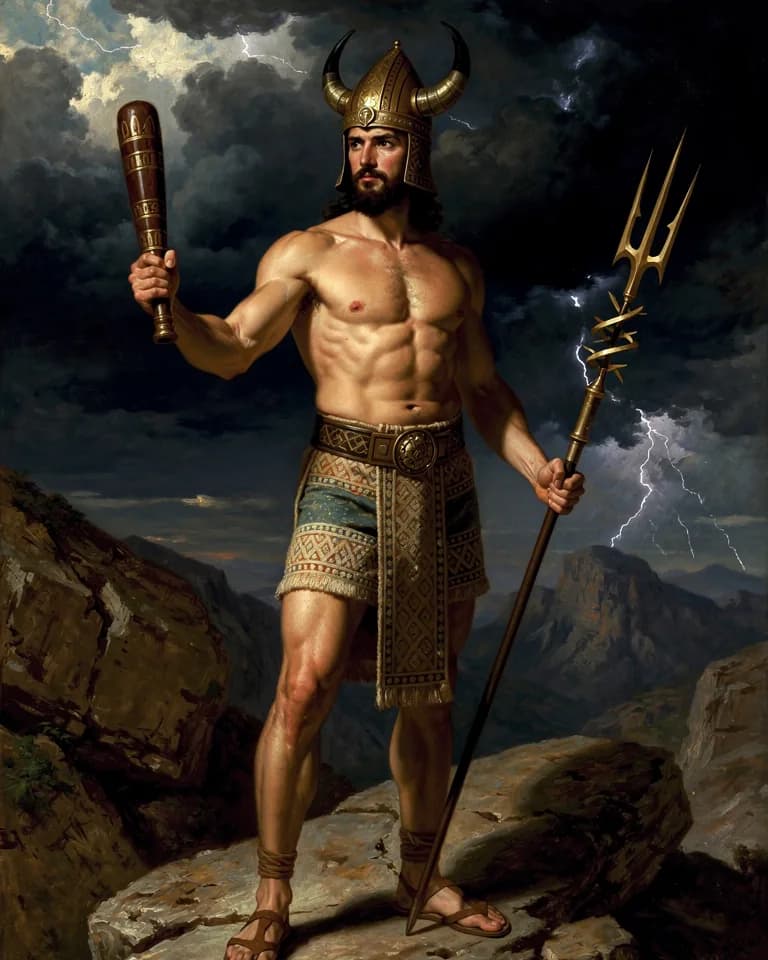
- storms
- rain
- fertility
- kingship among the gods
The storm-god of Ugarit, 'Rider of the Clouds', whose rain makes the land fertile; he defeats Yamm the Sea, builds his palace on Mount Zaphon, is swallowed by Mot (Death), and returns to life.
About Baal (Baʿlu Haddu)
Lord Haddu
Baal is a title, "lord", and at Ugarit it belongs above all to the storm-god whose personal name was Haddu (Hadad). He is "Mightiest Baal" (aliyn bʿl) and "Rider of the Clouds" (rkb ʿrpt), and his voice is the thunder. Ugaritic texts call him the son of Dagan, a grain-god worshipped along the middle Euphrates, even though he lives among El's family; the tension between those two statements has never been fully explained. His home is Mount Zaphon (Ṣapānu), the mountain north of Ugarit now called Jebel Aqra, and one of the two great temples on Ugarit's acropolis is generally identified as his.
The Baal Cycle
Baal's story is told in the six tablets of the Baal Cycle (KTU 1.1-1.6). He defeats Yamm, the Sea, who had been granted kingship by El, using two clubs made by the craftsman Kothar-wa-Khasis. He then campaigns, with the help of Anat and Athirat, for a palace of his own, and when it is built on Zaphon he gives his thunder voice through a window in the clouds. Finally he challenges Mot, Death, and is swallowed; the earth dries up until Anat destroys Mot and El dreams that Baal lives. After seven years Baal and Mot fight again, and Mot yields.
Rain and the agricultural year
Many scholars have read Baal's death and return as reflecting the eastern Mediterranean year, with its dry summer and rainy winter. The texts support a link between Baal and rain (his absence dries the furrows) but do not state that the cycle was performed annually, and this site presents that seasonal reading as an interpretation.
Beyond Ugarit
Baal-Hadad was worshipped across the Levant and beyond, and under local titles (Baal Shamem, Baal of Tyre) into the first millennium BCE. The Hebrew Bible's polemic against "the Baals" reflects that later, wider cult; Ugarit preserves his mythology from his own worshippers.
Across traditions
Parallel figures
Figures who play a role like Baal (Baʿlu Haddu)'s in other traditions.
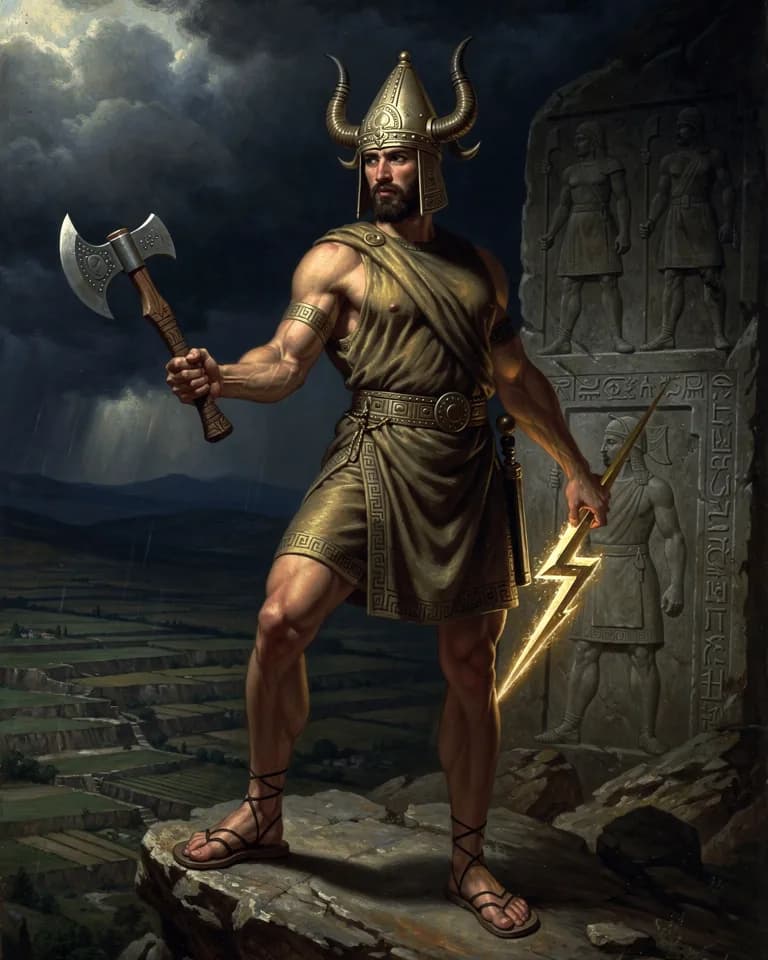 HittiteTarhunna (the Storm-god of Hatti)
Both storm-gods have their mountain at Jebel Aqra (Ugaritic Zaphon, Hurrian-Hittite Hazzi) and both fight a sea or serpent enemy; the Hurrian storm-god Teššub watches Ullikummi from Mount Hazzi.
Compare Baal (Baʿlu Haddu) and Tarhunna (the Storm-god of Hatti) side by side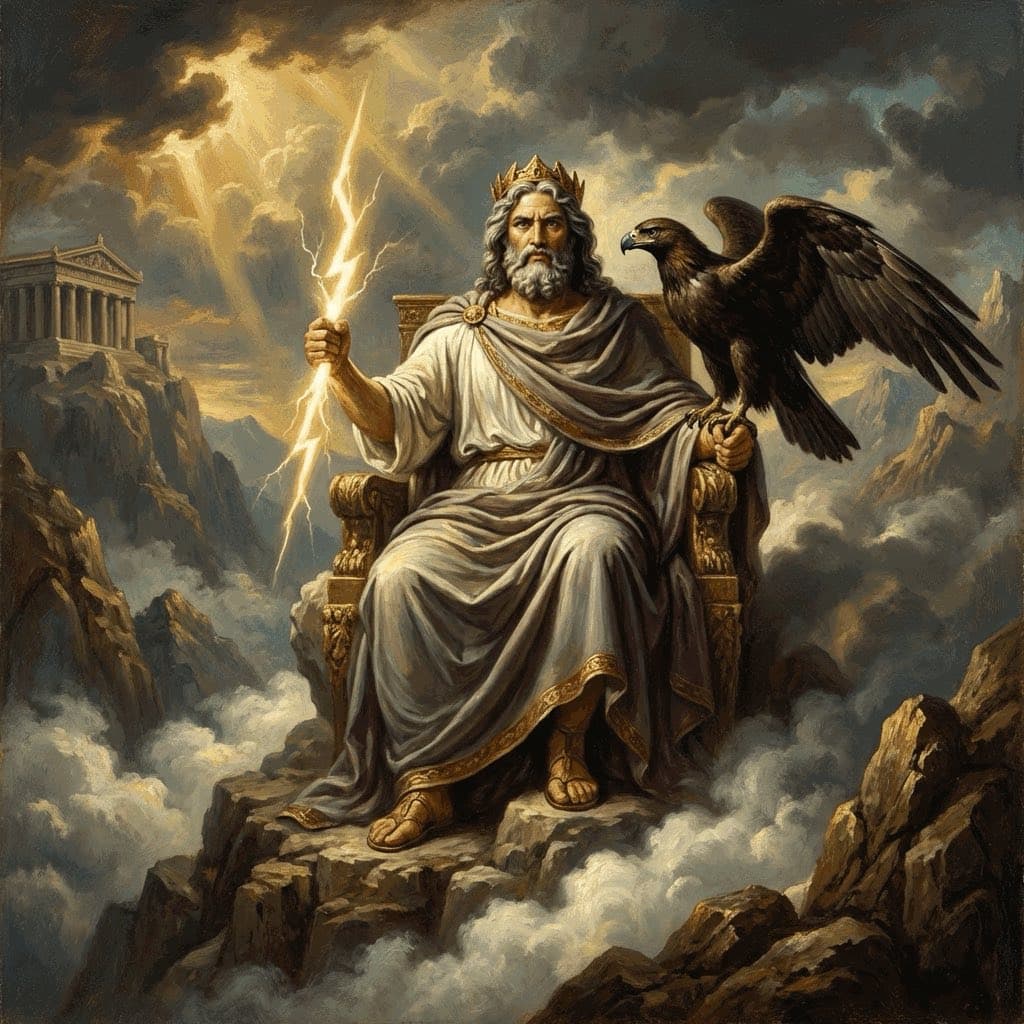 GreekZeus
Both are storm-kings who win their rule against a chaotic rival; Greek sources later called the same mountain Kasios and worshipped Zeus Kasios there.
Compare Baal (Baʿlu Haddu) and Zeus side by side
Worship and cult
Temples, festivals, and practices recorded for Baal (Baʿlu Haddu)
Ugaritic ritual texts list offerings to Baal of Zaphon and to Baal under several local titles; stone anchors dedicated in his temple at Ugarit suggest the devotion of seafarers.
Sacred sites
- Temple of Baal on the acropolis of Ugarit
- Mount Zaphon (Jebel Aqra)
Family
Baal (Baʿlu Haddu)'s family at a glance
- Who are Baal (Baʿlu Haddu)'s siblings?
- Siblings of Baal (Baʿlu Haddu) recorded in the atlas: Anat.
In the atlas
Where Baal (Baʿlu Haddu) appears
Sources and further reading
Source notes
These references are recorded in the catalog. Their passage wording and translation have not been checked, so quotations are not displayed here.
- Baal Cycle, KTU 1.2 IV
- Baal Cycle, KTU 1.6 III
Appears in
Ancient and classical works featuring this figure.
the storm-god who defeats Yamm, builds his palace, dies, and returns (throughout, KTU 1.1-1.6)
The Epic of Aqhat (KTU 1.17-1.19)
intercedes for Danel; breaks the wings of the vultures (KTU 1.17 I; 1.19 III)
Further reading
The whole cycle, tablet by tablet
- Smith, Mark S. The Ugaritic Baal Cycle, vols. 1-2 (Brill, 1994, 2009), with Wayne T. Pitard for vol. 2.
- Smith, Mark S. The Early History of God (2nd ed., Eerdmans, 2002).
About this entry
By Elizabeth Stein for Mythos Atlas. About the author. Editorial notes are grounded in the site's cited sources and can be challenged through the contact page.
Parallels are editorial comparisons across traditions: a shared role does not, by itself, establish a shared origin.
Family relationships come from the atlas's kinship records. Ancient sources often disagree on divine genealogy.
Genealogy
Family tree
Baal (Baʿlu Haddu)'s parents, consorts, children and rivals, as recorded in the atlas.