Canaanite Pantheon (Ugarit)
Mot
mt(Môtu)
Also known as Death, Beloved of El (ydd il), Son of El (bn ilm)
- death
- the underworld
- drought and sterility
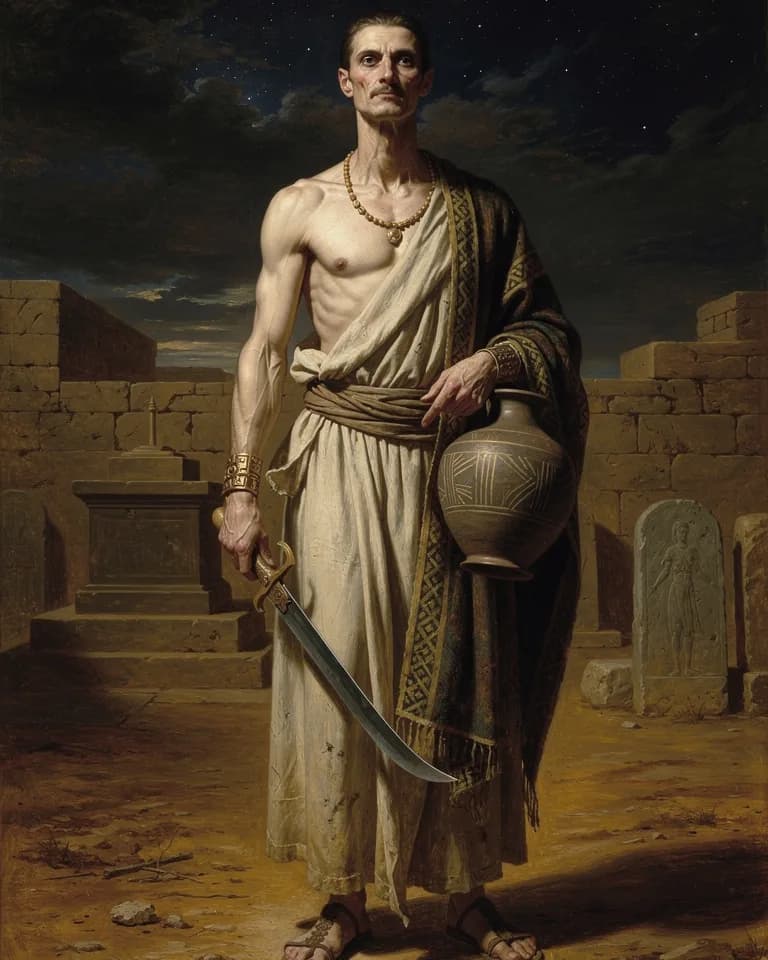
Death personified, whose throat reaches to the heavens and whose lip touches the earth, who swallows Baal and is himself destroyed by Anat and then fights Baal to a standstill.
About Mot
Death with a throat
Mot is death itself, not a ruler of the dead. The Baal Cycle gives him an enormous appetite: one lip to the earth, one lip to the heavens, a tongue to the stars (KTU 1.5 II), and a craving that the text compares to a lion's hunger and a dolphin's thirst. His city is Hmry ("Miry" or "Muddy"), where he sits on a throne in a land of filth, and messengers are warned not to come too close in case he swallows them.
Baal in Mot's throat
After Baal builds his palace and declares his kingship, Mot answers with a threat, reminding Baal of the serpent Litan he defeated and warning that Baal must now come down into his throat (KTU 1.5 I). Baal submits. His death is announced to El, who mourns, and to Anat, who searches for him.
Mot destroyed, and back again
Anat finds Mot and treats him like grain at harvest, splitting, winnowing, burning, grinding, and sowing him (KTU 1.6 II), and the birds eat his remains. Yet in the seventh year Mot returns, demanding compensation, and he and Baal fight like wild oxen, serpents, and stallions until both fall. Only when the sun-goddess Shapash warns Mot that El will overturn his throne does he give way and acknowledge Baal's kingship (KTU 1.6 VI).
Interpretation
The grain imagery of Mot's destruction has led some scholars to read him as a harvest figure, but most now see the language as Anat's way of annihilating him completely. Mot is never finally destroyed: death can be driven back, not abolished.
Across traditions
Parallel figures
Figures who play a role like Mot's in other traditions.
 GreekHades
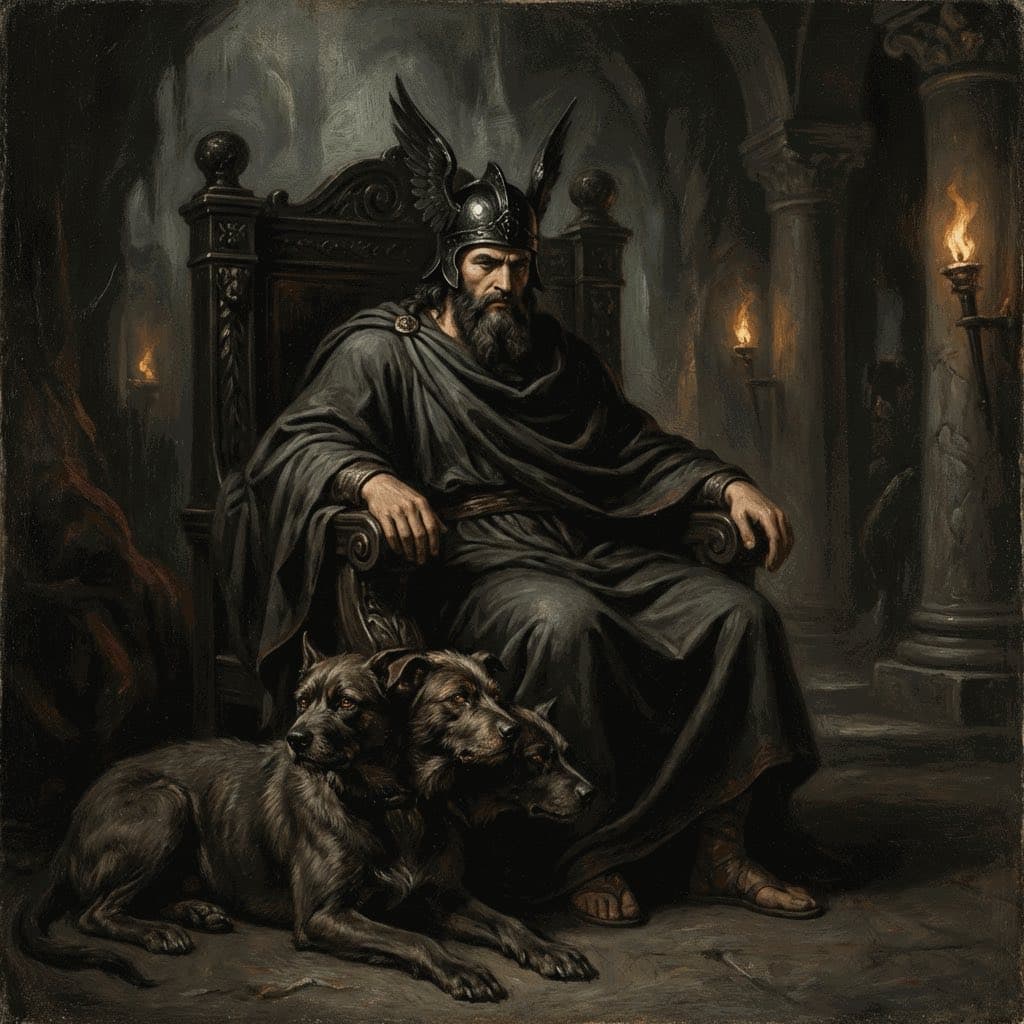
Both are gods of death who hold a divine figure in the underworld; unlike Hades, Mot is death itself rather than the ruler of the dead, and he never rules a structured realm of souls.
Compare Mot and Hades side by side
Family
Mot's family at a glance
- Who are Mot's parents?
- The atlas's kinship records name one parent of Mot: El (Ilu). Ancient accounts do not always agree on divine parentage.
In the atlas
Where Mot appears
Play the myth
Branching retellings featuring Mot: your choices decide the ending.
The Judgment of Paris
Step into the sandals of Paris, prince of Troy. Three goddesses stand before you, each offering a gift beyond mortal dreams. But every choice carries consequences that will echo through eternity.
5-8 min3 endingsThor's Journey to Jotunheim
Accompany Thor, god of thunder, on a perilous journey to the realm of giants. Will you rely on Mjolnir's might, or discover that sometimes wisdom serves better than strength?
8-12 min4 endingsOrpheus in the Underworld
Descend into the realm of the dead as Orpheus, the greatest musician who ever lived. Can your love for Eurydice triumph over death itself? The choice that awaits you has haunted lovers for millennia.
6-10 min4 endings
Sources and further reading
Source notes
These references are recorded in the catalog. Their passage wording and translation have not been checked, so quotations are not displayed here.
- Baal Cycle, KTU 1.5 II
- Baal Cycle, KTU 1.6 VI
Appears in
Ancient and classical works featuring this figure.
Death, who swallows Baal (KTU 1.4 VIII-1.6)
Further reading
Baal and Mot, KTU 1.4 VIII-1.6
About this entry
By Elizabeth Stein for Mythos Atlas. About the author. Editorial notes are grounded in the site's cited sources and can be challenged through the contact page.
Parallels are editorial comparisons across traditions: a shared role does not, by itself, establish a shared origin.
Family relationships come from the atlas's kinship records. Ancient sources often disagree on divine genealogy.
Genealogy
Family tree
Mot's parents, consorts, children and rivals, as recorded in the atlas.