Canaanite Pantheon (Ugarit)
Athirat (Asherah)
aṯrt(ʾAṯiratu)
Also known as Asherah, Lady Athirat of the Sea (rbt aṯrt ym), Creatress of the Gods (qnyt ilm)
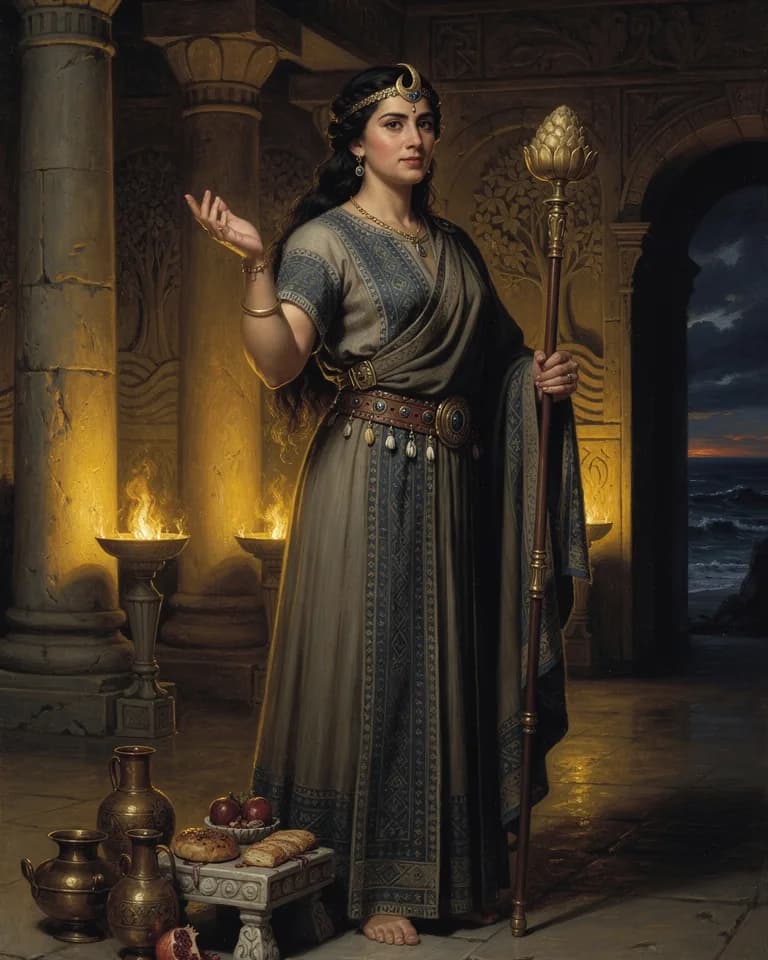
- motherhood of the gods
- queenship
- intercession with El
El's consort, 'Lady Athirat of the Sea' and 'Creatress of the Gods', mother of the seventy sons of El, who can persuade El when no one else can.
About Athirat (Asherah)
Queen mother of the gods
Athirat is El's wife and the mother of the gods, who are called her seventy sons. Her titles are "Lady Athirat of the Sea" and "Creatress of the Gods". In the Baal Cycle she is first seen by the sea, spinning, when Baal and Anat come to her with gifts made by Kothar-wa-Khasis (KTU 1.4 II), and at first she fears they come as enemies.
The intercessor
Athirat is the one god El reliably listens to. It is her visit to El, riding a donkey saddled by her servant, that finally wins Baal permission for his palace; El greets her warmly and asks whether she is hungry or thirsty before she makes her request (KTU 1.4 IV-V). After Baal's death it is Athirat whom El asks to name a new king from among her sons, and she proposes Athtar (KTU 1.6 I).
In the Epic of Kirta
King Kirta stops at the shrine of "Athirat of Tyre, goddess of Sidon" on his way to war and vows to give her twice a bride's weight in silver and three times in gold if he succeeds. He wins his bride and forgets the vow, and Athirat remembers; his illness follows.
Asherah
Athirat is the Ugaritic form of the goddess the Hebrew Bible calls Asherah. Inscriptions from Kuntillet ʿAjrud and Khirbet el-Qom in the eighth century BCE, invoking "Yahweh and his asherah", are much debated evidence for her later cult; this site notes that debate without taking a side on it.
Worship and cult
Temples, festivals, and practices recorded for Athirat (Asherah)
Athirat receives offerings in Ugaritic ritual texts; vows made to her, like Kirta's, were expected to be paid.
Sacred sites
- Her shrine at Tyre and Sidon, named in the Epic of Kirta
Family
In the atlas
Where Athirat (Asherah) appears
Sources and further reading
Source notes
These references are recorded in the catalog. Their passage wording and translation have not been checked, so quotations are not displayed here.
- Baal Cycle, KTU 1.4 IV-V
- Epic of Kirta, KTU 1.14 IV
Appears in
Ancient and classical works featuring this figure.
El's consort, persuaded to intercede for Baal's palace (KTU 1.4 II-V; 1.6 I)
The Epic of Kirta (KTU 1.14-1.16)
receives Kirta's vow and punishes its neglect (KTU 1.14 IV; 1.15 III)
Further reading
Athirat's intercession for Baal's palace
The Epic of Kirta (KTU 1.14-1.16)
Kirta's vow at her shrine
- Hadley, Judith M. The Cult of Asherah in Ancient Israel and Judah (Cambridge University Press, 2000).
About this entry
By Elizabeth Stein for Mythos Atlas. About the author. Editorial notes are grounded in the site's cited sources and can be challenged through the contact page.
Parallels are editorial comparisons across traditions: a shared role does not, by itself, establish a shared origin.
Family relationships come from the atlas's kinship records. Ancient sources often disagree on divine genealogy.
Genealogy
Family tree
Athirat (Asherah)'s parents, consorts, children and rivals, as recorded in the atlas.