Canaanite Pantheon (Ugarit)
Athtar
ʿṯtr(ʿAṯtaru)
Also known as Athtar the Terrible (ʿṯtr ʿrẓ), Attar
- the morning star
- irrigation (disputed)
- a failed claim to kingship
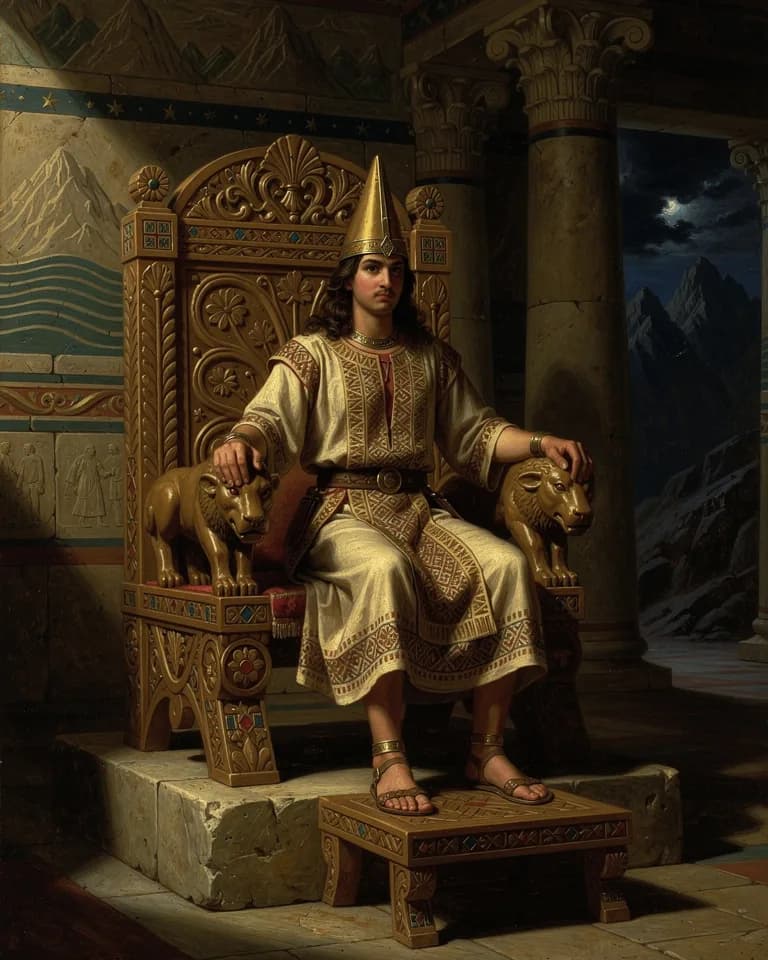
The god whom Athirat proposes as king after Baal's death, who climbs onto Baal's throne on Zaphon and finds that his feet do not reach the footstool.
About Athtar
A king too small for the throne
Athtar's best-known scene is brief. After Baal's death, El asks Athirat to name one of her sons as king, and she proposes "Athtar the Terrible". Athtar goes up to Baal's throne on the heights of Zaphon, but his feet do not reach the footstool and his head does not reach its top. He admits that he cannot be king on Zaphon, comes down, and rules instead over the broad earth (KTU 1.6 I).
A rival of Yam and Baal
In the fragmentary early tablets of the cycle, Athtar also seems to complain that he has no palace like other gods, and is told by Shapash that he will not be king because El favours Yam (KTU 1.2 III). The passage is broken and its interpretation debated.
The Venus star
The name Athtar is related to the name of the Venus-star deity across the Semitic world, including the South Arabian ʿAthtar and, in feminine form, Athtart and Mesopotamian Ištar. Older scholarship made him an irrigation god, contrasted with the rain-god Baal; that theory rests on thin evidence and is presented here only as a proposal.
In the atlas
Where Athtar appears
Sources and further reading
Source notes
These references are recorded in the catalog. Their passage wording and translation have not been checked, so quotations are not displayed here.
- Baal Cycle, KTU 1.6 I
Appears in
Ancient and classical works featuring this figure.
tries and fails to fill Baal's throne (KTU 1.6 I)
Further reading
Athtar's attempt on the throne
About this entry
By Elizabeth Stein for Mythos Atlas. About the author. Editorial notes are grounded in the site's cited sources and can be challenged through the contact page.
Parallels are editorial comparisons across traditions: a shared role does not, by itself, establish a shared origin.
Genealogy
Family tree
Athtar's parents, consorts, children and rivals, as recorded in the atlas.