Canaanite Pantheon (Ugarit)
Yam (Yammu)
ym(Yammu)
Also known as Prince Sea (zbl ym), Judge River (ṯpṭ nhr), Beloved of El
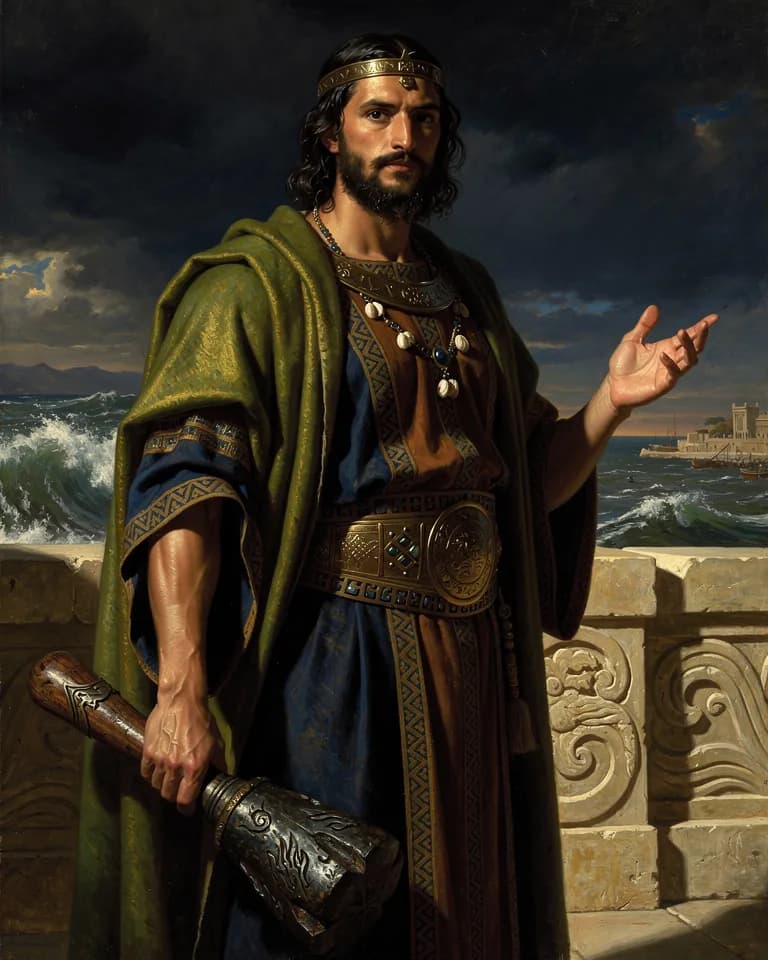
- the sea
- rivers
- chaotic waters
The Sea as a god, 'Prince Sea, Judge River', El's favourite, who demands that Baal be handed over as his captive and is struck down by Baal's clubs.
About Yam (Yammu)
Prince Sea, Judge River
Yam, whose name simply means "sea", is always paired in poetic parallelism with "River": he is "Prince Sea" and "Judge River". He is "beloved of El", and in the fragmentary first tablet of the Baal Cycle El proclaims his name and gives him a house built by Kothar-wa-Khasis (KTU 1.1-1.2). His power over the waters is also a claim to kingship among the gods.
The demand for Baal
In KTU 1.2 I Yam sends messengers to the assembly of the gods on El's mountain with a blunt order: hand over Baal and his followers. The gods lower their heads onto their knees in fear, Baal rebukes them, and El agrees that Baal is Yam's servant. Baal lunges at the messengers and has to be held back by Anat and Athtart.
Defeat
With two clubs made by Kothar-wa-Khasis, Baal fights Yam. The first club, Yagrush, strikes his shoulders but does not fell him; the second, Ayyamur, strikes him on the head and he collapses. Athtart then urges Baal to finish him, and the text declares that Yam is dead and Baal shall be king (KTU 1.2 IV). Elsewhere, Anat boasts that she herself defeated Yam.
The sea and the serpent
Yam is associated with sea-monsters, the dragon Tunnan and the serpent Litan, and his defeat belongs to a wide Near Eastern pattern of a storm-god subduing the sea. The Hebrew Bible uses the same imagery when it describes God rebuking or dividing the sea (yam).
Across traditions
Parallel figures
Figures who play a role like Yam (Yammu)'s in other traditions.
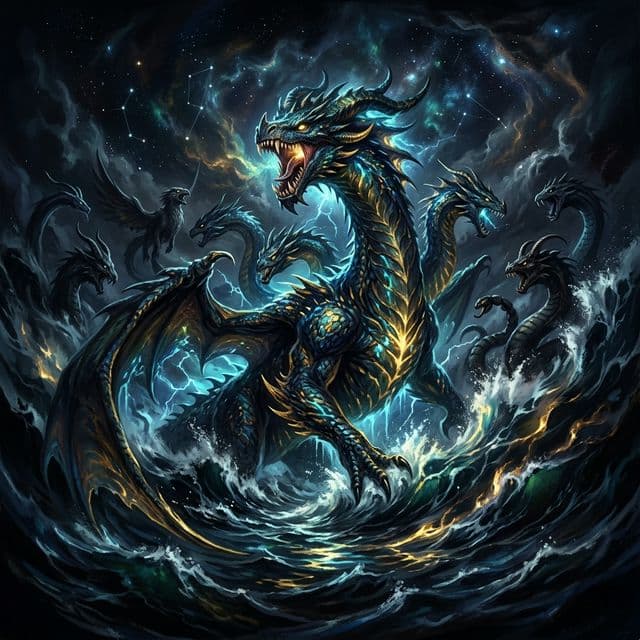 MesopotamianTiamat
Both are personified seas defeated by a younger god who then becomes king, Yam by Baal and Tiamat by Marduk; the Ugaritic and Babylonian texts are independent tellings of a shared regional pattern.
Compare Yam (Yammu) and Tiamat side by side
Worship and cult
Temples, festivals, and practices recorded for Yam (Yammu)
Yam receives offerings in some Ugaritic ritual lists, showing that the Sea was honoured in cult as well as defeated in myth.
Family
Yam (Yammu)'s family at a glance
- Who are Yam (Yammu)'s parents?
- The atlas's kinship records name one parent of Yam (Yammu): El (Ilu). Ancient accounts do not always agree on divine parentage.
In the atlas
Where Yam (Yammu) appears
Sources and further reading
Source notes
These references are recorded in the catalog. Their passage wording and translation have not been checked, so quotations are not displayed here.
- Baal Cycle, KTU 1.2 I
- Baal Cycle, KTU 1.2 IV
Appears in
Ancient and classical works featuring this figure.
the Sea, Baal's first rival (KTU 1.1-1.2)
Further reading
The conflict of Baal and Yam, KTU 1.1-1.2
About this entry
By Elizabeth Stein for Mythos Atlas. About the author. Editorial notes are grounded in the site's cited sources and can be challenged through the contact page.
Parallels are editorial comparisons across traditions: a shared role does not, by itself, establish a shared origin.
Family relationships come from the atlas's kinship records. Ancient sources often disagree on divine genealogy.
Genealogy
Family tree
Yam (Yammu)'s parents, consorts, children and rivals, as recorded in the atlas.