Slavic Pantheonritual vessel
Svantevit's Horn
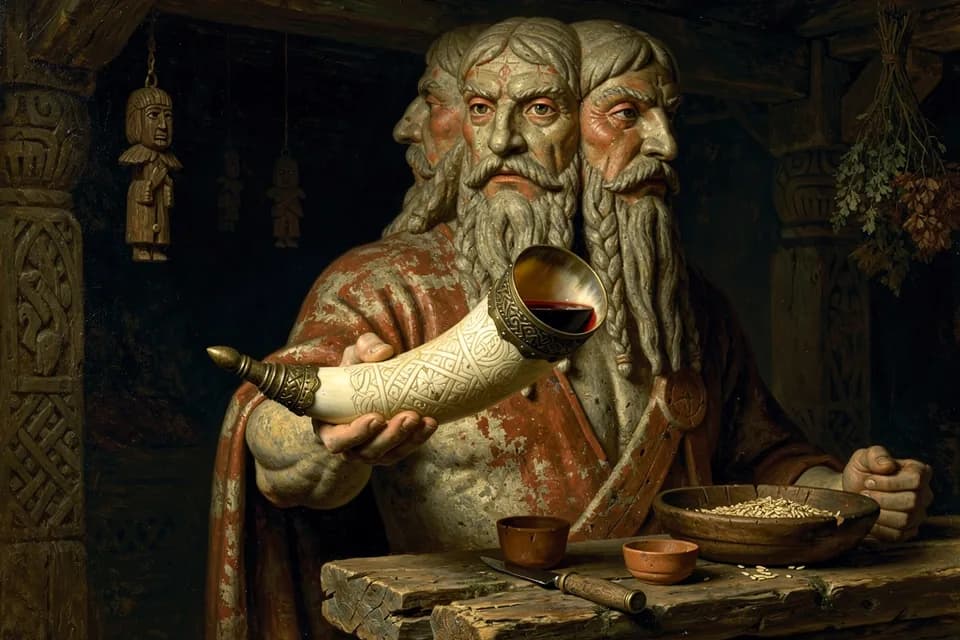
- Harvest divination
- Measure of the coming year
The drinking horn held in the right hand of Svantevit's four-headed statue at Arkona, filled with wine once a year; the priest read the coming harvest from how much remained.
About Svantevit's Horn
An attested object
Unlike most Slavic cult objects, Svantevit's horn is described by a witness close to the events. Saxo Grammaticus, writing his Gesta Danorum around 1200, describes the temple at Arkona that King Valdemar I's Danish army destroyed in 1168: its huge four-headed wooden statue held in its right hand a horn worked in various metals, which the priest filled with wine every year. Beside the statue hung a bridle and saddle, and a great sword was kept there too.
Reading the harvest
At the yearly festival after harvest, Saxo writes, the priest examined the horn the day after the rites: if the wine had diminished, he foretold a poor harvest and advised the people to save their grain; if it had not, he foretold plenty. He then poured the old wine at the statue's feet, refilled the horn, and drank to the god, praying for the people's prosperity.
Reading Saxo
Saxo was a Christian writer celebrating the conquest, and his account is shaped by that purpose; but the detail of the horn, the statue, and the rite is specific, and it is among the best-attested descriptions of West Slavic temple religion.
Origin
Described by the Danish historian Saxo Grammaticus (c. 1200) as part of the cult statue in Svantevit's temple at Arkona on Rügen, destroyed by the Danes in 1168.
Sources and further reading
Source notes
These references are recorded in the catalog. Their passage wording and translation have not been checked, so quotations are not displayed here.
- Saxo Grammaticus, Gesta Danorum, Book 14
About this entry
By Elizabeth Stein for Mythos Atlas. About the author. Editorial notes are grounded in the site's cited sources and can be challenged through the contact page.