Slavic Pantheonidol
Zbruch Idol
- Unknown; interpretations are modern
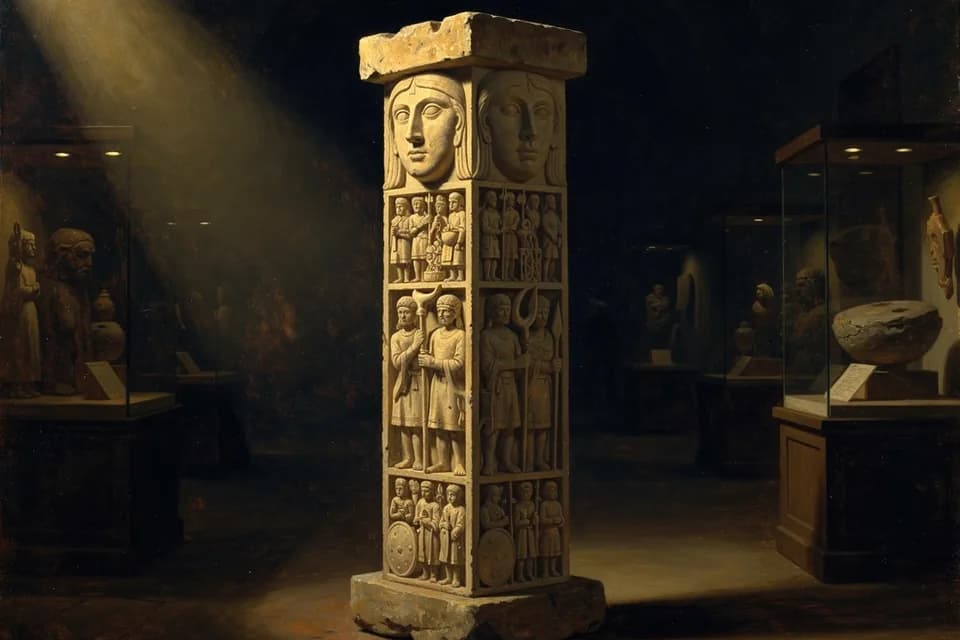
A four-sided limestone pillar about 2.6 metres tall, carved with four faces under a single cap and tiers of figures below, found in the Zbruch River in 1848 and now in the Archaeological Museum in Kraków; its identification with Svantevit is a modern hypothesis.
About Zbruch Idol
A real object, an uncertain meaning
The Zbruch Idol is one of the very few surviving pieces of what may be Slavic pagan sculpture. The pillar, a little over 2.5 metres tall, has four faces on its sides beneath a single round cap. Below them run tiers of smaller figures, and at the base a kneeling or crouching figure seems to hold up the whole. One face holds a horn, another a ring, and a horse and a sword are carved on other sides.
Svantevit? Reconstruction, not attestation
Because Saxo describes Svantevit's statue at Arkona as four-headed and holding a horn, the pillar was soon called a 'Sviatovid', and it appears under that name in older literature and in Polish and Ukrainian heraldry. But nothing ties this object to Svantevit: Arkona is on the Baltic island of Rügen, hundreds of kilometres from the Zbruch, and Saxo's statue was wooden. Scholars such as Boris Rybakov read the tiers as a three-level cosmos of gods, people, and underworld; others have questioned whether the pillar is medieval at all. This site treats all of those readings as hypotheses.
Seeing it
The original is displayed in the Archaeological Museum in Kraków.
Origin
Found in 1848 in the Zbruch River near Husiatyn (now in western Ukraine); usually dated to the 9th or 10th century, though some scholars have questioned that date.
Sources and further reading
Source notes
These references are recorded in the catalog. Their passage wording and translation have not been checked, so quotations are not displayed here.
- Archaeological Museum in Kraków, collection record; Boris Rybakov, Yazychestvo drevnikh slavyan (Paganism of the Ancient Slavs)
- Saxo Grammaticus, Gesta Danorum, Book 14
About this entry
By Elizabeth Stein for Mythos Atlas. About the author. Editorial notes are grounded in the site's cited sources and can be challenged through the contact page.