Side by sideParallel across traditions

Lugh vs Mercury

Lugh
LughCeltic
Mercury
MercuryRoman

Caesar's De Bello Gallico reports the Gauls' chief god, identified with Lugus/Lugh, as Mercury, inventor of all arts and god of trade.

At a glance

Lugh and Mercury compared
LughMercury
TraditionCeltic PantheonRoman Pantheon
Domainsskill, craft, arts, oaths, kingshipmessengers, commerce, thieves, travelers, boundaries, eloquence
Symbolsspear, slingcaduceus, winged sandals, winged cap, rooster
Also calledLugh Lámhfhada, SamildánachMercurius

Where they meet

The atlas records no domain or symbol that Lugh and Mercury share.

They are compared for the part each plays in their own tradition rather than for any attribute in common.

Where they part

Only Lugh

Associated with skill, craft, arts, oaths, and kingship.

Only Mercury

Associated with messengers, commerce, thieves, travelers, boundaries, and eloquence.

Why they are compared

Caesar identified the Gaulish god later associated with Lugh/Lugus with Mercury, both master craftsmen-gods of skill, trade, and eloquence.

How each was worshipped

Lugh

Cult sites
No surviving temple; Lughnasadh assembly sites in later tradition (Tailtiu)
Festivals
Lughnasadh (1 August)

Many skills, the spear, and the harvest fair. Lughnasadh is the one calendar fact that stuck. Games for a foster-mother, first fruits, and a god who is not only a sun sticker on a modern altar.

Mercury

Cult sites
Temple of Mercury on the Aventine, dedicated 495 BCE; Shrine at the Circus Maximus associated with trade and the guild of merchants
Festivals
Mercuralia (15 May)

Merchants sprinkled their heads and goods with water from a well at the Porta Capena. The caduceus marked the guild of Mercuriales. He is profit, messages, and the uneasy honesty of the market, not a psychopomp first.

The two figures

Celtic Pantheon

Lugh

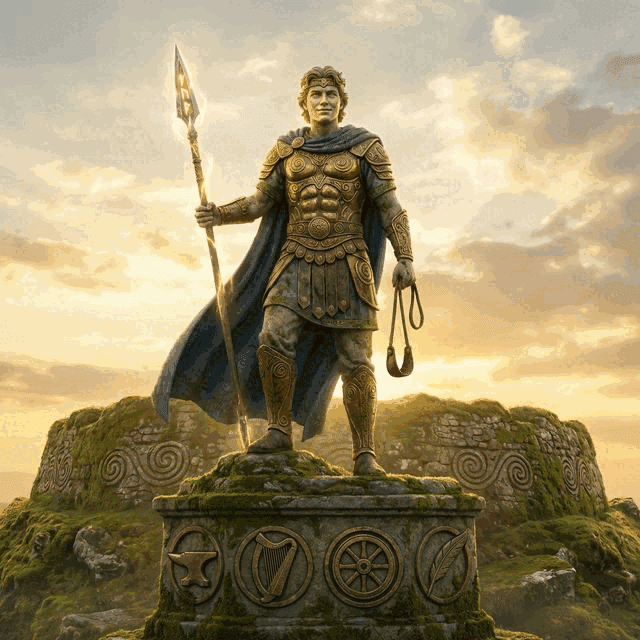
The master of all skills and arts. A youthful warrior king who led the Tuatha Dé Danann to victory against the Fomorians.

Lugh is the son of Cian of the Tuatha Dé Danann and Ethniu, daughter of **Balor of the Evil Eye**, king of the Fomorians. A prophecy foretold that Balor would be killed by his own grandson, so he imprisoned Ethniu in a tower. Despite these precautions, Cian reached her with the help of the druidess Biróg, and Lugh was conceived. When Balor discovered the child, he ordered him drowned, but Lugh was rescued and raised by different foster-parents, including Tailtiu and Manannán mac Lir. He came to Tara as a young man and gained entry by demonstrating that he alone possessed every skill the court required.

Lugh, known as **Lugh Lámhfhada** ("Long-Armed Lugh") and **Samildánach** ("Equally Skilled in All Arts"), is the radiant warrior-king of Irish mythology. He represents mastery, excellence, and the ideal of kingship. Unlike many deities who specialize in one domain, Lugh has perfected every skill: from warfare to poetry, from smithcraft to sorcery.

Read the full Lugh entry

Roman Pantheon

Mercury

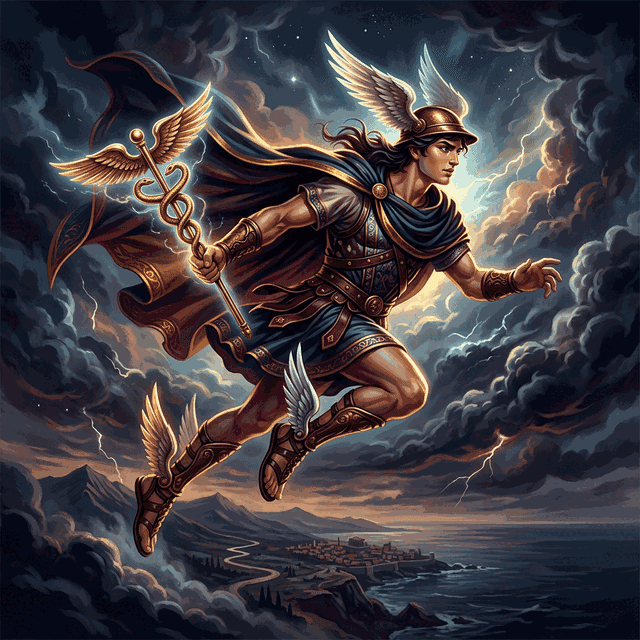
Messenger of the gods and god of commerce, eloquence, messages, travelers, boundaries, luck, and thieves. Guide of souls to the underworld. Roman equivalent of Hermes.

Mercury is the god of messages, thieves, travelers, and, above all in Rome, **commerce**. His temple on the Aventine was dedicated in 495 BCE and associated with a merchants' guild, the Mercuriales. The caduceus and winged hat come from Hermes. The shopkeeper's prayer is Latin.

Read the full Mercury entry
About this comparison

Comparisons pair figures that play a similar role across traditions, or that the myths connect within one. A shared role does not, by itself, establish a shared origin.