Mesopotamian PantheonCreature
Lamassu
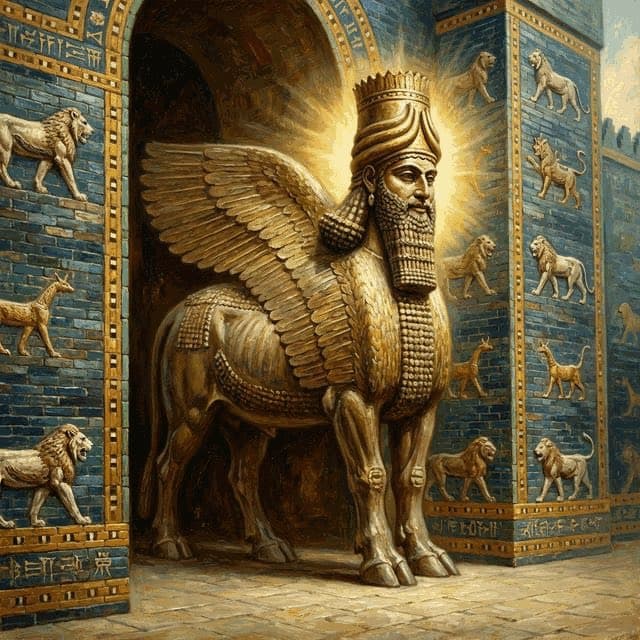
- Divine Protection
- Evil Spirit Repulsion
- Eternal Vigilance
- Blessing of Travelers
A protective deity with the body of a bull or lion, the wings of an eagle, and the head of a human. These colossal guardian figures flanked the gates of Assyrian and Babylonian palaces, warding off evil spirits and enemies. They were carved with five legs so they appeared to be walking when viewed from the side.
About Lamassu
Five-Legged Watchers
Assyrian lamassu (and cognate šēdu) are human-headed winged bulls or lions that flank palace gates at Nimrud, Khorsabad, Nineveh. Inscriptions name them as protective genii. Five legs let the figure stand from the front and stride from the side.
They are architecture with a spirit, not a hunted monster. Danger is low for those the king admits.
From palace to museum
The great Neo-Assyrian lamassu were excavated in the 19th century by Austen Henry Layard at Nimrud and by Paul-Émile Botta at Khorsabad, and pairs now stand in the British Museum, the Louvre, and the Metropolitan Museum. Some surviving examples at Nimrud and Nineveh were deliberately destroyed in 2015, and the Mosul Museum's pieces were among the heritage lost in that period.
Quick answers about Lamassu
- What is Lamassu?
- A protective deity with the body of a bull or lion, the wings of an eagle, and the head of a human. These colossal guardian figures flanked the gates of Assyrian and Babylonian palaces, warding off evil spirits and enemies. They were carved with five legs so they appeared to be walking when viewed from the side.
- Where does Lamassu live?
- The atlas lists Lamassu's habitat as Palace Gates and Temple Entrances.
- What abilities does Lamassu have?
- The atlas lists these abilities for Lamassu: Divine Protection, Evil Spirit Repulsion, Eternal Vigilance, and Blessing of Travelers.
Sources and further reading
Source notes
These references are recorded in the catalog. Their passage wording and translation have not been checked, so quotations are not displayed here.
- Neo-Assyrian palace orthostats (Nimrud, Khorsabad, Nineveh)
About this entry
By Elizabeth Stein for Mythos Atlas. About the author. Editorial notes are grounded in the site's cited sources and can be challenged through the contact page.
The danger rating is an editorial shorthand for how the myths portray the creature, not a claim made by the sources.
Keep exploring
One myth a week, with its sources in a short email. The sign-up form is just below.