Mesopotamian PantheonCreature
Humbaba
- Seven Auras of Terror
- Fire Breath
- Earthquake Voice
- Death Gaze
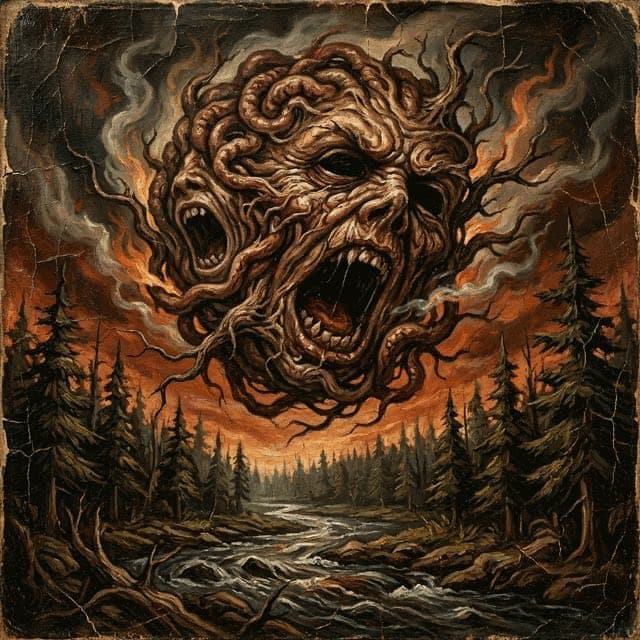
The terrifying guardian of the Cedar Forest, appointed by Enlil to protect the sacred trees. His face was formed from the intestines of gods, his roar was the flood, his breath was fire, and his mere glance was death. Gilgamesh and Enkidu slew him despite his pleas for mercy.
About Humbaba
Warden of the Cedar
Huwawa / Humbaba is Enlil's appointed guardian of the Cedar Forest. Gilgamesh and Enkidu cut him down anyway; the Standard Babylonian epic makes the killing a moral problem, not a clean trophy. His face is a coil of entrails in terracotta plaques.
The seven auras (melammu) are stripped one by one. The forest's protection dies with him.
The Old Babylonian and Ishchali tablets
The earliest version, the Sumerian poem Gilgamesh and Huwawa, has Gilgamesh trick Huwawa into giving up his auras by offering gifts. In the Standard Babylonian epic (Tablet V) Shamash sends thirteen winds to pin Humbaba down, and Humbaba curses Enkidu before he dies; that curse is one thread leading to Enkidu's death. A tablet acquired in 2011 by the Sulaymaniyah Museum adds a vivid description of the forest as noisy with birds and monkeys, Humbaba's own court.
Quick answers about Humbaba
- What is Humbaba?
- The terrifying guardian of the Cedar Forest, appointed by Enlil to protect the sacred trees. His face was formed from the intestines of gods, his roar was the flood, his breath was fire, and his mere glance was death. Gilgamesh and Enkidu slew him despite his pleas for mercy.
- Where does Humbaba live?
- The atlas lists Humbaba's habitat as The Cedar Forest.
- What abilities does Humbaba have?
- The atlas lists these abilities for Humbaba: Seven Auras of Terror, Fire Breath, Earthquake Voice, and Death Gaze.
Sources and further reading
Source notes
These references are recorded in the catalog. Their passage wording and translation have not been checked, so quotations are not displayed here.
- Epic of Gilgamesh, Standard Babylonian version, Tablets IV–V
About this entry
By Elizabeth Stein for Mythos Atlas. About the author. Editorial notes are grounded in the site's cited sources and can be challenged through the contact page.
The danger rating is an editorial shorthand for how the myths portray the creature, not a claim made by the sources.
Keep exploring
One myth a week, with its sources in a short email. The sign-up form is just below.