Mesopotamian PantheonCreature
Anzu
- Flight
- Destiny Theft
- Storm Wings
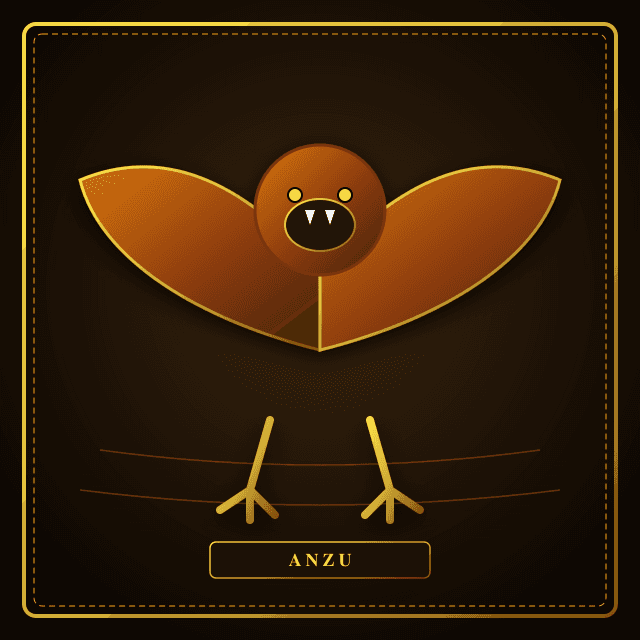
A monstrous lion-headed eagle who stole the Tablet of Destinies from Enlil, throwing the cosmos into chaos until defeated by Ninurta.
About Anzu
Thief of the Tablet of Destinies
Anzû (Imdugud), the lion-headed eagle, steals Enlil's Tablet of Destinies in the Anzû epic; Ninurta recovers it. Older Imdugud reliefs (Tell al-Ubaid) show the bird as a temple emblem before the theft story. The Standard Babylonian poem is the narrative spine.
Chaos here is bureaucratic: stolen office, not a random storm.
Ningirsu's eagle
In Early Dynastic Lagash the lion-headed eagle was the emblem of the god Ningirsu, and on the Stele of the Vultures (c. 2450 BCE) the god holds a net of captured enemies closed with an Anzû. The Old Babylonian and Standard Babylonian versions of the Epic of Anzû describe Ninurta's arrows bouncing off the bird's magic until Ea advises him to cut off its wings.
Quick answers about Anzu
- What is Anzu?
- A monstrous lion-headed eagle who stole the Tablet of Destinies from Enlil, throwing the cosmos into chaos until defeated by Ninurta.
- Where does Anzu live?
- The atlas lists Anzu's habitat as Mountain peaks and storm clouds.
- What abilities does Anzu have?
- The atlas lists these abilities for Anzu: Flight, Destiny Theft, and Storm Wings.
Sources and further reading
Source notes
These references are recorded in the catalog. Their passage wording and translation have not been checked, so quotations are not displayed here.
- Epic of Anzû (Standard Babylonian)
About this entry
By Elizabeth Stein for Mythos Atlas. About the author. Editorial notes are grounded in the site's cited sources and can be challenged through the contact page.
The danger rating is an editorial shorthand for how the myths portray the creature, not a claim made by the sources.
Keep exploring
One myth a week, with its sources in a short email. The sign-up form is just below.