Mesopotamian PantheonCreature
Mušḫuššu
- Sacred Terror
- Royal Emblem
- Venom Strike
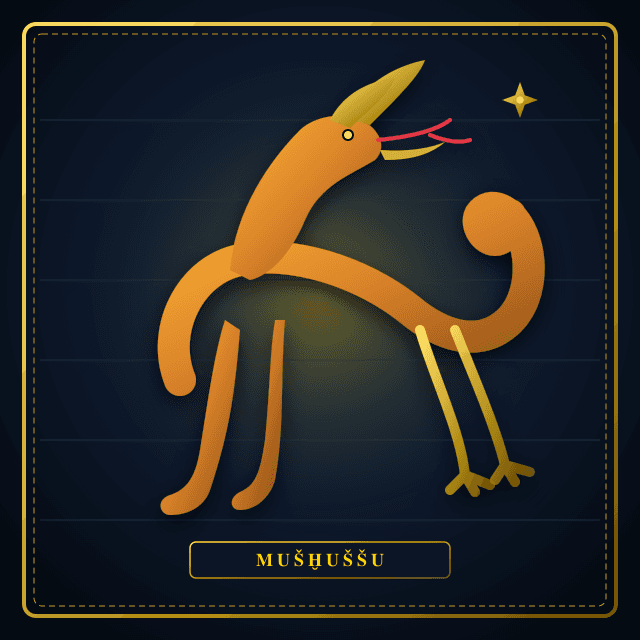
The snaked-headed dragon of Marduk, later emblem of Babylon: horns, lion forelegs, and bird hind talons.
About Mušḫuššu
The Snake-Dragon on the Gate
Mušḫuššu is the long-necked, horned dragon of Marduk on Babylon's Ishtar Gate: snake head, lion forelegs, bird hind talons. The Enūma Eliš and god lists give Marduk (and earlier Ninazu/Tishpak) the animal as emblem. It is glazed brick walking, not a forest hunt.
Danger is ceremonial. The beast means the god is home.
Tishpak, Ninazu, and Marduk
The mušḫuššu ('furious snake') first belonged to Ninazu of Eshnunna and to Tishpak, who replaced him there; when Hammurabi conquered Eshnunna, the creature passed to Marduk, and later, in the Neo-Babylonian period, to Nabu too. The Ishtar Gate and Processional Way built by Nebuchadnezzar II (c. 575 BCE) alternated rows of mušḫuššu with the bulls of Adad; the reconstructed gate stands in Berlin's Pergamon Museum.
Quick answers about Mušḫuššu
- What is Mušḫuššu?
- The snaked-headed dragon of Marduk, later emblem of Babylon: horns, lion forelegs, and bird hind talons.
- Where does Mušḫuššu live?
- The atlas lists Mušḫuššu's habitat as Babylon / sacred precincts.
- What abilities does Mušḫuššu have?
- The atlas lists these abilities for Mušḫuššu: Sacred Terror, Royal Emblem, and Venom Strike.
Sources and further reading
Source notes
These references are recorded in the catalog. Their passage wording and translation have not been checked, so quotations are not displayed here.
- Ishtar Gate orthostats; Mesopotamian god lists
About this entry
By Elizabeth Stein for Mythos Atlas. About the author. Editorial notes are grounded in the site's cited sources and can be challenged through the contact page.
The danger rating is an editorial shorthand for how the myths portray the creature, not a claim made by the sources.
Keep exploring
One myth a week, with its sources in a short email. The sign-up form is just below.