Hindu Pantheon
Rama
Also known as Ramachandra, Maryada Purushottama

- dharma
- virtue
- duty
- ideal kingship
Seventh avatar of Vishnu and hero of the Ramayana epic. Ideal man, son, husband, and king. His life demonstrates perfect adherence to dharma (duty).
About Rama
The Ideal Man
Rama is the seventh avatar of Vishnu and the hero of the Ramayana epic. Known as Maryada Purushottama ("the perfect man who follows dharma"), he embodies the ideals of virtue, duty, honor, and righteous conduct.
Prince of Ayodhya
Born as the eldest son of King Dasharatha of Ayodhya, Rama was exiled for fourteen years due to a palace intrigue. Accompanied by his wife Sita and brother Lakshmana, he lived in the forest, fulfilling his duty to honor his father's promise.
The Ramayana
When Sita was kidnapped by the demon king Ravana, Rama allied with the monkey king Sugriva and the devoted Hanuman to rescue her. The war against Ravana in Lanka demonstrated Rama's prowess as a warrior and his commitment to defeating evil.
Rama Rajya
After defeating Ravana and rescuing Sita, Rama returned to Ayodhya to rule. His reign, called Rama Rajya, represents the ideal kingdom of peace, prosperity, and justice. The festival Diwali celebrates his return, and Ram Navami marks his birthday. The mantra "Sri Ram Jai Ram Jai Jai Ram" is chanted by devotees.
Origin story
Born as prince of Ayodhya. Exiled for 14 years, during which his wife Sita was kidnapped by Ravana. With the help of Hanuman, he defeated Ravana and returned to rule as ideal king.
Across traditions
Parallel figures
Figures who play a role like Rama's in other traditions.
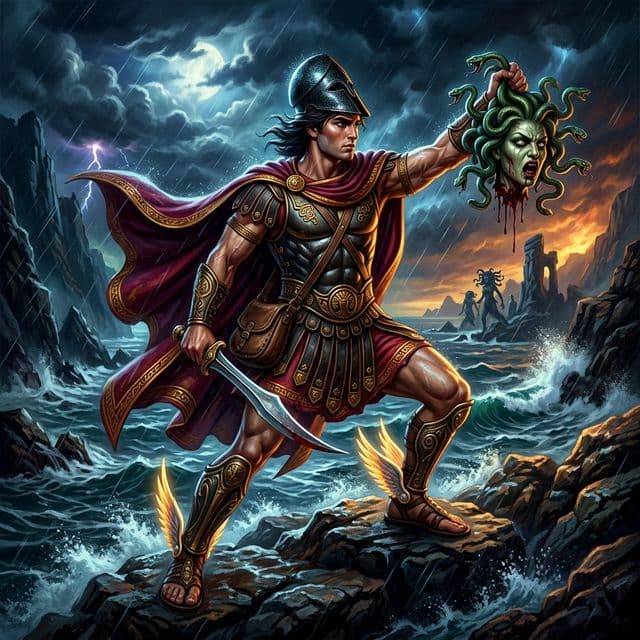 GreekPerseusIllustration
Both are heroic demigods who defeat a monstrous antagonist through divine favor and are held up as models of virtue
Compare Rama and Perseus side by side
Worship and cult
Temples, festivals, and practices recorded for Rama
The epic is the temple. Towns stage his war with Ravana in the open; the cult is story first, stone second. Kingship and exile are both in the offering.
Sacred sites
- Ram Janmabhoomi at Ayodhya
- Rameswaram
- Household Ramayana recitation
Festivals
- Rama Navami
- Dussehra
- Ram Lila performances
Family


In the atlas
Where Rama appears
Stories
Sources and further reading
Source notes
These references are recorded in the catalog. Their passage wording and translation have not been checked, so quotations are not displayed here.
- Ramayana of Valmiki, Book I (trans. Griffith)
Appears in
Ancient and classical works featuring this figure.
protagonist, exiled prince of Ayodhya and avatar of Vishnu (Books 1-7)
About this entry
By Elizabeth Stein for Mythos Atlas. About the author. Editorial notes are grounded in the site's cited sources and can be challenged through the contact page.
Parallels are editorial comparisons across traditions: a shared role does not, by itself, establish a shared origin.
Family relationships come from the atlas's kinship records. Ancient sources often disagree on divine genealogy.
Keep exploring
One myth a week, with its sources in a short email. The sign-up form is just below.
Genealogy
Family tree
Rama's parents, consorts, children and rivals, as recorded in the atlas.